Skip to content
You can now search across every topic, entity and event.What's new
US Midterms 2026
7SEP

Sanford files a day before the deadline

2 min read
13:32UTC

Elections desk

PoliticsDeveloping
Key takeaway

The late entrant is the only serious candidate whose win would not thin the House majority.

At 09:13 on 27 July, Marshall C. Sanford lodged a Statement of Candidacy with federal regulators, naming Sanford for Senate as his principal campaign committee and giving an address on Sullivan's Island. The filing went in one day before South Carolina shut its window on a vacancy created by Lindsey Graham's death on 11 July .

Sanford governed South Carolina for two terms and then represented its first congressional district until a Trump-endorsed challenger took the seat from him in a 2018 primary. He returns to a ballot on which the President has again backed someone else.

His entry carries a structural feature the rest of the field lacks. Sanford holds no office, so a victory costs his party nothing. A Fry or Norman victory empties a House seat that a separate special election cannot refill until well into 2027, which means the two frontrunners carry a price their newest rival does not.

Deep Analysis

In plain English

Anyone running for federal office in the United States must register with a national regulator as well as qualify for the state ballot. Sanford did the federal step on 27 July and made the state deadline the next day. He used to be South Carolina's governor and then one of its congressmen, until he lost a party contest in 2018 to a rival the President supported. He is now standing again in a contest where the President has endorsed somebody else.

Deep Analysis
Root Causes

A special primary in a safe seat offers a former officeholder the cheapest route back to national office: one three-week campaign, an electorate of party primary voters only, and no general election worth the name afterwards.

The compressed calendar also suppresses the fundraising advantage incumbents normally enjoy, because nobody has time to build one.

What could happen next?
  • Meaning

    A candidate holding no office removes the House-vacancy cost that both frontrunners carry.

  • Precedent

    A Sanford victory would be a direct test of whether a presidential endorsement still decides South Carolina Republican primaries.

First Reported In

Update #15 · Trump's pick is being outspent in a safe seat

Federal Election Commission· 4 Aug 2026
Read original
Causes and effects
This Event
Sanford files a day before the deadline
Adds the only candidate in the field who would cost Republicans nothing in the House by winning.
Different Perspectives
New Hampshire student voters
Students who hold no accepted photo ID under HB 323 cannot vote in the 8 September primary after Judge Laplante declined to block the law on timing grounds. Whether the same rule applies on 3 November is still open.
Alaska Democratic Party
The Alaska Democratic Party moved $884,835 in coordinated spending to Mary Peltola between 17 and 30 July, more than the DCCC spent nationally in the same fortnight.
National Republican Senatorial Committee
The NRSC, which sued to remove coordinated-spending caps in NRSC v. FEC, put $2,230,472 behind candidates in the first complete month after winning that case, more than double the total for the prior six months combined.
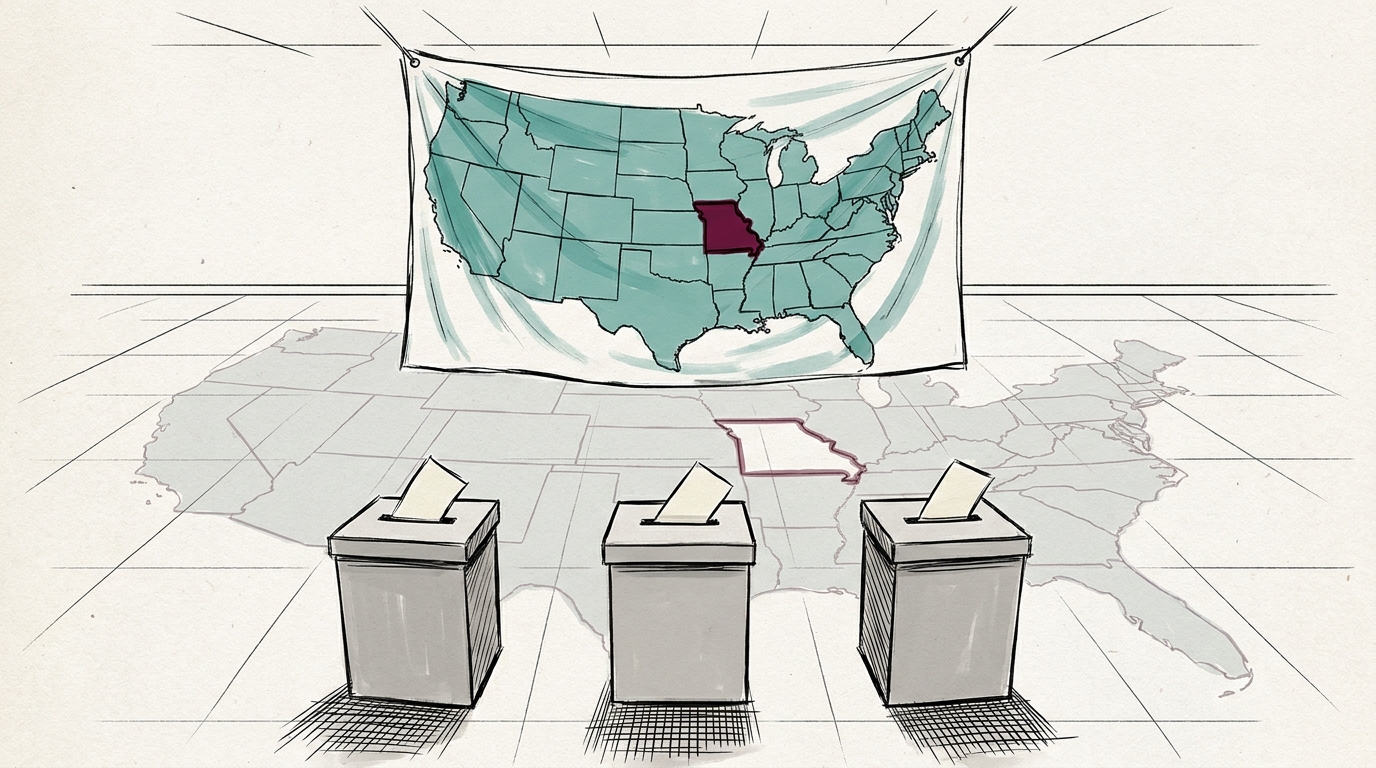
Supreme Court of Missouri
The unanimous court held that Article III, section 49 carries no redistricting exception, so a referendum petition against a congressional map is as valid as against any other law. It ordered the 2022 map to govern unless voters approve HB 1 on 3 November.
Denny Hoskins, Missouri Secretary of State
Hoskins told the Supreme Court that changing the congressional map after 1.2 million primary votes and ahead of the 19 September overseas-ballot deadline violates Purcell and the Elections Clause. He wants HB 1 reinstated before ballots print for November.
Senate Republican leadership
Floor time is finite at 51-47 with a bipartisan funding negotiation running, and a contested procedural fight over grant conditions is not the best use of it this month. Nothing has been abandoned; the resolution keeps its place on the calendar.
