Skip to content
You can now search across every topic, entity and event.What's new
UK Startups and Innovation
22APR

EC clears €211m Italian aid for Cambridge spinout

4 min read
17:16UTC

A University of Cambridge graphene photonics spinout just received the biggest industrial cheque ever written for one of its own, and the factory will open in Pisa.

TechnologyDeveloping
Key takeaway

CamGraPhIC's Italian factory is the clearest test yet of whether UK state-aid governance can match EU-scale industrial cheques.

On 15 April 2026 the European Commission approved €211m (£183m) of Italian state aid for CamGraPhIC, a University of Cambridge graphene photonics spinout; the pilot manufacturing facilities will open in Pisa and Bergamo in 2028. Professor Andrea Ferrari of the Cambridge Graphene Centre, who co-founded the company with Dr Marco Romagnoli (formerly of Italy's inter-university telecommunications consortium CNIT), called it "the largest single grant ever made to a University of Cambridge spinout". 1

CamGraPhIC makes graphene-based optical transceivers, the components that shuttle data between chips inside a data centre. The company's transceivers consume roughly 80% less energy than silicon equivalents at higher bandwidth and lower latency, targeted at AI data centres, high-performance computing, automotive, telecoms and aerospace. The efficiency gain is precisely the bottleneck the UK state has been funding around; SAIU and the AI Growth Zones both exist because running AI inference on silicon at UK electricity prices has stopped making economic sense.

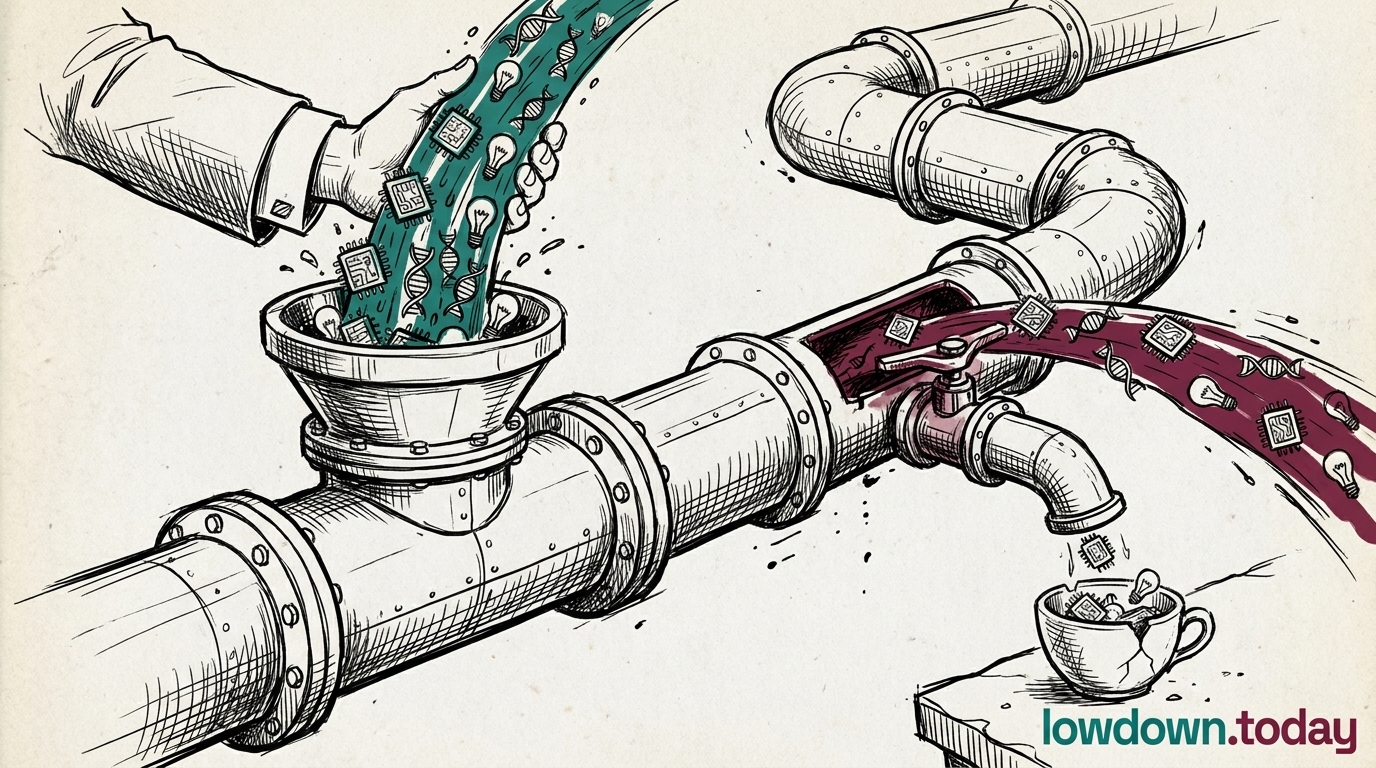
HM Treasury has the money but not the vehicle. The Subsidy Control Act 2022, Britain's post-Brexit replacement for EU state-aid rules, has not produced a mechanism that can write a €200m-scale industrial subsidy to a single spinout without triggering review. Italy's aid flowed through a bilateral notification the UK framework cannot currently match; the European Commission approves EU member-state aid, while UK Treasury must route domestic equivalents through smaller, risk-averse vehicles. Onward's Venturing Out series has been documenting this lab-to-factory gap for four years; CamGraPhIC is the latest quarterly case.

The IP stays in Cambridge. The manufacturing, the roughly 600-800 advanced-manufacturing jobs, and the €211m of industrial capital do not. This is the same commercialisation pattern ProQure's £2bn on quantum exists to prevent; on graphene photonics, the same conversion did not happen despite four years of documented policy effort. Whether the UK Treasury ships a bespoke subsidy vehicle before the next spinout of this scale is the policy question the CamGraPhIC decision has now forced.

Deep Analysis

In plain English

Scientists at Cambridge University invented technology that makes the data-centre computers powering AI use 80% less electricity than current equipment. That technology could be worth billions. But the factory that will make it is going to be built in Italy, not Britain, because the Italian government was willing to write a cheque for £183m that the UK government could not match. Britain keeps the patents and the university's reputation; Italy gets the factory, the jobs, and the manufacturing revenue. It is a bit like a British chef inventing a recipe that becomes a global chain; but opening all the restaurants in France because France offered a better lease.

Deep Analysis
Root Causes

The Subsidy Control Act 2022 replaced the EU state-aid notification framework with a domestic subsidy-control regime that sets a baseline subsidy ceiling of £500m per firm per three years but requires HM Treasury approval for single-firm subsidies above approximately £100m, a threshold CamGraPhIC's €211m exceeds; Italy's state aid notification flowed through the EU's bilateral framework, which has no equivalent ceiling for member-state industrial policy.

UK commercial electricity costs at 4x US equivalents (IEA, 2025) make graphene photonics manufacturing; an energy-intensive process requiring cleanroom fabrication at controlled temperatures; structurally more expensive in the UK than in northern Italy, where industrial electricity costs are approximately 1.8x US rates under EU energy market subsidies.

For a £183m facility, that electricity differential translates to roughly £12-15m per year in additional operating cost at UK tariffs versus Italian ones.

What could happen next?
  • Risk

    If no UK instrument is created before 2028 that can write a single-firm industrial subsidy above £100m, at least three further Cambridge and Oxford deep-tech spinouts in materials, photonics, and advanced manufacturing will follow CamGraPhIC's path to EU-member-state manufacturing sites during the 2026-2028 window.

    Medium term · 0.7
  • Precedent

    CamGraPhIC's EC-approved Italian state aid sets a benchmark that UK Treasury will be asked to match for the ProQure (ID:2349) quantum commercialisation pipeline; DSIT will face pressure before 2027 to clarify whether a comparable single-firm quantum manufacturing instrument is feasible under the Subsidy Control Act.

    Medium term · 0.65
  • Opportunity

    The IP remains in Cambridge: if the Pisa and Bergamo pilot facilities deliver the 80% energy-efficiency claim at volume, Cambridge Graphene Centre retains licensing rights that could generate royalty income irrespective of where the factory sits, provided the original IP assignment agreements did not transfer ownership to CamGraPhIC at formation.

    Long term · 0.55
  • Consequence

    Onward's fifth 'Venturing Out' report, expected 2026, will cite CamGraPhIC as the leading exemplar of the lab-to-factory gap; that will create direct parliamentary pressure on DSIT to publish a commercialisation vehicle design before the report's release.

    Short term · 0.6
First Reported In

Update #2 · Britain's innovation pipe leaks at both ends

University of Cambridge· 22 Apr 2026
Read original
Causes and effects
This Event
EC clears €211m Italian aid for Cambridge spinout
The CamGraPhIC approval exposes a specific vehicle gap in UK post-Brexit state-aid law: Britain has no mechanism to match EU-scale single-firm industrial subsidies, and commercialisation migrates accordingly.
Different Perspectives
Institute of Physics
The Institute has long argued STFC's national-laboratory infrastructure, not its grant programmes, is the binding constraint on UK physics output, and warns mothballing capacity like Clara removes capability that cannot be rebuilt on a four-year cycle. It represents the discovery-science community absorbing the reallocation the Bank's equity cheques do not touch.
Helsing
Helsing
The Munich-headquartered defence-AI firm chose Plymouth over Continental sites for a £350m manufacturing plant building underwater surveillance gliders, alongside its record raise. Its choice of postcode signals confidence in UK manufacturing capacity for defence hardware even as it looks abroad for the capital financing that hardware.
Dragoneer Investment Group, Lightspeed Venture Partners and Iconiq
The three US growth-capital firms backed Helsing's $1.8bn round at an $18bn valuation, more than doubling the mark set only a year earlier, with demand reportedly exceeding the capital on offer. Their money, not a UK sovereign vehicle, is what funds the Plymouth plant, extending a pattern of foreign capital underwriting British defence-hardware manufacturing this cycle.
British Business Bank
The Bank wrote its largest-ever direct life-sciences cheque into Alchemab and added a £6.5bn SME lending guarantee the same week UKRI confirmed the STFC cuts. It is deploying an April mandate change letting it lead venture rounds and invest directly up to £60m per company, treating equity extension rounds and small-business debt as newly within its risk appetite.
Daphni
Daphni
The Paris seed fund joined Speedinvest and three UK backers in Astral Systems' GBP23m Series A for modular fusion reactors, one of the round's five European co-investors betting on lab-to-market fusion ahead of any working commercial reactor. Unlike CuspAI's all-foreign cap table, this round kept a UK lead investor in Mercia Ventures.
EQT
EQT
EQT, appointed by the European Innovation Council to run the EUR5bn Scaleup Europe Fund, entered advanced talks for a further CuspAI stake reported on 3 July, the fund's first pursuit of a UK-founded winner. A closed deal would put EU sovereign capital, not a UK vehicle, on the cap table of a company Britain's own funds passed over.
