Skip to content
Briefings are running a touch slower this week while we rebuild the foundations.See roadmap
UK Local Elections 2026
9MAY

Major Questions FPTP Before Three-System Election Night

3 min read
17:17UTC

A former Conservative Prime Minister said the English voting system is acting more erratically and throwing into doubt its own validity. He said it at the Attlee Foundation, a Labour institution, six weeks before England, Scotland and Wales each use a different system on the same polling night.

PoliticsDeveloping
Key takeaway

A Conservative questioning FPTP before a three-system election night gives electoral reform its most credible witness.

Sir John Major delivered the Attlee Foundation Lecture at King's College London on 18 March 2026, stating that recent general elections had "thrown into doubt the continuing validity of the First past the post system" and that it was "acting more erratically" as votes spread across more parties. He stopped short of endorsing proportional representation. The choice of venue is pointed: Clement Attlee's foundation, a Labour platform, chosen by a Conservative former Prime Minister to make the case that the English voting system is broken.

The venue choice is not incidental. The last senior Conservative to publicly question FPTP was Douglas Hurd in 1998. Since then the argument has belonged almost exclusively to the Liberal Democrats and the Electoral Reform Society, which has allowed defenders of FPTP to dismiss it as the self-interest of parties that do badly under the current system. Major's intervention removes that dismissal. He has no incentive: the Conservatives benefited from FPTP for most of his career.

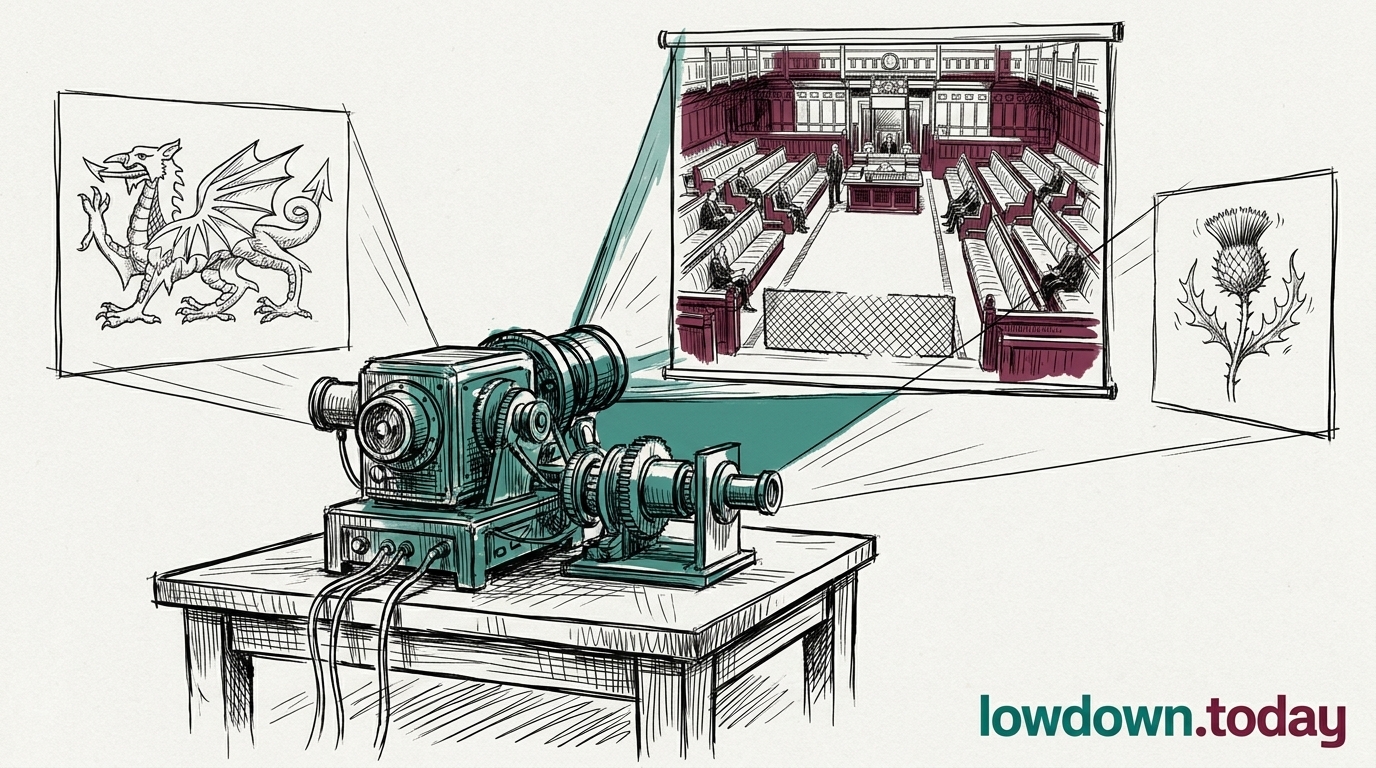
On 7 May, England votes under FPTP, Scotland under the Additional Member System, and Wales under closed-list proportional representation for the first time . The contrast will be visible in the same night's results. If FPTP produces a significant gap between national vote share and seat share in England while the Welsh and Scottish systems track closer to proportionality, the Major speech becomes a reference point that is difficult to ignore in any post-election debate about Reform.

The Wales Governance Centre's consolidation thesis makes the comparison starker still: both Welsh blocs are hardening simultaneously. Under PR, each point of vote share converts to seats more faithfully. Under FPTP, concentrated vote produces wasted votes. On the same night, the same underlying polarisation will be expressed differently in each nation's results, and the difference will be on television simultaneously.

Deep Analysis

In plain English

The UK currently uses a voting system called first past the post for general elections and English council elections. Under this system, whichever candidate gets the most votes in a local area wins, even if it is only 30 or 35 per cent of the vote. Critics say this means parties can win or lose large numbers of seats for small shifts in support, and that millions of votes for smaller parties never translate into any representation at all. John Major was the Conservative Prime Minister from 1990 to 1997. The Conservative Party has historically supported first past the post, so when he said publicly that the system is behaving more erratically and its validity is being thrown into doubt, it was unusual. Conservatives almost never say this. On 7 May this year, England uses first past the post while Scotland uses a different system called the Additional Member System and Wales uses proportional representation for the first time. Watching the same election play out differently across three systems in a single night will give people a direct comparison they have never had before.

First Reported In

Update #2 · New Money Rules, Old Party Fractures

John Major Archive· 10 Apr 2026
Read original
Causes and effects
This Event
Major Questions FPTP Before Three-System Election Night
When a senior Conservative breaks cover on electoral reform, the argument escapes its usual party-political container. The 7 May results will produce a natural experiment visible in a single night's count: same electorate, three systems, one comparison.
Different Perspectives
Green Party
Green Party
Zack Polanski's campaign delivered the Hackney and Lewisham mayoralties and both councils, plus 543 English council seats, establishing the first Green governing base in outer London. The 153-seat MRP undershoot was attributed to FPTP tactical dynamics in marginal wards rather than a polling error in vote share.
UK Labour Government
Keir Starmer's government faces the immediate test of whether to intervene in Lancashire's withdrawal from the UK refugee resettlement scheme and the longer question of how to respond if the SNP tables a Section 30 vote. MHCLG's posture on Reform-controlled councils sets the template for the next four years of divided local government.
Scottish National Party (SNP)
John Swinney committed to a Section 30 vote on the first Holyrood sitting day post-appointment and a draft referendum bill within 100 days, reframing the 58-seat result as a working mandate despite missing his own 65-seat trigger. Westminster's pre-stated refusal of a Section 30 order means the constitutional confrontation is now a matter of timing.
Plaid Cymru
Plaid Cymru
Rhun ap Iorwerth confirmed on 8 May that Plaid would attempt to govern Wales as a minority, ruling out immediate coalition talks and naming budget priorities as the test of cross-party support. The 43-seat result leaves Plaid six seats short of the 49-seat majority threshold.
Reform UK
Reform UK
Nigel Farage claimed 7 May as a historic breakthrough, pointing to 1,448 new councillors and 14 councils won from a near-zero base. The internal reckoning is that transition teams built for 22 councils must now govern 14, and three of those 14 produced immediate governance disputes.
Wales Governance Centre
The Centre framed Wales's mid-campaign Green-to-Plaid consolidation as 'consolidation, not conversion' in April, meaning voters did not migrate ideologically but regrouped tactically inside the same bloc because closed-list PR made it arithmetically rational. The final MRP result confirms that framing.