Skip to content
Briefings are running a touch slower this week while we rebuild the foundations.See roadmap
Russia-Ukraine War 2026
27MAR

Al-Aqsa sealed for Eid; first since 1967

3 min read
20:48UTC

Israeli authorities barred Muslim worshippers from al-Aqsa for Eid al-Fitr and dispersed crowds with tear gas — the first such closure since 1967, breaking a status quo that survived every war and intifada of the past six decades.

ConflictDeveloping
Key takeaway

The first al-Aqsa closure since 1967 on Eid al-Fitr hands Iran its most potent propaganda instrument of the war.

Israeli authorities barred Muslim worshippers from entering the al-Aqsa Mosque compound for Eid al-Fitr prayers — the first such closure since 1967, according to The National 1. Police deployed tear gas and stun grenades against hundreds of worshippers who had gathered in streets around the Old City. Eid al-Fitr, marking the end of Ramadan, is one of the two most important holidays in the Islamic calendar.

The closure breaks a status quo that held for 59 years through conditions arguably more dangerous than the present. Israel maintained Muslim access to al-Aqsa during the 1973 Yom Kippur War, through both intifadas, during every Gaza operation, and through the 2021 crisis when clashes inside the compound helped trigger an 11-day war. When Israel installed metal detectors at the compound's gates in 2017 after a shooting attack, Palestinian protests and Jordanian diplomatic pressure forced their removal within two weeks. The consistent lesson of six decades: restrictions on al-Aqsa access generate political costs that exceed whatever security rationale produced them.

The timing compounds the effect. The closure fell on the same day the war disrupted Nowruz celebrations inside Irantwo religious calendars broken simultaneously by the same conflict. For Iran's population, Nowruz is a cultural and national marker predating Islam; Supreme Leader Mojtaba Khamenei's silence through the holiday was itself a measure of the state's disarray . For the 1.8 billion Muslims who regard al-Aqsa as the third holiest site in Islam, the Eid closure is visible confirmation that the war's consequences extend beyond Iranian and Israeli territory into the practice of their faith. Jordan, which retains custodial authority over the Haram al-Sharif through the Waqf, has not yet issued a public response.

The security rationale is not irrational — a missile crater appeared 400 metres from the compound the same day. But every previous Israeli government that weighed security concerns against the cost of restricting al-Aqsa access concluded that access must be maintained. The decision to reverse that calculus on the single most symbolically charged day of the Islamic year will register across a far wider audience than those dispersed with tear gas at the Old City's gates on Friday morning.


Deep Analysis

In plain English

Eid al-Fitr marks the end of Ramadan with communal prayers — the most significant day in the Islamic calendar for public worship. Barring worshippers from Islam's third-holiest site on that day, enforcing the ban with tear gas and stun grenades in narrow medieval streets, is understood across 57 Muslim-majority countries as a profound collective humiliation. The 1967 benchmark is precise and deliberate. That year Israel captured East Jerusalem and took administrative control of the site. Using 1967 as the reference point implicitly acknowledges that this closure is without precedent in the entire history of Israeli administration — not merely unusual, but historically singular.

Deep Analysis
Root Causes

Israel's immediate security calculus — preventing a mass gathering near a fresh missile debris crater under global media attention — is rational on its own terms. The structural problem is that decades of contested sovereignty over the Haram al-Sharif mean that no Israeli security action at this site can be read as a temporary wartime measure. Every closure is automatically interpreted through the lens of permanent status and Islamic holy-site sovereignty, regardless of the stated rationale.

Escalation

The closure is political rather than kinetic, but its second-order effects may prove more consequential than additional missile strikes. Abraham Accords partners — UAE, Bahrain, Morocco — face immediate domestic pressure to publicly distance from Israel, potentially fracturing the informal Arab coalition whose passive acquiescence has underpinned US regional positioning throughout the campaign.

What could happen next?
  • Risk

    Abraham Accords partners face acute domestic pressure to publicly distance from Israel, potentially suspending normalisation activities that anchor US regional strategy.

    Immediate · Assessed
  • Consequence

    Iran acquires its most powerful wartime narrative asset — having forced Israel to bar Muslim worshippers from al-Aqsa on Eid — without requiring any additional military action.

    Immediate · Assessed
  • Risk

    An OIC emergency session could produce a formal multilateral diplomatic response that further isolates the US-Israeli position among the Global South.

    Short term · Suggested
  • Precedent

    The first wartime al-Aqsa closure since 1967 establishes that Israeli security forces can bar access during active hostilities, with unpredictable long-term legal and sovereignty implications.

    Long term · Suggested
First Reported In

Update #43 · Trump floats wind-down, deploys 2,200 more

Al Jazeera· 21 Mar 2026
Read original
Causes and effects
This Event
Al-Aqsa sealed for Eid; first since 1967
The closure breaks a 59-year precedent maintained through the 1973 war, two intifadas, and multiple Gaza operations. Access to al-Aqsa has historically been among the most reliable triggers of mass mobilisation across the Muslim world, and denial on the holiest day of the Ramadan calendar risks generating political consequences that outlast the military conflict itself.
Different Perspectives
North Korea / DPRK
North Korea / DPRK
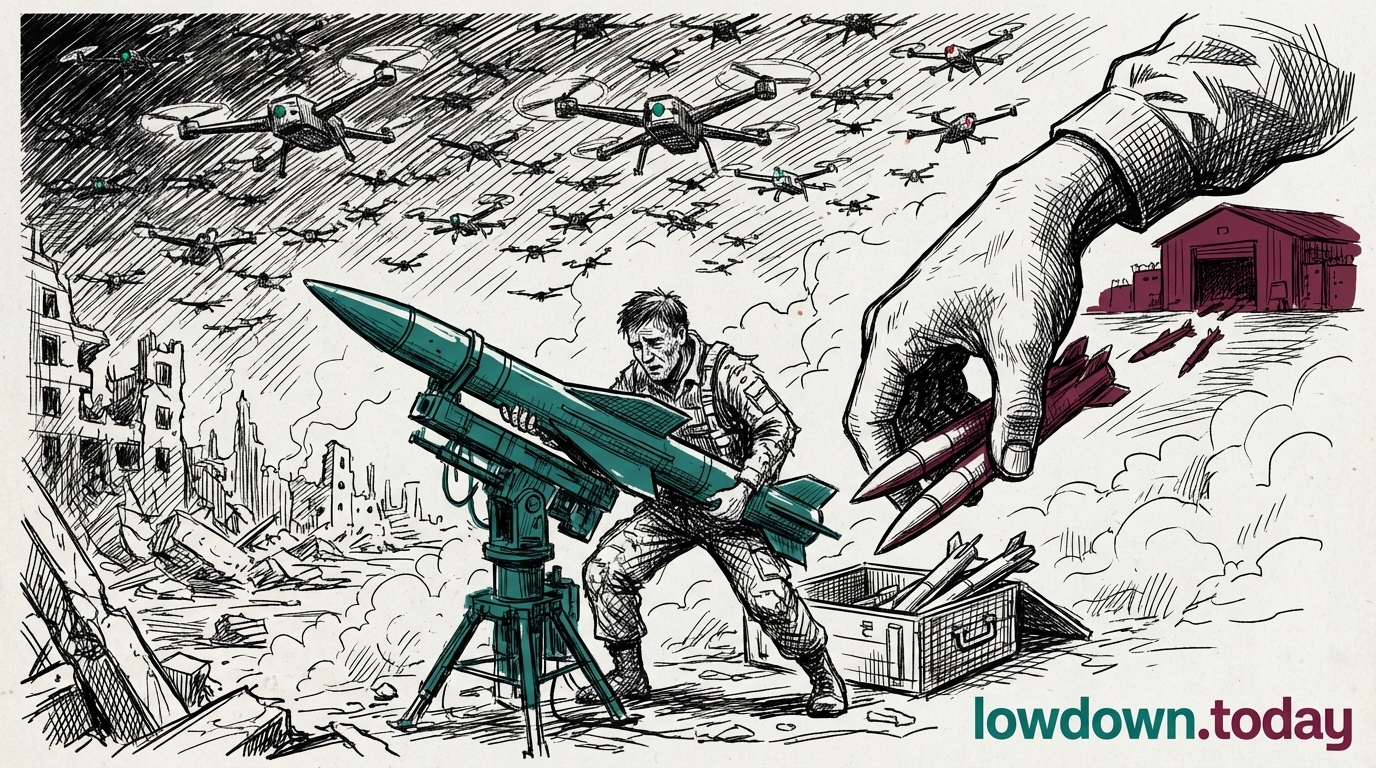
ISW confirmed the first mounting of DPRK Type-75 MLRS on Russian autonomous UGVs near Kharkiv on 7 June, the latest step in a supply axis that escalated from shells in 2023 to troops in 2024. Pyongyang gains live battlefield data on its ordnance and on Russia's uncrewed-systems programme.
IAEA / Rafael Grossi
Grossi confirmed Chornobyl structural damage with nuclear material metres away and could not attribute the ZNPP 15-hour blackout during the agreed repair window. Six ceasefires brokered and broken at ZNPP, compounded by Rosatom's May attack on IAEA neutrality, have eroded his ability to enforce the windows he negotiates.
Emmanuel Macron / France
Macron co-signed the E3 framework whose line-of-contact baseline marks Europe's first formal acceptance that 1991 borders are not the opening position. France's role carries weight because Macron had previously proposed a European force for Ukraine, and the framework's multinational force point is the vehicle for that.
Keir Starmer / E3
Keir Starmer / E3
Starmer, Macron and Merz met Zelenskyy on 7 June and backed a five-point framework taking the line of contact as the talks baseline, conceding roughly one fifth of Ukraine in exchange for a multinational force and frozen assets. With US mediation ended, the NATO Ankara summit on 7-8 July is the next test.
Vladimir Putin / Kremlin
Putin used SPIEF to reject Zelenskyy's summit letter, citing 'elements of rudeness', and repeated the pre-agreed treaty precondition that has frozen every diplomatic round since May. The SPIEF platform's message of investor confidence was punctured by naval fires visible from St Petersburg, which Moscow declined to dispute in scale.
Ukraine / Unmanned Systems Forces
Commander Brovdi confirmed USF units tracked and set fire to Boikyi at Kronstadt, while Code 9.2 struck the Chonhar Bridge the following day. Ukraine is sequencing strikes for rear-area interdiction and political timing rather than ground gains, trading the Baltic Fleet's home base for the logistics squeeze Russia cannot absorb without rationing its own occupied territory.



