Skip to content
Briefings are running a touch slower this week while we rebuild the foundations.See roadmap
Russia-Ukraine War 2026
27MAR

IDF destroys Litani bridge; a first

3 min read
20:48UTC

The first acknowledged Israeli strike on Lebanese civilian infrastructure cuts a key river crossing, isolating the south ahead of the planned ground offensive.

ConflictDeveloping
Key takeaway

The Zrarieh strike activates the Dahiya doctrine's infrastructure-coercion phase for the first time in this conflict.

The IDF destroyed the Zrarieh Bridge over the Litani River on Friday — the first acknowledged Israeli strike on Lebanese civilian infrastructure in this conflict 1. Defence Minister Israel Katz framed the destruction as policy: Israel would impose "increasing costs through damage to infrastructure and loss of territory" 2.

The tactical purpose requires no interpretation. A ground force planning to seize everything south of the Litani needs to control movement across it. Destroying the bridge severs a supply and evacuation route, isolating the southern theatre before troops advance. Israel destroyed every major crossing over the Litani during the 2006 war for the same reason — but those strikes came after the ground invasion began. This one comes before, as preparation.

Until Friday, Israel's Lebanon campaign had struck what it described as Hezbollah military infrastructure: weapons depots, command centres, launch sites. The Zrarieh Bridge is a civilian road crossing. Katz's language — "loss of territory" — frames the destruction not as collateral damage but as a cost imposed on the Lebanese state, consistent with his earlier warning that Israel would take Lebanese territory if the government could not prevent Hezbollah attacks . For the 830,000 people displaced within Lebanon and the nearly 100,000 who have crossed into Syria, each destroyed crossing compresses the remaining evacuation corridors.


Deep Analysis

In plain English

The Litani River is a natural east-west barrier across southern Lebanon. Destroying the bridge serves two immediate purposes: cutting Hezbollah's ability to move fighters and equipment across the river, and creating a physical boundary that matches Israel's intended buffer zone. More significantly, this is the first time Israel has acknowledged targeting Lebanese civilian infrastructure in this conflict — a deliberate signal, backed by an explicit ministerial warning of more to come. The Dahiya doctrine, developed by the IDF after 2006, envisages destroying civilian infrastructure to raise costs on the Lebanese state for tolerating Hezbollah. That doctrine is now operationally active.

Deep Analysis
Synthesis

The strike is addressed to the Lebanese state, not to Hezbollah. Hezbollah operates multiple crossing points and maintains pre-positioned supplies. The Zrarieh Bridge's primary users are civilians and the Lebanese Army — precisely the entities Israel is signalling it holds responsible. Katz's language about 'loss of territory' is an ultimatum to Beirut: it demands action from a government that structurally cannot deliver it.

Escalation

Katz's explicit warning of 'increasing costs through damage to infrastructure' follows the Dahiya doctrine's graduated escalation logic. Based on 2006 precedent and doctrine, the next likely targets are power generation infrastructure and the road network linking Sidon to Tyre. The body notes Katz's warning but does not identify the probable sequence.

What could happen next?
  • Precedent

    The first acknowledged civilian infrastructure strike establishes a permissive precedent — each subsequent strike requires less political justification than the first.

    Immediate · Assessed
  • Consequence

    Civilian evacuation from villages south of the Litani is now physically more difficult, compounding the displacement crisis already at 830,000 people.

    Immediate · Assessed
  • Risk

    If power infrastructure follows bridges as the next Dahiya target, Lebanon's already-degraded electrical grid — running two to four hours daily in most areas — could fail entirely, with cascading effects on hospitals and water pumps.

    Short term · Suggested
  • Meaning

    Israel's acknowledgement that this is a civilian infrastructure strike — unlike earlier strikes framed as targeting Hezbollah positions — shifts the legal and political framing of the Lebanon operation internationally.

    Immediate · Assessed
First Reported In

Update #36 · Israel plans full Litani seizure

Axios· 15 Mar 2026
Read original
Causes and effects
This Event
IDF destroys Litani bridge; a first
The bridge destruction shifts Israel's Lebanon campaign from targeting Hezbollah military assets to destroying civilian infrastructure, physically isolating the southern theatre before a ground advance. Defence Minister Katz framed it as deliberate policy — territorial loss imposed as punishment on the Lebanese state.
Different Perspectives
North Korea / DPRK
North Korea / DPRK
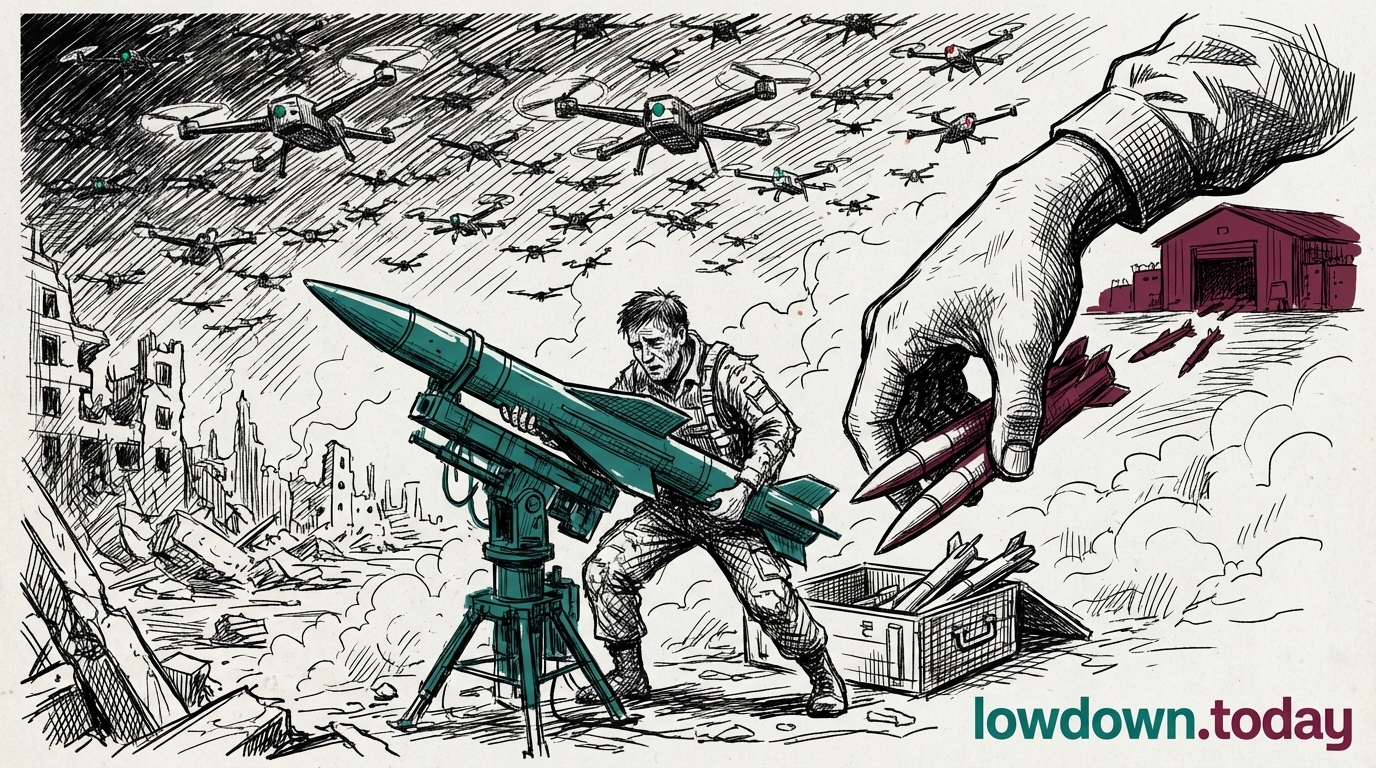
ISW confirmed the first mounting of DPRK Type-75 MLRS on Russian autonomous UGVs near Kharkiv on 7 June, the latest step in a supply axis that escalated from shells in 2023 to troops in 2024. Pyongyang gains live battlefield data on its ordnance and on Russia's uncrewed-systems programme.
IAEA / Rafael Grossi
Grossi confirmed Chornobyl structural damage with nuclear material metres away and could not attribute the ZNPP 15-hour blackout during the agreed repair window. Six ceasefires brokered and broken at ZNPP, compounded by Rosatom's May attack on IAEA neutrality, have eroded his ability to enforce the windows he negotiates.
Emmanuel Macron / France
Macron co-signed the E3 framework whose line-of-contact baseline marks Europe's first formal acceptance that 1991 borders are not the opening position. France's role carries weight because Macron had previously proposed a European force for Ukraine, and the framework's multinational force point is the vehicle for that.
Keir Starmer / E3
Keir Starmer / E3
Starmer, Macron and Merz met Zelenskyy on 7 June and backed a five-point framework taking the line of contact as the talks baseline, conceding roughly one fifth of Ukraine in exchange for a multinational force and frozen assets. With US mediation ended, the NATO Ankara summit on 7-8 July is the next test.
Vladimir Putin / Kremlin
Putin used SPIEF to reject Zelenskyy's summit letter, citing 'elements of rudeness', and repeated the pre-agreed treaty precondition that has frozen every diplomatic round since May. The SPIEF platform's message of investor confidence was punctured by naval fires visible from St Petersburg, which Moscow declined to dispute in scale.
Ukraine / Unmanned Systems Forces
Commander Brovdi confirmed USF units tracked and set fire to Boikyi at Kronstadt, while Code 9.2 struck the Chonhar Bridge the following day. Ukraine is sequencing strikes for rear-area interdiction and political timing rather than ground gains, trading the Baltic Fleet's home base for the logistics squeeze Russia cannot absorb without rationing its own occupied territory.



