Skip to content
Welcome, thoughtbot's Giant Robots listeners!Start here
Russia-Ukraine War 2026
18MAR

France scraps two drones for mass buys

3 min read
11:41UTC

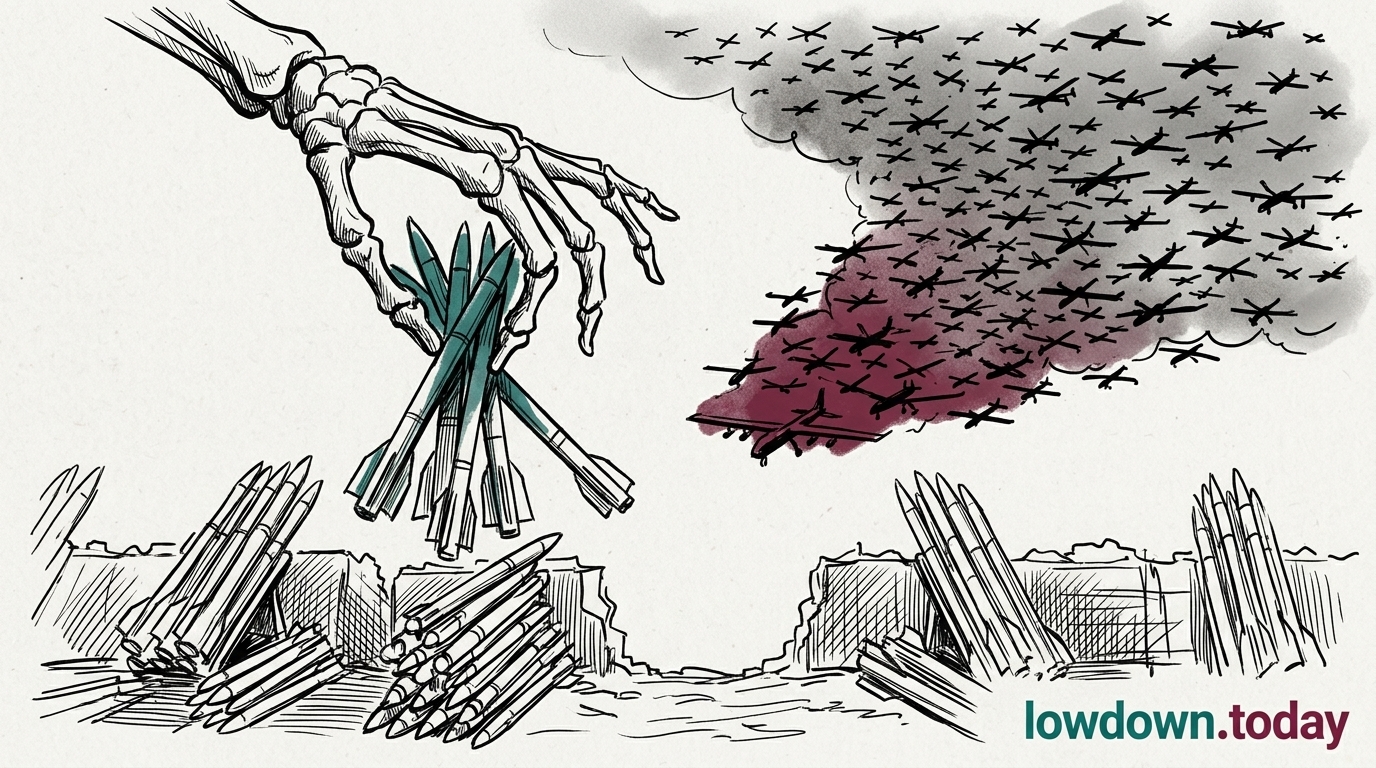
France cancelled the Safran Patroller and the multinational Eurodrone programme on 8 April, redirecting approximately €600 million to roughly 40 small tactical systems including Delair/KNDS Damocles loitering munitions.

ConflictDeveloping
Key takeaway

France killed Eurodrone and pivoted to mass attritable drones, ending its pre-Ukraine doctrine.

France cancelled both the Safran Patroller tactical drone and the multinational Eurodrone programme in an updated military programming law presented on 8 April, redirecting approximately €600 million toward small tactical drones and low-altitude MALE systems. Roughly 40 tactical drone systems will be ordered in 2026. Delair, in collaboration with KNDS, is delivering the first batch of Damocles loitering munitions.

The Patroller programme had been delayed for years. Its cancellation frees budget for attritable tactical mass, a doctrinal shift validated by Ukraine's FPV-dominant front lines. The simultaneous Eurodrone cancellation kills the main vehicle for European drone industrial convergence, leaving Germany (Helsing HX-2, €1.46 billion framework) and the UK (Corvus/NYX) to pursue separate national paths.

The cancellation of two flagship programmes at once is the clearest European break with the pre-Ukraine procurement model. Before February 2022, the doctrine prioritised large, exquisite platforms that took a decade to develop and entered service in single-digit quantities. Ukraine's front has demonstrated that attritable mass at €300 to €5,000 per unit, not €30 million platforms, determines who holds ground. France is the first major European military to codify that lesson in law, and the EU AGILE programme has no mechanism to prevent the resulting national fragmentation.

Deep Analysis

In plain English

France was building a large, expensive surveillance drone (Patroller, costing hundreds of millions) and was part of a European project to build an even bigger drone (Eurodrone). After watching how drones are used in Ukraine, France decided to cancel both and instead buy roughly 40 smaller, cheaper drones and some loitering munitions (flying bombs that circle until they find a target). The logic is that cheap drones you can lose in large numbers beat one expensive drone you cannot afford to risk. France is the first major European country to make this switch official.

Deep Analysis
Root Causes

France's cancellation reflects three structural forces: the Ukraine war's operational data demonstrating that FPV-type attritable drones at low unit costs outperform expensive persistent platforms in force-on-force combat; France's defence budget constraint, with the military programming law requiring difficult prioritisation choices; and the Eurodrone's schedule slippage and cost growth, which made it an easy cut.

France's €600 million pivot from Patroller and Eurodrone to Damocles loitering munitions and 40 tactical systems reflects both operational learning from Ukraine and fiscal pressure under the military programming law.

What could happen next?
  • Consequence

    France's cancellation accelerates the breakup of the Eurodrone consortium model. Germany (Helsing HX-2) and the UK (Project NYX, Corvus) are already pursuing separate national paths. The pan-European MALE drone as a coordination vehicle for the defence industry is effectively dead. Individual nations will procure attritable systems nationally, with occasional bilateral workshare, rather than through multinational programmes.

First Reported In

Update #10 · NATO shoots down drone over Estonia

Aerotime· 29 May 2026
Read original →
Different Perspectives
Government of Latvia
Latvia abstained on 22 September when the EU renewed its individual sanctions for 36 months at the price of delisting Alisher Usmanov and Mikhail Fridman, and promised national sanctions of its own. Riga's abstention marks how far a frontline member state will go to keep listed names listed.
India's Ministry of External Affairs
After the House passed the Graham bill on 16 September, India's foreign ministry said it would keep buying energy on market terms and protect its trade. Russia supplied 30.3% of India's crude imports in fiscal 2026, so the tariff decision due around 18 October falls directly on New Delhi.
Kaja Kallas, EU foreign policy chief
Kallas answered the US licence on 10 October by saying Europe would not ease pressure, and EU ministers adopted a 22nd package of nearly 1,600 listings two days later. Brussels is tightening as Washington loosens, though TASS reported the package adds no significant new trade restrictions.
Donald Trump and the US Treasury
The Treasury licensed Russian diesel imports until 7 April 2027 on the day of Trump's call with Putin, and Trump then told reporters Ukraine should find a new leader. Washington is trading sanctions relief for fuel supply while pressing Kyiv to halt the refinery strikes behind the shortage.
Kremlin and Deputy Prime Minister Alexander Novak
After the 9 October call the Kremlin said Russia was ready to supply oil and petroleum products to American and global markets, and Novak brought forward the end of diesel export curbs. Moscow is selling the shortage back as goodwill, with volumes that Decree No. 686 now hides from outside checks.
Volodymyr Zelenskyy, President of Ukraine
Zelenskyy called GL 135 an investment in prolonging the war and offered to stop striking Russian refineries if Russia stops destroying Ukraine's energy system. Answering Trump's call for a new leader, he set a total 60-day ceasefire as the condition for elections, which puts the next move on Moscow.

Written with AI from Lowdown's published reporting. Not individually reviewed by an editor. Editorial standards.
