Skip to content
Briefings are running a touch slower this week while we rebuild the foundations.See roadmap
Russia-Ukraine War 2026
5MAR

Brent at $85 as Hormuz stays shut

3 min read
04:57UTC

Brent crude has risen more than 16% since strikes began, and OPEC+'s production increase covers barely 1% of the strait's normal flow.

ConflictDeveloping
Key takeaway

The relative containment of crude prices is itself a signal — markets are betting on a short conflict, and that bet has no verified factual basis beyond a presidential statement.

Brent Crude rose to $85–90 per barrel, up from approximately $73 before the campaign — a rise of 16 to 23 per cent in three days. The price had opened at $82.37 on 1 March and has climbed steadily as the strait of Hormuz closure enters its fourth day. Gold held at a record $5,362 per ounce . Dow futures fell 300 points and the Nikkei dropped 2% .

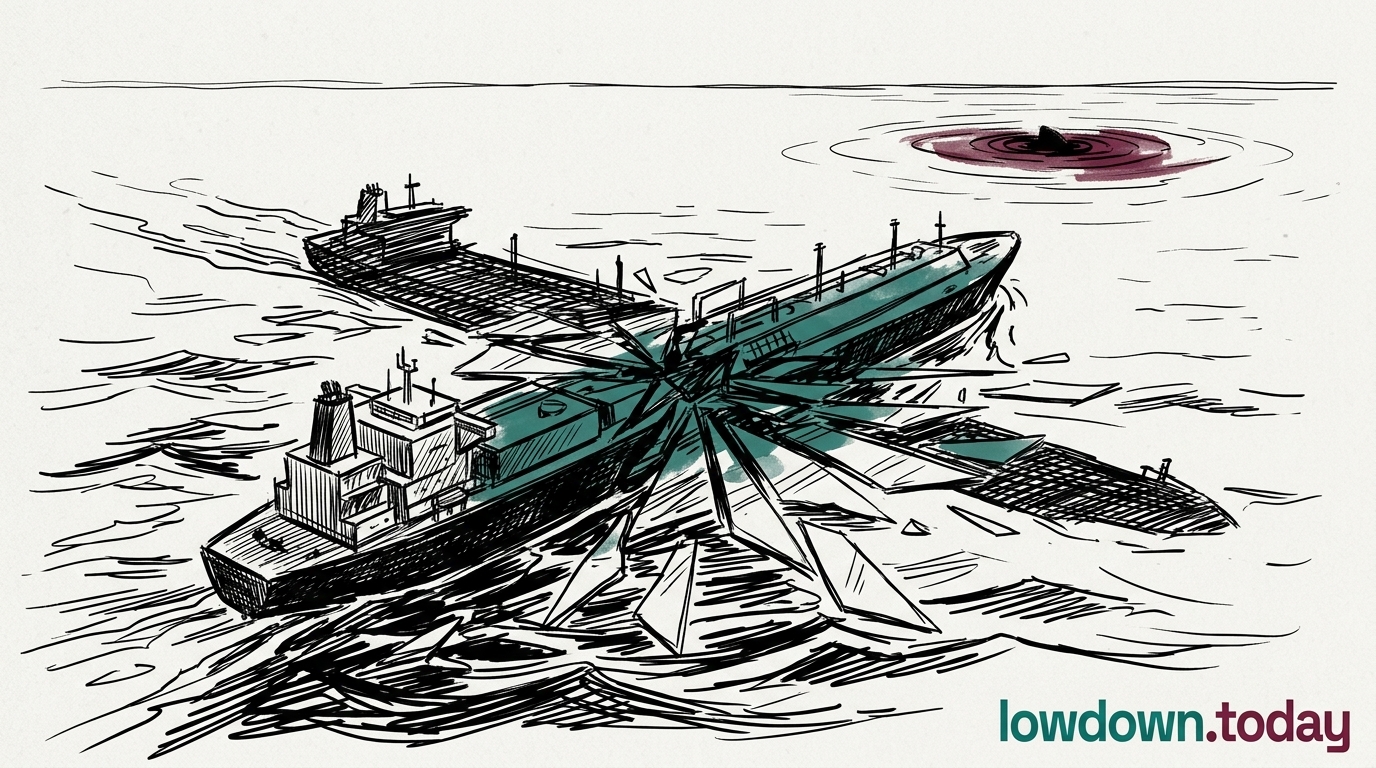
The driver is physical, not speculative. Vessel traffic through the strait has fallen 70 per cent , with more than 150 tankers anchored in open Gulf waters. CMA CGM, Maersk, and four other major carriers have suspended all transits . Roughly 20 million barrels per day normally pass through — one-fifth of the world's traded oil. OPEC+'s 220,000 barrel-per-day increase replaces 1.1 per cent of that volume.

Goldman Sachs projects oil averaging $98 near-term, rising to $110 in a high-disruption scenario. JPMorgan forecast $120–130 if prolonged . Goldman raised its US recession probability estimate to 25%; prediction market Kalshi briefly priced it at 35%. JPMorgan Asset Management identified a sustained Hormuz closure as the variable separating a contained price shock from a supply crisis reaching European and Asian consumers.

The 1973 Arab oil embargo — the closest historical precedent to a sustained Gulf supply disruption — quadrupled oil prices over six months and triggered a global recession. The critical variable then was not the initial spike but duration. At $85–90, the market is pricing in a resolution. Goldman and JPMorgan are pricing in the possibility that one does not come.

Deep Analysis

In plain English

Oil prices jumped roughly 20% in a few days, which sounds alarming but is actually smaller than many analysts expected given the world's most critical oil shipping lane is nearly shut. The reason prices are not higher is that traders appear to believe the conflict will end quickly, partly anchored to Trump's 'four weeks or less' comment. If that timeline slips, expect a second, steeper price jump — the first move was markets pricing duration, the second would be markets pricing failure.

Deep Analysis
Synthesis

The spread between current price ($85–90) and Goldman's high-disruption scenario ($110) implicitly encodes the market's probability-weighted estimate of closure duration — roughly a 30–40% chance of extended disruption. This spread is the single most liquid real-time indicator of conflict duration expectations and will move faster than any intelligence assessment.

Root Causes

The UAE's Habshan–Fujairah bypass pipeline — the only meaningful Hormuz alternative — maxes out at approximately 1.5 million barrels per day against roughly 20 million transiting the strait. Decades of underinvestment in non-Hormuz infrastructure means the chokepoint has no material bypass capacity, so the price impact of closure is entirely duration-dependent.

Escalation

Prices are floor-testing rather than ceiling-testing at the current range. The $85–90 band reflects optimistic duration assumptions; if Hormuz stays closed beyond 14 days, the structural supply deficit (~18 million barrels per day of missing flow) reasserts and the Goldman $110 high-disruption scenario becomes the base case rather than a tail risk.

What could happen next?
  • Meaning

    Markets are pricing Trump's 'four weeks or less' timeline as credible — the price level is a duration bet, not a supply-shock assessment.

    Immediate · Assessed
  • Risk

    A second, sharper price dislocation follows if the conflict duration exceeds market expectations, with no structural buffer between current prices and the $110–130 range.

    Short term · Suggested
  • Consequence

    Import-dependent economies — particularly South Asia, East Africa, and Southeast Asia — face immediate inflationary pressure on food and transport, sectors with limited price absorption capacity.

    Short term · Assessed
  • Opportunity

    US domestic shale producers and tanker-owning companies are structural beneficiaries of elevated prices combined with Hormuz disruption.

    Short term · Assessed
First Reported In

Update #9 · IRGC HQ destroyed; Britain quits coalition

Euronews· 2 Mar 2026
Read original
Causes and effects
This Event
Brent at $85 as Hormuz stays shut
The price reflects a physical supply blockage — vessel traffic down 70%, all major carriers suspended — not speculative positioning, and the gap between $85–90 and bank forecasts of $98–130 measures the market's remaining assumption that the Hormuz closure will be resolved quickly.
Different Perspectives
North Korea / DPRK
North Korea / DPRK
ISW confirmed the first mounting of DPRK Type-75 MLRS on Russian autonomous UGVs near Kharkiv on 7 June, the latest step in a supply axis that escalated from shells in 2023 to troops in 2024. Pyongyang gains live battlefield data on its ordnance and on Russia's uncrewed-systems programme.
IAEA / Rafael Grossi
Grossi confirmed Chornobyl structural damage with nuclear material metres away and could not attribute the ZNPP 15-hour blackout during the agreed repair window. Six ceasefires brokered and broken at ZNPP, compounded by Rosatom's May attack on IAEA neutrality, have eroded his ability to enforce the windows he negotiates.
Emmanuel Macron / France
Macron co-signed the E3 framework whose line-of-contact baseline marks Europe's first formal acceptance that 1991 borders are not the opening position. France's role carries weight because Macron had previously proposed a European force for Ukraine, and the framework's multinational force point is the vehicle for that.
Keir Starmer / E3
Keir Starmer / E3
Starmer, Macron and Merz met Zelenskyy on 7 June and backed a five-point framework taking the line of contact as the talks baseline, conceding roughly one fifth of Ukraine in exchange for a multinational force and frozen assets. With US mediation ended, the NATO Ankara summit on 7-8 July is the next test.
Vladimir Putin / Kremlin
Putin used SPIEF to reject Zelenskyy's summit letter, citing 'elements of rudeness', and repeated the pre-agreed treaty precondition that has frozen every diplomatic round since May. The SPIEF platform's message of investor confidence was punctured by naval fires visible from St Petersburg, which Moscow declined to dispute in scale.
Ukraine / Unmanned Systems Forces
Commander Brovdi confirmed USF units tracked and set fire to Boikyi at Kronstadt, while Code 9.2 struck the Chonhar Bridge the following day. Ukraine is sequencing strikes for rear-area interdiction and political timing rather than ground gains, trading the Baltic Fleet's home base for the logistics squeeze Russia cannot absorb without rationing its own occupied territory.