Skip to content
Briefings are running a touch slower this week while we rebuild the foundations.See roadmap
Russia-Ukraine War 2026
9JUN

Istanbul Round 2: prisoners, no truce

2 min read
11:54UTC

Russia and Ukraine met for a second time at Istanbul's Ciragan Palace on 2 June and agreed to exchange up to 1,200 prisoners per side, including journalists and political prisoners; Russia pledged to return 6,000 bodies. Ukraine's proposed 30-day ceasefire was rejected; a third round was set for 20-30 June.

ConflictDeveloping
Key takeaway

Istanbul's second round delivered prisoners but confirmed the ceasefire gap is structural, not procedural.

Russia and Ukraine met at Istanbul's Ciragan Palace on 2 June for a second round of direct talks lasting just over an hour, with near-identical delegations, venue and mediator to Round 1. Rustem Umerov again led Kyiv's 14-member delegation; Vladimir Medinsky again led Russia's. The consistency points to institutionalisation, not improvisation.

The prisoner mechanism works because it sidesteps the territorial geometry that blocks everything else. Both sides can exchange up to 1,200 prisoners each without conceding the other's claim to contested land. The pledge to return 6,000 bodies of fallen Ukrainian service members is not a tactical concession, but it carries domestic political weight in Ukraine.

Ukraine demands all-domain cessation because partial truces historically aid Russian force reconstitution. Russia offers localised pauses, specifically because a full ceasefire at the current front line would freeze its worst territorial position since August 2024. Neither side can move without changing territorial red lines.

Ukraine's submitted peace memorandum, covering EU membership, international guarantees, phased sanctions relief and frozen-asset reparations, is Kyiv's formal opening position. Russia tabled no comparable document. That asymmetry, paper submitted versus paper withheld, will define Round 3's agenda. Round 2 builds directly on the Istanbul Round 1 framework .

Deep Analysis

In plain English

Russia and Ukraine held a second round of direct talks in Istanbul on 2 June, at the same venue and with the same lead negotiators as the first round in May. They agreed to swap more prisoners, up to 1,200 per side this time, and Russia agreed to return the bodies of up to 6,000 fallen Ukrainian soldiers. But they could not agree to stop fighting. Ukraine wanted a full 30-day pause across all military domains. Russia offered only a 2-3 day partial pause in specific areas, which Ukraine rejected. A third round of talks was proposed for 20-30 June. The prisoner swaps are achievable because they do not require either side to give up territorial claims. A ceasefire cannot happen for the same reason: whichever side accepts a front-line freeze would be locking in what it considers an unacceptable loss.

Deep Analysis
Root Causes

The ceasefire gap at Istanbul Round 2 is structural, not procedural. Russia's minimum position requires Ukraine to withdraw from all four annexed regions as a ceasefire precondition; Ukraine's maximum position is a 30-day all-domain halt that freezes the front line at its current coordinates. Those two positions are not adjacent: no procedural compromise can bridge them because they represent incompatible territorial baselines.

The prisoner mechanism succeeds precisely because it does not touch territorial geometry. Both sides hold prisoners the other side wants; exchanging them requires only logistics, not a change in strategic position. Russia agreed to return 6,000 bodies for the same reason: humanitarian concessions carry domestic political weight in Ukraine without conceding anything Moscow values.

What could happen next?
  • Precedent

    Including journalists and political prisoners in the exchange sets a template that could extend future mechanisms beyond military personnel.

  • Risk

    Turkey's mediator consolidation reduces US leverage in any future re-engagement with the peace process.

First Reported In

Update #18 · Oreshnik doubles as Russia's front collapses

PBS NewsHour· 1 Jun 2026
Read original
Causes and effects
This Event
Istanbul Round 2: prisoners, no truce
The Istanbul channel has institutionalised as the war's sole diplomatic format, but its ceiling is visible: prisoner exchanges are achievable precisely because they require no territorial concession, while a ceasefire remains structurally blocked.
Different Perspectives
North Korea / DPRK
North Korea / DPRK
ISW confirmed the first mounting of DPRK Type-75 MLRS on Russian autonomous UGVs near Kharkiv on 7 June, the latest step in a supply axis that escalated from shells in 2023 to troops in 2024. Pyongyang gains live battlefield data on its ordnance and on Russia's uncrewed-systems programme.
IAEA / Rafael Grossi
Grossi confirmed Chornobyl structural damage with nuclear material metres away and could not attribute the ZNPP 15-hour blackout during the agreed repair window. Six ceasefires brokered and broken at ZNPP, compounded by Rosatom's May attack on IAEA neutrality, have eroded his ability to enforce the windows he negotiates.
Emmanuel Macron / France
Macron co-signed the E3 framework whose line-of-contact baseline marks Europe's first formal acceptance that 1991 borders are not the opening position. France's role carries weight because Macron had previously proposed a European force for Ukraine, and the framework's multinational force point is the vehicle for that.
Keir Starmer / E3
Keir Starmer / E3
Starmer, Macron and Merz met Zelenskyy on 7 June and backed a five-point framework taking the line of contact as the talks baseline, conceding roughly one fifth of Ukraine in exchange for a multinational force and frozen assets. With US mediation ended, the NATO Ankara summit on 7-8 July is the next test.
Vladimir Putin / Kremlin
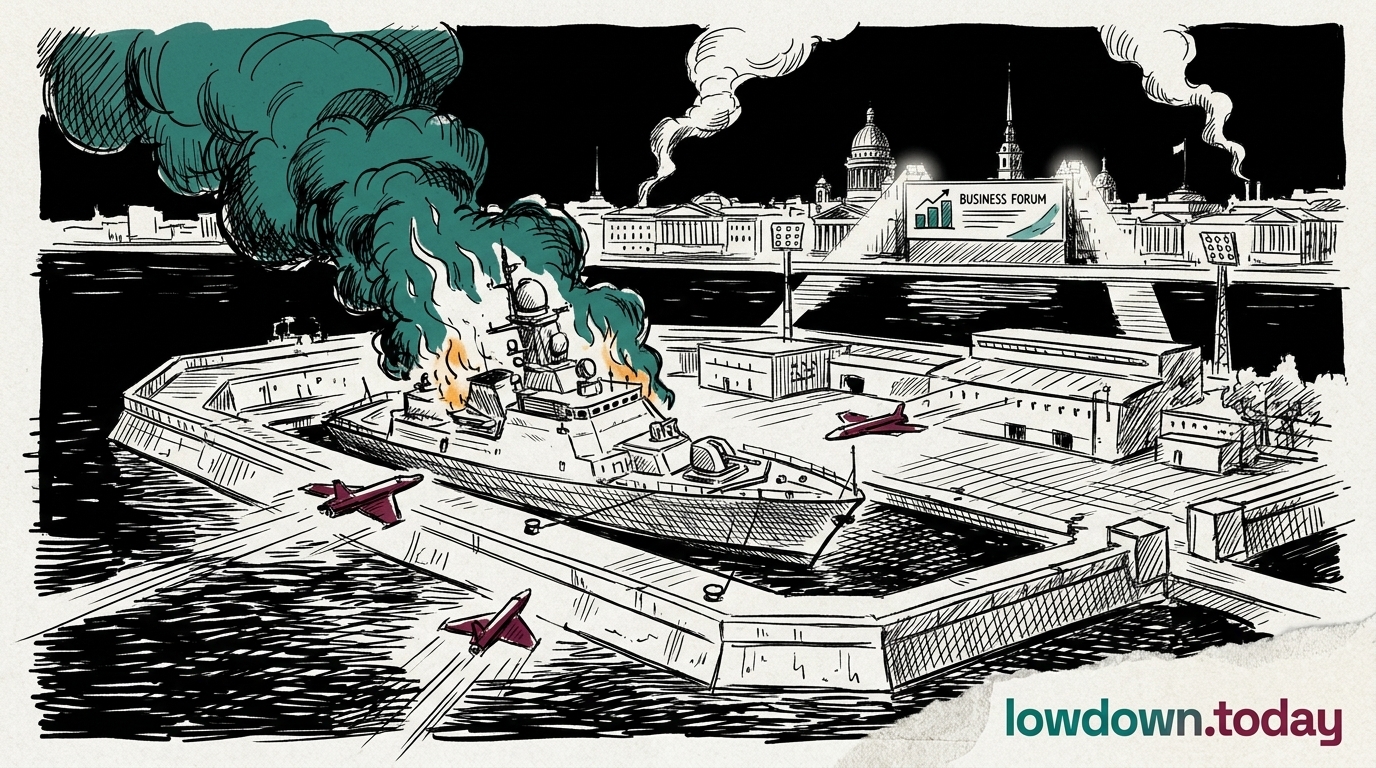
Putin used SPIEF to reject Zelenskyy's summit letter, citing 'elements of rudeness', and repeated the pre-agreed treaty precondition that has frozen every diplomatic round since May. The SPIEF platform's message of investor confidence was punctured by naval fires visible from St Petersburg, which Moscow declined to dispute in scale.
Ukraine / Unmanned Systems Forces
Commander Brovdi confirmed USF units tracked and set fire to Boikyi at Kronstadt, while Code 9.2 struck the Chonhar Bridge the following day. Ukraine is sequencing strikes for rear-area interdiction and political timing rather than ground gains, trading the Baltic Fleet's home base for the logistics squeeze Russia cannot absorb without rationing its own occupied territory.