Skip to content
You can now search across every topic, entity and event.What's new
Pandemics and Biosecurity
21JUL

Nine of twelve Djugu posts shut

2 min read
09:12UTC

Radio Okapi reported on 15 July that nine of the twelve health posts in Djugu Territory's Heritage health area had closed, overwhelmed by patients. Customary chiefs raised the alarm, not the health ministry.

ScienceDeveloping
Key takeaway

Djugu's closed health posts stop treating patients and stop counting them at the same moment.

Nine of the twelve health posts in the Heritage health area of Djugu territory, in Ituri Province, have closed after being overwhelmed by patient numbers, Radio Okapi reported on Wednesday 15 July 1. Djugu is a territory of roughly a million people in north-eastern DR Congo, already displaced in large numbers by a decade of militia violence, and its health posts are the first and often only clinical contact most residents have.

Customary chiefs raised the alarm rather than the health ministry, which is itself a measure of how far the formal reporting line has thinned. One sector chief told Radio Okapi the closures had "already caused the death of more than one hundred people" 2. That is his own assertion and not verified surveillance data; no health ministry or WHO bulletin has published a figure for the Heritage health area at all. He named Community resistance to sanitation protocols in the Djatsi and Pitsi sectors as accelerating the chains of infection.

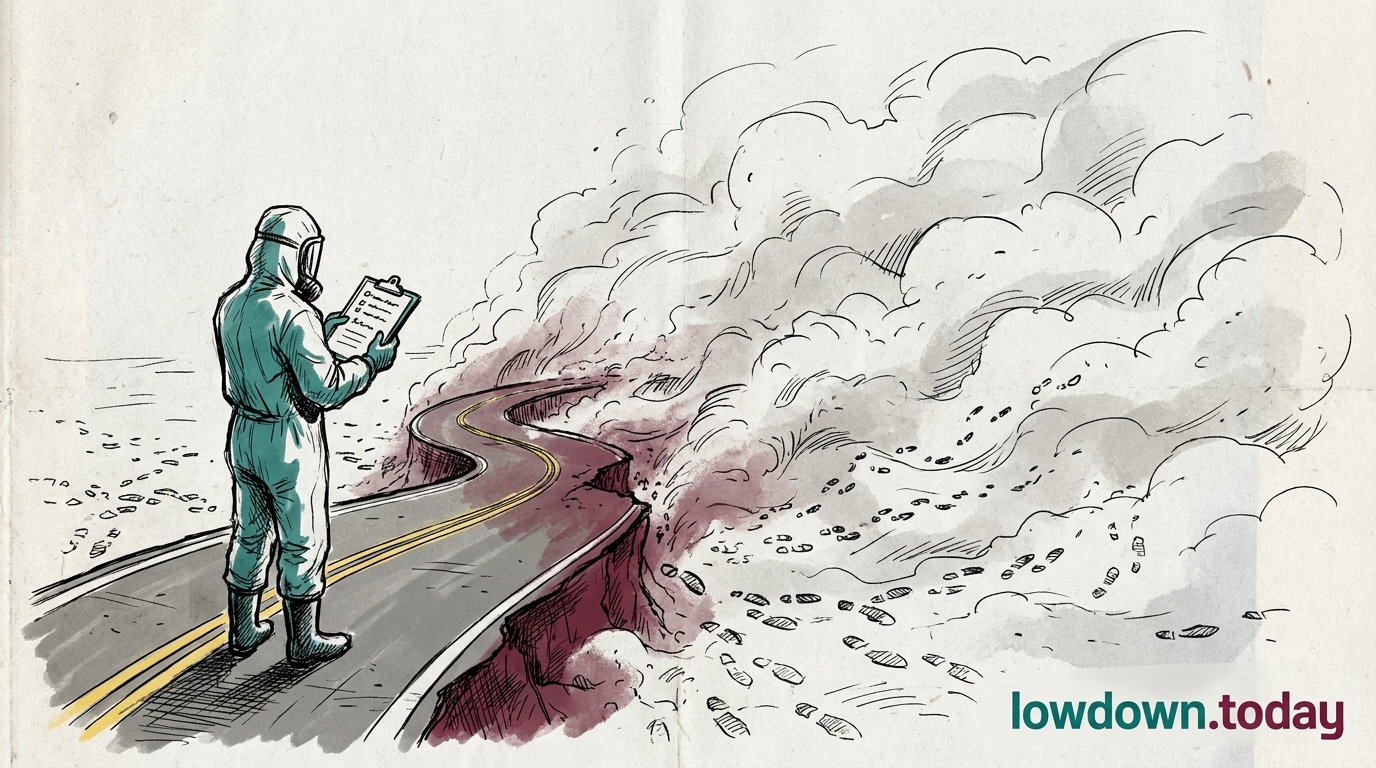
A closed health post does two things at once, and the second is the one that shows up in the national numbers later. It stops treating people, and it stops reporting them. Ebola surveillance in DRC is built upwards from exactly these facilities, so a case that never reaches a post never enters the count. Responder infections had already tripled to 112 with 35 dead before the posts began closing , and the staff WHO would reopen them come from the same shrinking pool.

Deep Analysis

In plain English

Health posts are small, local clinics, often the first place someone with symptoms goes for care. In Djugu, an area of eastern DR Congo, nine out of twelve of these clinics have now closed because they could not cope with the number of Ebola patients arriving. A local official said the closures have already led to more than a hundred deaths, but that is his own estimate, not a confirmed count from health authorities.

Deep Analysis
Root Causes

Djugu Territory sits within a CODECO-contested zone that has constrained health workforce presence for years before this outbreak began; a caseload surge on top of that pre-existing under-staffing, not the outbreak alone, tips facilities into closure.

A second cause is structural rather than security-related: nine of twelve posts closing at once suggests the health area had no surge capacity built in, so any caseload spike above baseline overwhelms the same facilities that were already running near their limit.

What could happen next?
  • Meaning

    The closures show the outbreak reaching a point where formal health infrastructure, not just contact tracing, has started to give way.

  • Risk

    Patients turned away from closed posts likely seek care informally or not at all, feeding directly into the untraced-case pattern WHO reported for the wider outbreak.

First Reported In

Update #11 · Ebola outruns its own contact tracing

Radio Okapi· 21 Jul 2026
Read original
Different Perspectives
UK Government
UK Government
The Biological Security Strategy implementation report published 14 July commits the UK to deciding within twelve months whether to make DNA-synthesis screening mandatory, backed by GBP 1.83bn for biosecurity centres. It is a preemptive move on a threat that has not yet produced a UK incident.
Cambodia's Ministry of Health
Cambodia confirmed a nine-month-old girl in Phnom Penh as its fourth 2026 H5N1 case on 11 July, the country supplying four of the world's seven new human cases since February. The ministry's confirmed-case cadence is running well ahead of a US surveillance system that has recorded nothing new since March.
Knowledge Ecology International
KEI published proposed annex text on the day IGWG7 opened that would attach benefit-sharing duties to a product's market registration, regardless of whether the manufacturer used shared samples or only downloaded sequence data. It is the Africa Group's fallback position if the sample-based bargain fails to bind.
European Union
European Union
The EU and other industrialised states backed a hybrid model built on centralised infrastructure with more flexible access terms, the opposite design choice from the Africa Group's. Brussels wants conditions handled contractually once samples reach shared facilities, not attached to national custody of the material itself.
Africa Group / Algeria
Algeria, speaking for the Africa Group at IGWG7, backed distributed national and regional laboratories under binding access conditions, arguing that supplying states must keep legal control of samples rather than surrender them into shared infrastructure.
Uganda's Ministry of Health
Uganda discharged its last confirmed patient on 16 July and opened a 42-day countdown to declaring its own outbreak over, closing at 20 cases and 2 deaths with no new case since 21 June. This is a closing chapter running alongside DR Congo's still-worsening one, contingent on a border DRC can no longer see across.
