Skip to content
Welcome, thoughtbot's Giant Robots listeners!Start here
Is Britain Actually Broke?
7OCT

We left the UK row of the table empty

3 min read
12:52UTC

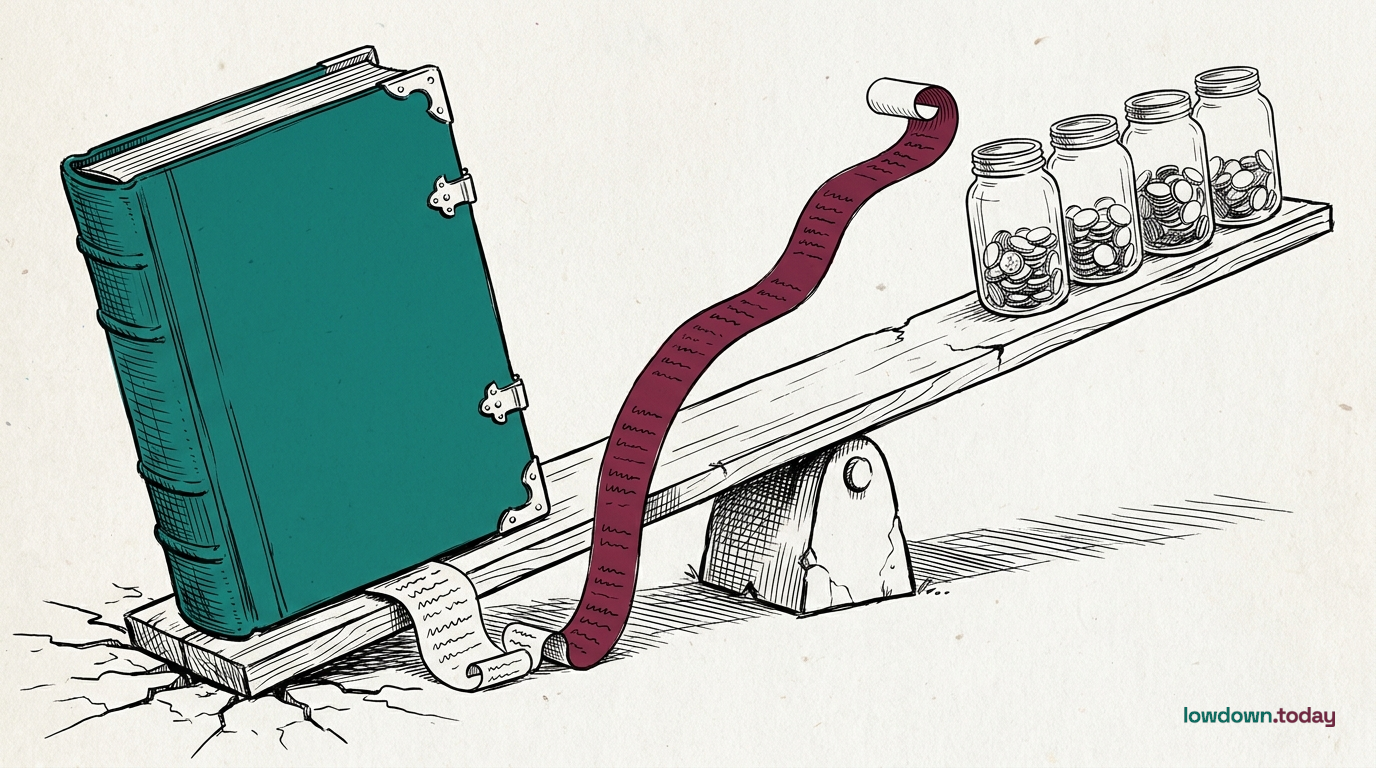
The IMF's tables, statistical appendix and DataMapper interface returned access errors across five URLs on two attempts, so this briefing publishes a G7 debt comparison with no British figure in it.

EconomicDeveloping
Key takeaway

A blank cell with a stated reason beats a plausible figure measuring the wrong thing.

The International Monetary Fund April 2026 World Economic Outlook puts general government gross debt at 204.4% of GDP in Japan, 138.4% in Italy, 125.8% in the United States, 118.4% in France, 110.7% in Canada and 64.6% in Germany⁠1. Germany is the only G7 member below 100%. Those six figures reach us through a secondary compilation of the IMF database rather than the IMF's own tables, which is a weaker provenance than every other cell in this briefing.

We left the British row blank on purpose. The IMF's tables, statistical appendix and DataMapper interface returned access errors across five separate URLs on two independent attempts this run, so we do not hold a UK figure on that standardised basis. The temptation is to reach for the 94.9% net debt figure the Office for National Statistics publishes and drop it in. That would be wrong twice over: public sector net debt is a different measure on a different definition, and general government gross debt already puts the UK above 100% on the IMF's convention. Two numbers in the same column measuring different things is the exact error this register was built to avoid, and a blank cell with a stated reason is more useful to a reader than a plausible wrong one.

Two British positions do stand out against that peer group, pointing in opposite directions. The average maturity of the gilt stock was 13.9 years at the end of December 2025, longer than the G7 average⁠2. Long maturities mean only a fraction of the debt has to be refinanced in any one year, so a buyers' strike would hurt Britain slowly rather than overnight, which is a genuine and underrated buffer. Against that, the UK carries the highest share of index-linked debt in the G7, the feature that blocks the inflation route out.

This briefing attempts no per-ledger international comparison, and later runs will not either. Section 114 notices, Office for Students returns and Regulator of Social Housing gradings have no foreign equivalents to compare against. The next run will try the IMF statistical appendix again; until then the cell stays empty.

Deep Analysis

In plain English

When comparing how much different countries owe, economists use a standardised measure called general government gross debt, tracked by the International Monetary Fund (IMF) so that every country is measured the same way. This is different from the UK's own headline figure, public sector net debt, which uses a different definition and cannot simply be swapped in. This week, the IMF's own website blocked every attempt to retrieve the UK's specific figure on that standardised basis, so this briefing reports Japan, Italy, the United States, France, Canada and Germany's figures but leaves the UK's blank rather than guess or substitute a different measure that would compare apples to oranges.

Deep Analysis
Root Causes

The IMF's World Economic Outlook database is the standardised source most cross-country debt comparisons rely on precisely because it applies one consistent methodology (general government gross debt) across member states, unlike each country's own domestic debt measure.

When that single source becomes technically unreachable, there is no equally authoritative substitute; a domestic figure like the UK's own PSND measure cannot simply be substituted, because it is not calculated on the same basis.

The access failure itself traces to standard web infrastructure (Akamai/edgesuite bot protection) applied to the IMF's domain, the kind of protection large institutional websites commonly deploy against automated scraping, which becomes a research obstacle specifically for anyone trying to fetch data programmatically rather than reading it manually in a browser.

What could happen next?
  • Risk

    Readers or other outlets substituting the ONS's 94.9% net-debt figure into an international gross-debt comparison table would be making a genuine category error, understating where the UK actually sits against G7 peers on the IMF's own convention.

First Reported In

Update #1 · The distress moved from banks to councils

Mappr· 27 Jul 2026
Read original →
Causes and effects
This Event
We left the UK row of the table empty
The obvious fix would be to drop Britain's 94.9% into the gap, and it would be a category error dressed up as completeness.
Different Perspectives
Conservative Party
Conservative Party
Leader Kemi Badenoch said Labour will run out of money and proposed lifting defence to 3% of GDP, paid for from welfare. Shadow work and pensions secretary Helen Whately put those savings at £23bn, "just the start".
Reform UK
Reform UK
Treasury spokesman Robert Jenrick pledged £80bn a year of spending cuts by the end of the next parliament and claimed £30bn a year of interest savings. The Spectator judged that the sums still do not fully add up.
Centre for Policy Studies
The right-of-centre think tank argued on 4 October that Britain is not a low-tax country once workplace pensions and student-loan repayments are counted. Its comparison rests on 2019 data.
Institute of Economic Affairs
The free-market think tank argued on 28 September that alcohol, tobacco and landfill duties raised £5.2bn less than the OBR projected. That comparison is separate from the five-month borrowing overshoot.
Resolution Foundation
The centre-left think tank said on 8 September that about £1 in every £12 of public spending now goes on debt interest. In July it put headroom against the fiscal rules at about £10bn.
Audit Scotland
Audit Scotland
It reported on 17 September that three Scottish budgets planned ScotWind drawdowns and drew nothing each time. It warned that using one-off receipts to balance annual budgets can weaken spending control.