Skip to content
Briefings are running a touch slower this week while we rebuild the foundations.See roadmap
Iran Conflict 2026
1MAY

Majlis approves Hormuz toll bill

2 min read
10:38UTC

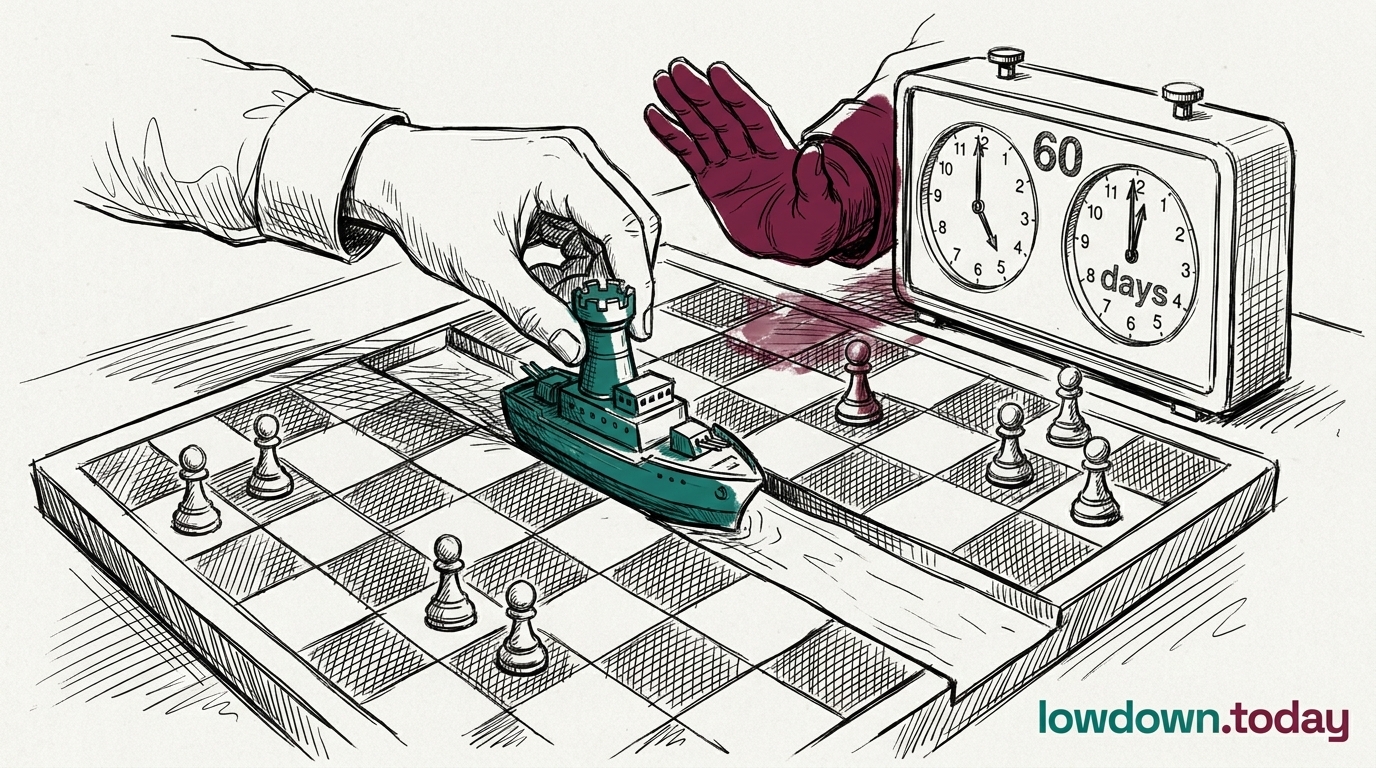
A key Majlis committee approved the Hormuz toll bill, advancing legislation that would permanently ban US and Israeli vessels and require fees in Iranian rial from all other shipping. Once codified, the toll becomes reversible only through domestic political process ; no future ceasefire can unwind it.

ConflictDeveloping
Key takeaway

Committee approval advances legislation that would make Hormuz's contested status a matter of Iranian domestic law, not merely military posture.

The Majlis committee approved the Hormuz toll legislation on 1 April, advancing a bill that permanently bans US and Israeli vessels from the strait and requires fees in Iranian rial from all other shipping. The bill had been drafted in parliament on Day 25, moved to committee stage on Day 32, and has now cleared committee. Full parliamentary vote, Guardian Council review, and presidential signature remain.

There is a fundamental difference between the IRGC imposing a toll because it controls a strait and the Iranian parliament enacting a law that makes the toll a statutory requirement. The first is a military fact reversible by military defeat. The second is a legal instrument reversible only by domestic political process. Iran had already demanded Hormuz sovereignty as a formal peace condition ; the legislation converts that negotiating demand into permanent law.

The bill bans US and Israeli vessels explicitly and requires fees in Iranian rial, forcing buyers to transact in a sanctioned currency. The NPT withdrawal bill is advancing on the same legislative track . Both bills are designed to survive any ceasefire: a ceasefire can stop the shooting, but it cannot repeal domestic Iranian legislation.

The IRGC's toll system had already been operating since around Day 12, with Chinese state ships paying and crossing . Codifying the practice into permanent law removes any ambiguity about whether a future Iranian government could unilaterally rescind it. If Trump withdraws in two to three weeks without securing this bill's reversal, the US leaves behind a legal architecture that makes Hormuz permanently contested.

Deep Analysis

In plain English

The Iranian parliament is voting on a law that would permanently charge ships money to use the Strait of Hormuz ; a narrow channel through which about one in five barrels of the world's oil passes. Right now, Iran is blocking the strait militarily during the war. This law would make that blockade permanent and legal under Iranian law, even after the war ends. American and Israeli ships would be banned outright. This matters because there is a big difference between Iran blocking the strait with soldiers, which can be reversed, and Iran blocking it with a law, which can only be reversed by Iran itself choosing to change the law.

Deep Analysis
Root Causes

The toll bill was drafted as a direct response to US and Israeli strikes on Iranian infrastructure . It converts an emergency military response into a permanent economic instrument, institutionalising the leverage Iran discovered it holds over global energy markets.

What could happen next?
  • Precedent

    First instance of a state attempting to codify transit fees for an international strait into domestic law, potentially triggering a global UNCLOS legal challenge.

    Long term · Assessed
  • Consequence

    A ceasefire that leaves the Hormuz toll law in place fails to address the economic cause of the oil price spike.

    Medium term · Assessed
  • Risk

    Guardian Council and presidential signature stages create multiple veto points, but each ratification stage makes repeal politically harder.

    Short term · Reported
First Reported In

Update #54 · Trump declares victory and withdrawal

ANI News· 1 Apr 2026
Read original
Different Perspectives
Oil markets
Oil markets
Brent fell $1.05 to $106.0 on summit Day 1 but remains $5-7 above the post-ceasefire equilibrium analysts modelled in March; the market is pricing a holding pattern, not a breakthrough. OilPrice.com and Aramco CEO Nasser converge on buffer-exhaustion before Hormuz reopens if the blockade extends past mid-June.
Iranian dissidents and human rights monitors
Hengaw documented a five-prison simultaneous execution cluster on 13 May, with Gorgan appearing for the first time in the wartime register. Espionage charges framed as Israel-linked moharebeh now extend across Mashhad, Karaj, and Gorgan, using the war as judicial cover for protest-era detainees.
BRICS / Global South
Araghchi's Delhi appearance positioned Iran as a victim of US aggression before non-Western foreign ministers, with Deputy FM Bagheri Kani calling on BRICS to act against US aggression. India, as the largest non-Chinese user of Iranian-routed crude, faces pressure to balance bloc solidarity against its own shipping and sanctions exposure.
China
China
Beijing accepted the Nvidia chip clearance on summit Day 1 and gave Rubio verbal acknowledgement of Iran as an Asian stability concern, having already put Pakistan on paper as the mediatory channel on 13 May (ID:3253), deflecting the US ask for direct Chinese action without refusing it.
Iran (government and civilian diplomatic track)
Araghchi denied any Hormuz obstruction at BRICS Delhi on 14 May while Iran's SNSC had finalised a Hormuz security plan the day before. Israel Hayom's single-sourced 15-year freeze offer gives Tehran a deployable figure in non-Western forums regardless of corroboration; the state attributed 3,468 wartime deaths with no independent verification.
United States (Trump administration and Senate moderates)
Trump signed a chip clearance for 10 Chinese firms on summit Day 1 and zero Iran instruments across 76 days; Rubio and Vance made verbal Iran asks without paper. Murkowski voted yes on the 49-50 war-powers resolution after Hegseth told the Senate that Article 2 makes an AUMF unnecessary.