Skip to content
Briefings are running a touch slower this week while we rebuild the foundations.See roadmap
Iran Conflict 2026
6APR

Pakistan pledges to continue mediating alone

1 min read
09:43UTC

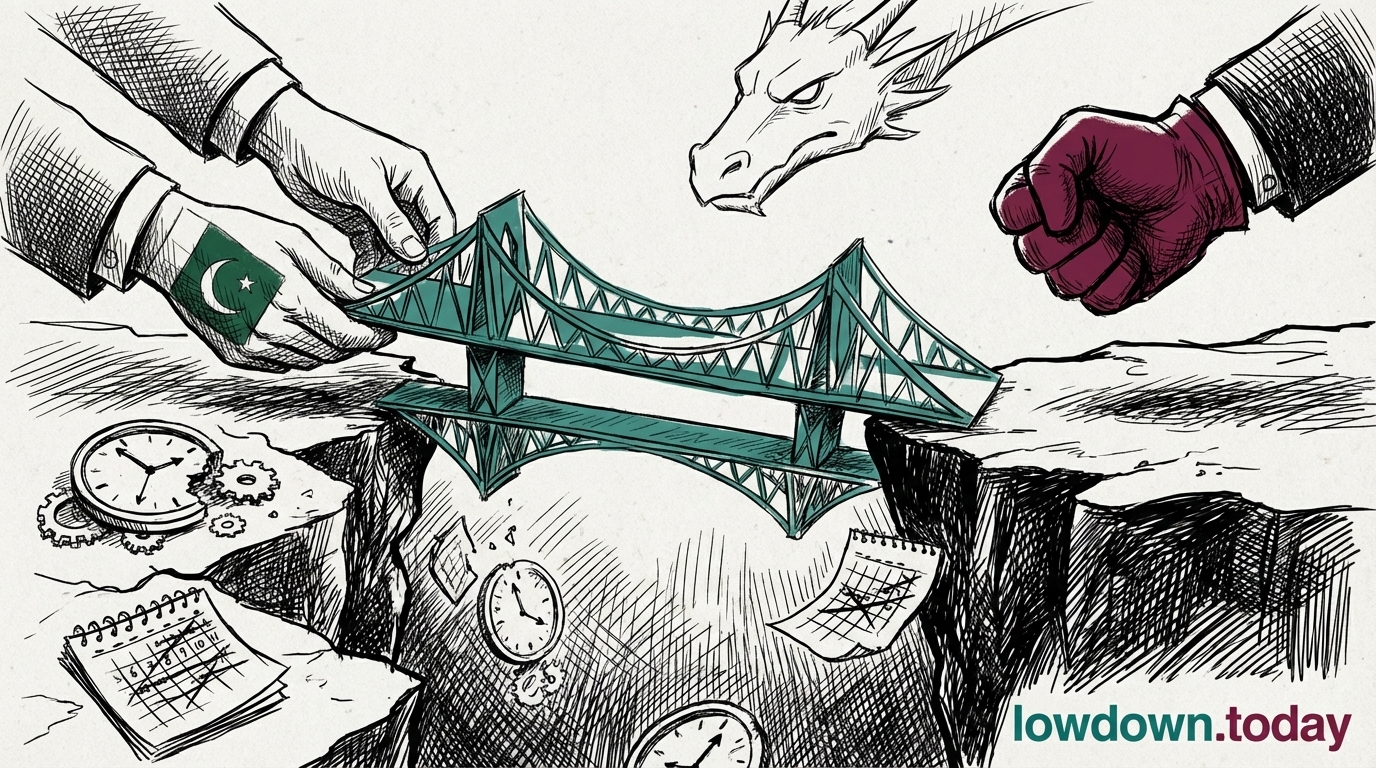
Deputy PM Ishaq Dar confirmed Pakistan will continue its mediator role despite the Islamabad breakdown.

ConflictDeveloping
Key takeaway

Pakistan holds the mediator role alone, with 10 days to produce a follow-up session.

Pakistan's Deputy Prime Minister Ishaq Dar confirmed on 12 April that Islamabad will continue mediating between the US and Iran despite the talks producing no agreement. Dar stated: "Islamabad has been and will continue" as mediator. Iran's Foreign Ministry signalled willingness to continue but proposed no date.

Pakistan hosted the talks by invoking the precedent of the 1988 Geneva Accords, when it hosted proximity negotiations between the Soviet Union and Afghanistan. Pakistani officials logged more than 25 high-level contacts in the days preceding the talks to arrange the format. Sessions shifted from proximity to direct, with Pakistani officials mediating in the room.

Vance's departure leaves Pakistan as the only state with an active claim to the mediator role. Oman, which facilitated earlier indirect channels, has not publicly offered to host a next round. Egypt relayed a truce offer in early April but has not been part of the Islamabad format. Pakistan now has roughly 10 days to produce a follow-up session before the ceasefire expires around 22 April.

Pakistan's neutrality took damage during the talks themselves. Defence Minister Khawaja Asif posted anti-Israel content on social media during the opening session , an unforced error that compromised the host country's image of impartiality. Whether that incident weakens Islamabad's standing as a future venue remains to be seen.


Deep Analysis

In plain English

Pakistan offered to host the talks and serve as a go-between because it has diplomatic relations with both the US and Iran, and because it wanted to establish itself as a regional power broker. After the talks failed to produce a deal, Pakistan's Deputy PM Ishaq Dar said his country would keep trying. The problem is that Pakistan's value as a mediator depends on being trusted by both sides. During the talks, Pakistan's Defence Minister posted on social media calling Israel 'a cancerous state'. Israel immediately said Pakistan could not be a neutral mediator. That controversy has not been resolved. Pakistan needs another round of talks to happen in Islamabad to prove the first round was not a one-off. If no second round is scheduled before the ceasefire expires, Pakistan's diplomatic investment is wasted.

What could happen next?
  • Consequence

    Pakistan's mediating credibility is contingent on producing a second round before the ceasefire expires; without a scheduled session, Islamabad's role as a diplomatic channel becomes a historical footnote rather than an active mechanism.

  • Risk

    The Pakistan Defence Minister's social media post calling Israel 'a cancerous state' remains unresolved; Netanyahu's office specifically stated Pakistan cannot be a neutral arbiter, which limits Islamabad's ability to serve as a venue if the US-Israel relationship constrains the format.

First Reported In

Update #66 · Islamabad collapses: 10 days to expiry

NPR· 12 Apr 2026
Read original
Causes and effects
This Event
Pakistan pledges to continue mediating alone
Pakistan is now the only active mediator with a stated commitment to continue, but its credibility depends on producing a follow-up session before the ceasefire expires.
Different Perspectives
Gulf shipping and insurance markets
With Hormuz and Bab el-Mandeb both hostile at once, war-risk underwriters face their first dual-chokepoint pricing problem; the rerouting hedge that absorbed one closure is gone for Israeli-linked hulls. Any deal that reopens Hormuz without a Houthi stand-down clause delivers only partial shipping relief.
Russia and China
Russia and China
Russia and China met IAEA chief Grossi jointly in Geneva on 5 June to coordinate an advance blocking position against Washington's censure resolution, the first documented instance of proactive pre-session obstruction rather than reactive post-vote dissent. Beijing's move came four days after OFAC designated Shanghai Qianye Energy under Iran energy sanctions.
Saudi Arabia
Saudi Arabia
Saudi Arabia was left out of the emergency $4.01 billion Patriot waiver Qatar received on 2 May as its own PAC-3 stocks ran near-empty from intercepting Iranian salvoes over Aramco facilities. Riyadh is on a standard 18-month FMS queue behind a production line booked through 2030, with no equivalent priority to Qatar's Al Udeid basing role.
Houthis (Ansar Allah)
The Houthis declared a complete ban on Israeli Red Sea navigation on 8 June and struck Jaffa, their first attack on Israeli territory since April, seven days after the Tasnim authorisation to activate other fronts including Bab el-Mandeb. The declaration put both chokepoints under hostile authority simultaneously.
Iran
Iran
Iran agreed the 9 June mutual halt after the Mahshahr exchange and coordinated with Russia and China to block Washington's IAEA censure resolution, using the Board as a second front while the bilateral pause held on the military one. Tehran's acceptance of the Lebanon carve-out contradicts the linkage position it stated on 1 June.
Benjamin Netanyahu and the IDF
Israel struck the Karun Petrochemical plant at Mahshahr on 8 June over Trump's explicit objection, then agreed a halt with Iran the following day scoped on Israeli terms with Lebanon carved out. Netanyahu's posture is that the IDF will not accept Iranian missile factories as off-limits regardless of US diplomatic timelines.



