Skip to content
Briefings are running a touch slower this week while we rebuild the foundations.See roadmap
Iran Conflict 2026
15MAR

Iran hits five KC-135s at Saudi base

3 min read
04:55UTC

An Iranian ballistic missile damaged five aerial refuelling aircraft at a Saudi base — the tankers that keep every US and Israeli strike sortie airborne over Iran and Lebanon.

ConflictDeveloping
Key takeaway

Iran targets US air logistics rather than aircrew, testing how much capability damage Washington will absorb.

An Iranian Ballistic missile struck Prince Sultan Air Base in Saudi Arabia, damaging five KC-135 Stratotanker aerial refuelling aircraft 1. No US personnel were killed. Trump claimed on Truth Social that four sustained "virtually no damage" and returned to service; one requires further repair 2.

KC-135s are not fighter jets. They are the refuelling fleet that keeps the air campaign running — every US and Coalition strike sortie over Iran and Lebanon depends on tankers to extend range and loiter time. The US Air Force operates roughly 400 KC-135s, with an average airframe age exceeding 60 years. The KC-46 Pegasus replacement programme, built by Boeing, has been delayed repeatedly and produces aircraft far below the replacement rate. Each tanker grounded compresses the aerial refuelling orbits, thinning sortie schedules.

This is the second KC-135 incident in one week. On Thursday, a tanker crashed near the Jordanian border, killing all six crew — the deadliest single US loss of the conflict . CENTCOM attributed that crash to non-hostile causes; Iraqi militias claimed responsibility without evidence. Two losses from the same airframe type in seven days, at a point when Israel's planned ground offensive south of the Litani demands heavier close air support and increased refuelling capacity.

Defence Secretary Hegseth claimed Friday that Iran's missile volume was down 90% . The strike on Prince Sultan — deep in Saudi territory — required a ballistic trajectory Iranian forces clearly retain. The Wall Street Journal, which broke the story, reported five aircraft damaged without specifying severity for each 3. Whether four genuinely returned to service, as Trump asserts, or the damage is more extensive, has direct consequences for a campaign entering its most demanding phase.

Deep Analysis

In plain English

KC-135s are the flying petrol stations of the US air campaign. Fighter jets cannot reach Iran or Lebanon from distant bases without mid-air refuelling. By disabling these tankers rather than attacking combat aircraft directly, Iran degrades how many strike sorties the US can fly each day — without killing American pilots in a way that might compel a massive US counter-strike. Iran appears to be calculating that Washington will absorb equipment losses it would not absorb personnel losses.

Deep Analysis
Synthesis

Two KC-135 losses in one week — one to enemy action, one to accident — reveal compounding fragility in the US tanker fleet at the moment Israel's Lebanon operation demands a sortie surge. The fleet averages 62 years of service; the KC-46 replacement programme has delivered fewer than 70 aircraft against a 179-unit contract, with persistent Remote Vision System defects. Targeting tankers rather than fighters is strategically elegant: it degrades campaign tempo without providing a politically compelling casus belli for massive retaliation.

Root Causes

Prince Sultan Air Base was selected as the primary US air hub in 2019 partly because its distance from Yemen placed it outside credible Houthi range. That security calculation assumed the threat envelope of 2019. The IRGC's Emad and Ghadr precision ballistic missiles — whose circular error probable has improved markedly since 2020 — have invalidated it. Iran invested a decade in exactly this capability: holding US regional basing at risk without nuclear escalation.

Escalation

The strike's precision — disabling aircraft without fatalities — suggests deliberate calibration to remain below US retaliation thresholds. However, compound tanker attrition from both enemy action and the Jordan crash creates pressure on operational planners. If sortie rates over Lebanon or Iran fall measurably, the US faces a binary choice: accept degraded campaign effectiveness, or escalate against IRGC launch sites in a way that risks broadening the war's geographic scope.

What could happen next?
  • Risk

    Compound tanker attrition — enemy strike plus accidental crash — reduces daily sortie capacity over Iran and Lebanon during the critical Lebanon operation phase.

    Immediate · Assessed
  • Consequence

    Two KC-135 incidents in one week intensify scrutiny of the aged fleet's wartime sustainability and the persistently delayed KC-46 replacement programme.

    Short term · Assessed
  • Precedent

    Successful precision strikes on US air logistics assets, without crossing the fatality threshold, may encourage similar targeting calculus by other adversaries in future conflicts.

    Long term · Suggested
  • Risk

    If tanker availability materially constrains the Lebanon operation, the US faces pressure to escalate against IRGC launch sites — broadening the conflict's geographic scope.

    Short term · Suggested
First Reported In

Update #36 · Israel plans full Litani seizure

Times of Israel· 15 Mar 2026
Read original
Different Perspectives
Gulf shipping and insurance markets
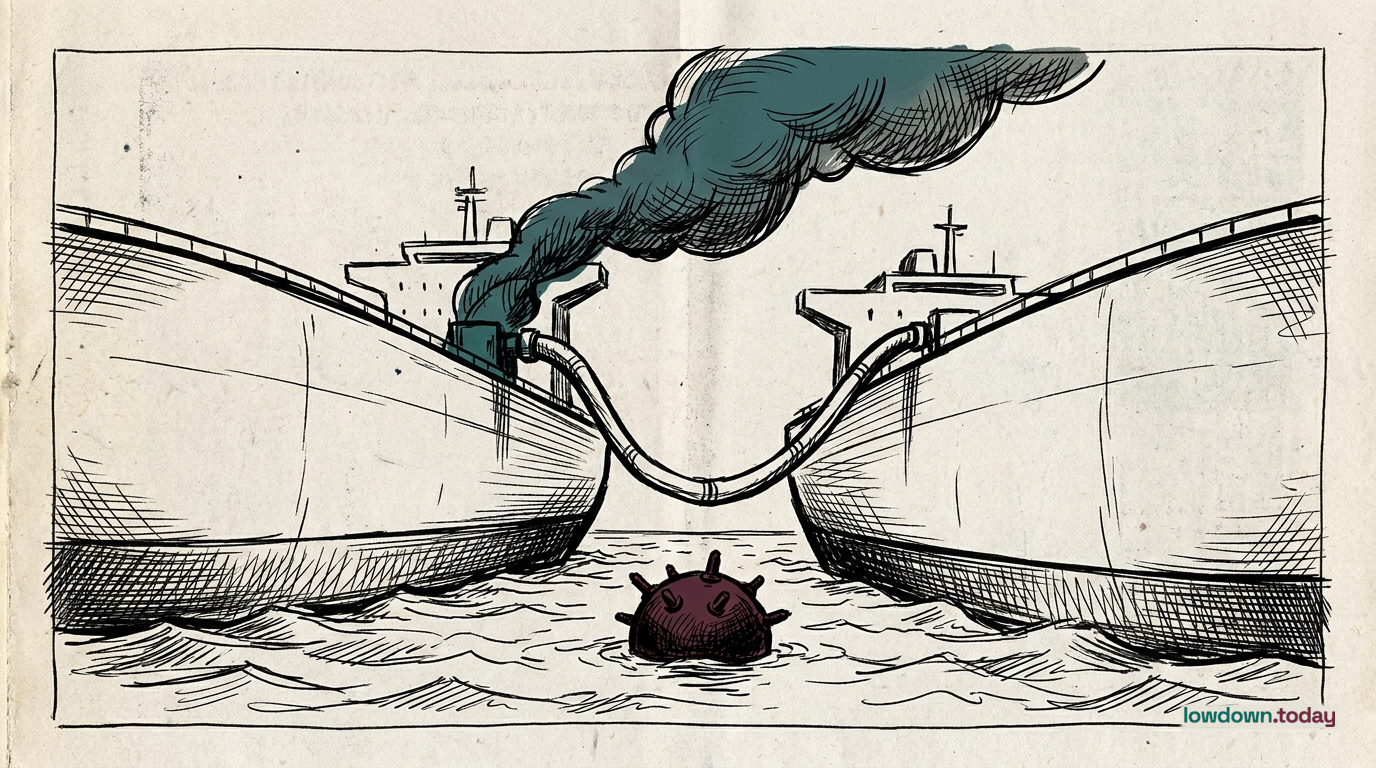
With Hormuz and Bab el-Mandeb both hostile at once, war-risk underwriters face their first dual-chokepoint pricing problem; the rerouting hedge that absorbed one closure is gone for Israeli-linked hulls. Any deal that reopens Hormuz without a Houthi stand-down clause delivers only partial shipping relief.
Russia and China
Russia and China
Russia and China met IAEA chief Grossi jointly in Geneva on 5 June to coordinate an advance blocking position against Washington's censure resolution, the first documented instance of proactive pre-session obstruction rather than reactive post-vote dissent. Beijing's move came four days after OFAC designated Shanghai Qianye Energy under Iran energy sanctions.
Saudi Arabia
Saudi Arabia
Saudi Arabia was left out of the emergency $4.01 billion Patriot waiver Qatar received on 2 May as its own PAC-3 stocks ran near-empty from intercepting Iranian salvoes over Aramco facilities. Riyadh is on a standard 18-month FMS queue behind a production line booked through 2030, with no equivalent priority to Qatar's Al Udeid basing role.
Houthis (Ansar Allah)
The Houthis declared a complete ban on Israeli Red Sea navigation on 8 June and struck Jaffa, their first attack on Israeli territory since April, seven days after the Tasnim authorisation to activate other fronts including Bab el-Mandeb. The declaration put both chokepoints under hostile authority simultaneously.
Iran
Iran
Iran agreed the 9 June mutual halt after the Mahshahr exchange and coordinated with Russia and China to block Washington's IAEA censure resolution, using the Board as a second front while the bilateral pause held on the military one. Tehran's acceptance of the Lebanon carve-out contradicts the linkage position it stated on 1 June.
Benjamin Netanyahu and the IDF
Israel struck the Karun Petrochemical plant at Mahshahr on 8 June over Trump's explicit objection, then agreed a halt with Iran the following day scoped on Israeli terms with Lebanon carved out. Netanyahu's posture is that the IDF will not accept Iranian missile factories as off-limits regardless of US diplomatic timelines.