Skip to content
Briefings are running a touch slower this week while we rebuild the foundations.See roadmap
Iran Conflict 2026
7MAR

Brent at $85 as Hormuz stays shut

3 min read
07:34UTC

Brent crude has risen more than 16% since strikes began, and OPEC+'s production increase covers barely 1% of the strait's normal flow.

ConflictDeveloping
Key takeaway

The relative containment of crude prices is itself a signal — markets are betting on a short conflict, and that bet has no verified factual basis beyond a presidential statement.

Brent Crude rose to $85–90 per barrel, up from approximately $73 before the campaign — a rise of 16 to 23 per cent in three days. The price had opened at $82.37 on 1 March and has climbed steadily as the strait of Hormuz closure enters its fourth day. Gold held at a record $5,362 per ounce . Dow futures fell 300 points and the Nikkei dropped 2% .

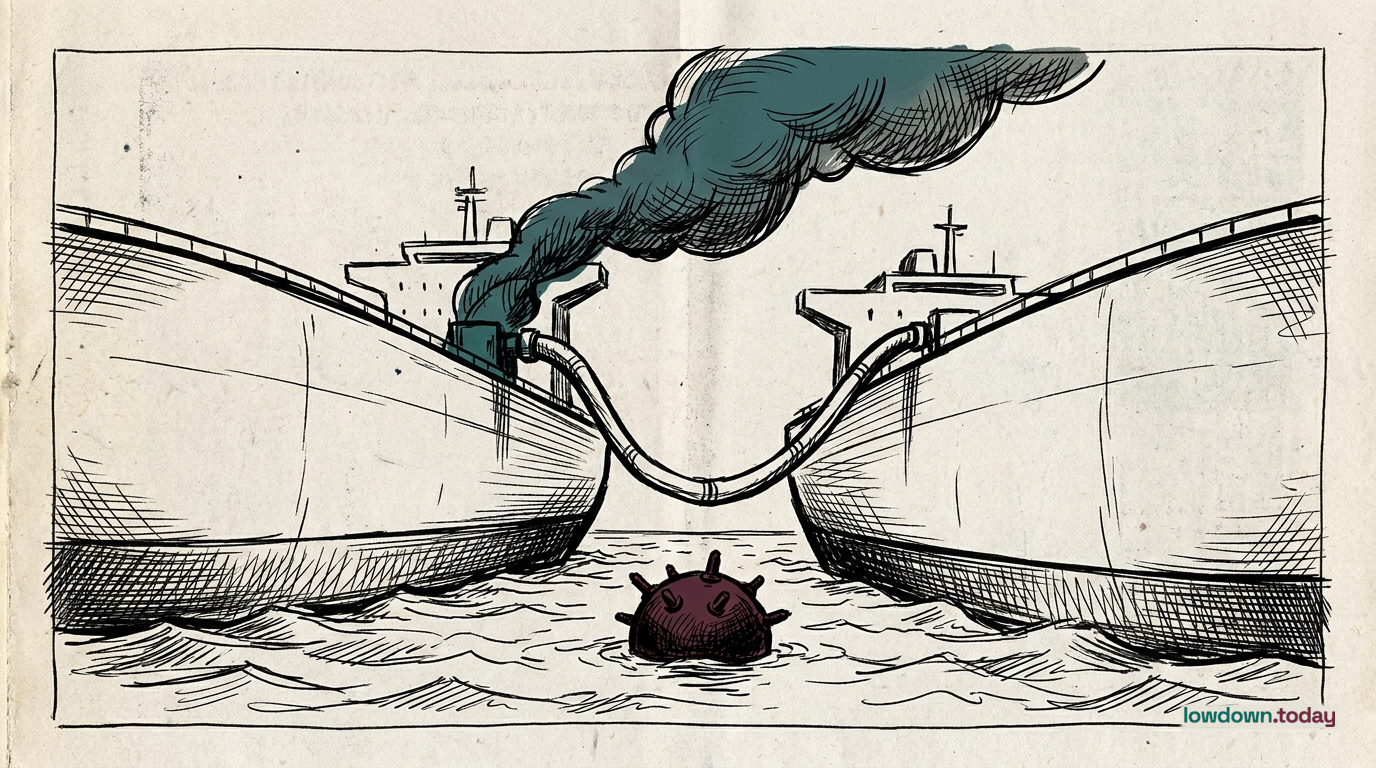
The driver is physical, not speculative. Vessel traffic through the strait has fallen 70 per cent , with more than 150 tankers anchored in open Gulf waters. CMA CGM, Maersk, and four other major carriers have suspended all transits . Roughly 20 million barrels per day normally pass through — one-fifth of the world's traded oil. OPEC+'s 220,000 barrel-per-day increase replaces 1.1 per cent of that volume.

Goldman Sachs projects oil averaging $98 near-term, rising to $110 in a high-disruption scenario. JPMorgan forecast $120–130 if prolonged . Goldman raised its US recession probability estimate to 25%; prediction market Kalshi briefly priced it at 35%. JPMorgan Asset Management identified a sustained Hormuz closure as the variable separating a contained price shock from a supply crisis reaching European and Asian consumers.

The 1973 Arab oil embargo — the closest historical precedent to a sustained Gulf supply disruption — quadrupled oil prices over six months and triggered a global recession. The critical variable then was not the initial spike but duration. At $85–90, the market is pricing in a resolution. Goldman and JPMorgan are pricing in the possibility that one does not come.

Deep Analysis

In plain English

Oil prices jumped roughly 20% in a few days, which sounds alarming but is actually smaller than many analysts expected given the world's most critical oil shipping lane is nearly shut. The reason prices are not higher is that traders appear to believe the conflict will end quickly, partly anchored to Trump's 'four weeks or less' comment. If that timeline slips, expect a second, steeper price jump — the first move was markets pricing duration, the second would be markets pricing failure.

Deep Analysis
Synthesis

The spread between current price ($85–90) and Goldman's high-disruption scenario ($110) implicitly encodes the market's probability-weighted estimate of closure duration — roughly a 30–40% chance of extended disruption. This spread is the single most liquid real-time indicator of conflict duration expectations and will move faster than any intelligence assessment.

Root Causes

The UAE's Habshan–Fujairah bypass pipeline — the only meaningful Hormuz alternative — maxes out at approximately 1.5 million barrels per day against roughly 20 million transiting the strait. Decades of underinvestment in non-Hormuz infrastructure means the chokepoint has no material bypass capacity, so the price impact of closure is entirely duration-dependent.

Escalation

Prices are floor-testing rather than ceiling-testing at the current range. The $85–90 band reflects optimistic duration assumptions; if Hormuz stays closed beyond 14 days, the structural supply deficit (~18 million barrels per day of missing flow) reasserts and the Goldman $110 high-disruption scenario becomes the base case rather than a tail risk.

What could happen next?
  • Meaning

    Markets are pricing Trump's 'four weeks or less' timeline as credible — the price level is a duration bet, not a supply-shock assessment.

    Immediate · Assessed
  • Risk

    A second, sharper price dislocation follows if the conflict duration exceeds market expectations, with no structural buffer between current prices and the $110–130 range.

    Short term · Suggested
  • Consequence

    Import-dependent economies — particularly South Asia, East Africa, and Southeast Asia — face immediate inflationary pressure on food and transport, sectors with limited price absorption capacity.

    Short term · Assessed
  • Opportunity

    US domestic shale producers and tanker-owning companies are structural beneficiaries of elevated prices combined with Hormuz disruption.

    Short term · Assessed
First Reported In

Update #9 · IRGC HQ destroyed; Britain quits coalition

Euronews· 2 Mar 2026
Read original
Causes and effects
This Event
Brent at $85 as Hormuz stays shut
The price reflects a physical supply blockage — vessel traffic down 70%, all major carriers suspended — not speculative positioning, and the gap between $85–90 and bank forecasts of $98–130 measures the market's remaining assumption that the Hormuz closure will be resolved quickly.
Different Perspectives
Markets
Markets
Brent crude rose 2.2 per cent to $96.34 on 10 June, reversing a 7 per cent weekly decline built on deal optimism, as the overnight exchange repriced the Strait of Hormuz risk premium in a single session. The move reflects transit-risk repricing rather than supply shock: Iran's exports had already collapsed to below 300,000 barrels per day.
Pakistan
Pakistan
Pakistan's Naqvi channel, the only mediation track carrying both civilian and military buy-in, was stress-tested by live ordnance within 48 hours of the 6-7 June Tehran visit. Whether Washington informed Islamabad of the imminent strike plan while Naqvi was in Tehran remains undisclosed, putting the channel's neutrality under scrutiny.
Kuwait
Kuwait
Kuwait hosted the third Iranian strike on its soil since the 3 June airport drone attack, with Ali Al Salem airbase targeted in the three-country salvo. Its recent $1.98 billion Anduril Anvil counter-drone purchase signals it is rearming rather than reconsidering its hosting posture.
Bahrain
Bahrain
Bahrain absorbed the IRGC barrage via PAC-3 intercepts with its magazine already at 87 per cent depletion and no resupply before 2027. Sounding air-raid sirens over Manama, it faced the intercept burden with the thinnest defensive stack in the Gulf coalition.
Jordan
Jordan
Jordan reported all five incoming missiles intercepted with no injuries and no damage, a clean defensive performance that strengthens Amman's case for staying in the Western coalition without escalating its own posture. It now sits on Iran's target list for the first time despite not being a party to the Abraham Accords confrontation.
Iran / IRGC
Iran / IRGC
Foreign Minister Araghchi posted on X that US forces should 'leave our region if you want to be safe' and framed the exchange as a US defeat, while the IRGC claimed 21 targets hit and an F-35 hangar destroyed. The claims serve a domestic and Arab-audience framing rather than a verified battle-damage assessment.