Skip to content
You can now search across every topic, entity and event.What's new
Iran Conflict 2026
23AUG

Trading desks stretch to 21-hour days

2 min read
19:02UTC

European energy trading hours have more than doubled from 10 to 21 hours as volatility forces round-the-clock coverage.

ConflictDeveloping
Key takeaway

Trading hours doubled to 21 per day; bank forecasts diverge by EUR 30/MWh on Hormuz timing.

European gas and power trading hours are extending from 10 to 21 hours per day, according to Bloomberg, a structural adaptation to sustained market volatility. The extension reflects the reality that price-moving events (Hormuz threats, ceasefire announcements, force majeure declarations) arrive outside traditional European trading hours, and desks that are not staffed miss the move.

Standard Chartered forecast TTF could breach the EUR eighty mark if the conflict remains unresolved at summer injection start. Goldman Sachs forecast Q2 TTF at EUR 50/MWh, but that assumes Hormuz normalisation by mid-April, an assumption already overtaken by events. That forecast gap captures the market's fundamental uncertainty: whether the strait reopens in weeks or months is the single variable that separates a manageable injection season from another winter of extreme price spikes.

Deep Analysis

In plain English

European gas and electricity traders are now working much longer days. The markets that allow energy companies, utilities, and industrials to buy and sell gas and power have extended their operating hours from 10 to 21 hours per day. This is because prices are moving so sharply, driven by news about the Hormuz disruption, that participants need more time to respond and manage their risk positions. Standard Chartered bank thinks prices could reach EUR 80/MWh if the disruption continues into summer. Goldman Sachs predicted EUR 50/MWh, but its forecast assumed Hormuz would normalise by mid-April, which has not happened.

Deep Analysis
Root Causes

The shift from 10 to 21 hours of trading reflects a practical response to a structural change in the volatility regime: when geopolitical events can move prices by EUR 5-10/MWh in a single session, and those events arrive on Middle Eastern time zones (which are 2-4 hours ahead of European market open), market participants face unhedgeable overnight gap risk under a 10-hour trading window.

Extended hours reduce the overnight gap risk by allowing participants to react to news as it emerges, but they also require 24-hour desk coverage for energy trading operations, increasing operational costs for smaller trading firms and potentially concentrating market activity among larger participants with the infrastructure to maintain extended desks.

What could happen next?
  • Risk

    Goldman Sachs's EUR 50/MWh Q2 forecast was conditioned on Hormuz normalisation by mid-April. With that deadline passed, a Goldman forecast revision upward would signal that consensus market expectations are moving toward the Standard Chartered EUR 80+/MWh scenario.

  • Consequence

    Extended trading hours concentrate market-making capacity among larger institutions, potentially reducing liquidity during off-peak trading windows and widening bid-ask spreads for smaller energy buyers.

First Reported In

Update #1 · Europe's thinnest gas cushion since 2018

Bloomberg· 13 Apr 2026
Read original
Causes and effects
This Event
Trading desks stretch to 21-hour days
The operational shift from 10 to 21-hour trading days is a structural adaptation that increases staffing costs and operational risk across every European energy trading desk.
Different Perspectives
Hizballah
Hizballah
Has not commented on the US Treasury's 20 August designation of ten people, including named couriers, over a cash network Treasury says moved money to it from the IRGC-Qods Force. ACLED recorded a sharp rise in attacks around it the same day.
Kuwait
Kuwait
Kuwait's Chief of the General Staff, Lieutenant General Khaled al-Shriaan, co-chaired the 16th US-Kuwait Joint Military Commission at the Pentagon on 21 August. Kuwait has not published what was agreed; only a summary of the meeting's existence and attendees is sourced.
Qatar
Qatar
Has not commented publicly on the $4.5bn KC-46A tanker Foreign Military Sale notification the State Department approved on 20 August. The notification opens a sale process; Doha has not confirmed whether it will proceed to a signed transfer.
Mohammad Bagher Ghalibaf
Told a Baghdad business meeting on 20 August that Iran will not endure a hungry population regardless of its military strength, against 87.9% point-to-point inflation and 128.1% food inflation for Tir. His fellow Majlis Economic Committee member Samsami separately warned a petrol price rise would ignite unrest.
US Navy
US Navy
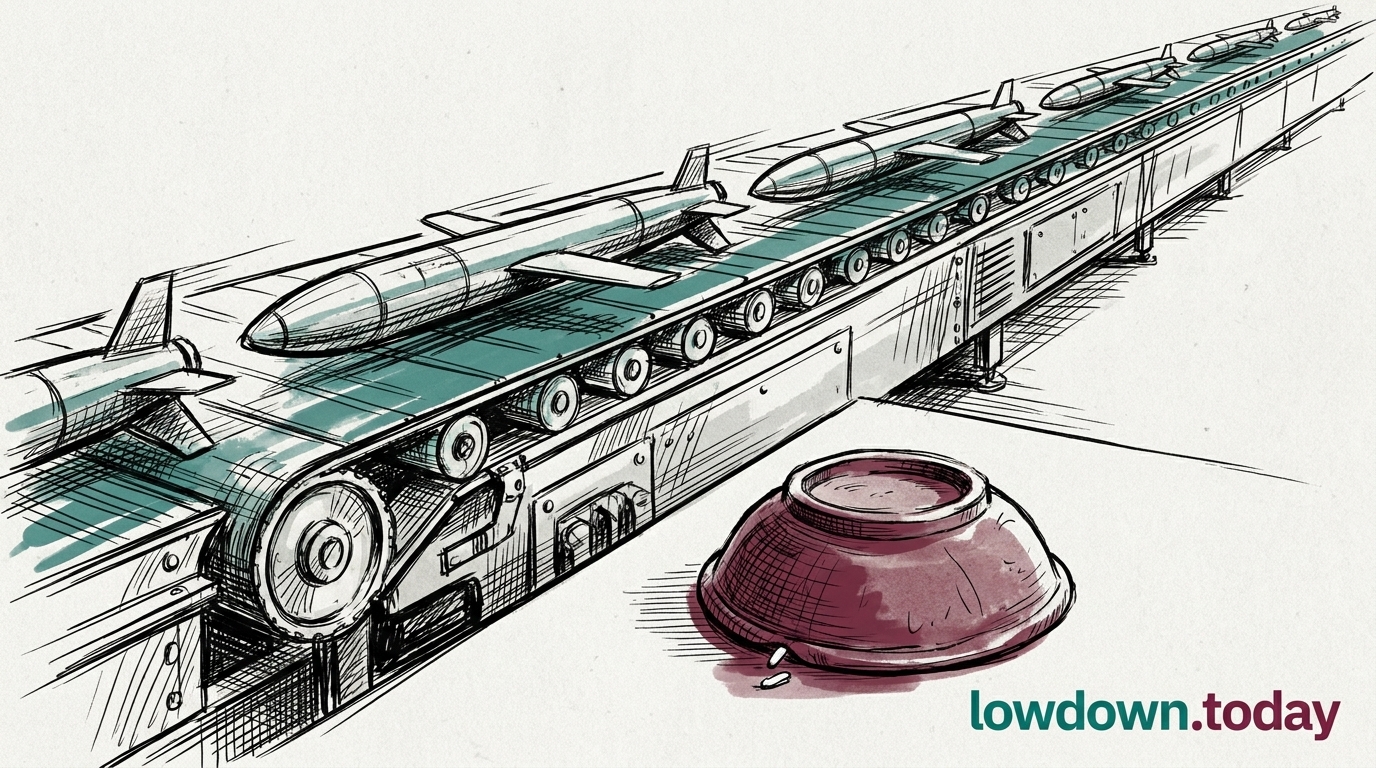
Signed a $22.9bn, seven-year contract with Raytheon on 17 August to raise Tomahawk output from about 60 a year to more than 1,000. The Acting Navy Secretary, quoted via an X post, framed it as the "Arsenal of Freedom" initiative; it replaces the 850 missiles fired by 1 April in about ten months at the new rate.
UK Maritime Trade Operations
UKMTO logged six armed men boarding a tanker 136 nautical miles east of Al Mukalla on 20 August and redirecting it toward Somalia. A vessel steered toward the Somali coast reads as an attempted seizure, a distinct hazard from the stand-off strikes the same lane has seen before.