Skip to content
You can now search across every topic, entity and event.What's new
Iran Conflict 2026
23AUG

Brent's worst month since the Covid crash

3 min read
19:02UTC

Brent Crude settled at $92.05 on Friday 29 May, down more than 19% across the month, its steepest monthly fall since the March 2020 Covid crash, on deal optimism alone.

ConflictDeveloping
Key takeaway

Futures and war-risk insurers read the same war apart: oil down nearly a fifth, yet Lloyd's unchanged.

Brent Crude settled at $92.05 per barrel on Friday 29 May, down more than 19% across May, its steepest monthly fall since the March 2020 Covid crash 1. That is roughly $20 below the $112.10 peak of Monday 18 May, a drop booked in 11 trading sessions, the fastest repricing of the conflict. WTI (West Texas Intermediate), the US oil benchmark, closed near $87.86.

The fall came on diplomatic optimism alone, with no instrument signed. Brent is the global price benchmark for two-thirds of traded crude, so the relief at the pump rests on a deal that could still collapse.

Two markets are reading the same war and pricing it apart. Futures price the probability of a signed page, and traders have bet heavily on one arriving. War-risk underwriters require the page itself. Lloyd's of London has still not de-listed Hormuz from its war-risk register, holding the divergence it opened when Brent first broke $100 .

When Iranian state television aired draft terms on Wednesday 27 May, Brent briefly touched a sub-$95 low before a White House denial reversed it . Friday's settle went lower and stayed there. The deal-optimism premium is unhedged against an unsigned outcome, so a collapse would reverse the move faster than the original war spike built it.

Deep Analysis

In plain English

Brent crude is the main global oil price benchmark, used to set the cost of petrol, diesel, and heating oil worldwide. In May 2026 it fell more than 19%, its steepest monthly drop since March 2020 when Covid stopped most economic activity. Traders became optimistic about a deal to reopen the Strait of Hormuz, pushing prices down. Trump walked out of his Situation Room meeting without signing it. Lloyd's of London, which insures ships sailing through the strait, kept its 'war-risk' designation in place: that designation requires shipping companies to pay tens of millions of dollars in extra insurance per voyage. Lloyd's changes that designation only when a government certifies the area is safe, not when traders feel optimistic. The result is a $20 gap between what futures markets think and what shipping insurers think.

Deep Analysis
Root Causes

Brent's 19% monthly fall reflects a single pricing event: the market's belief, from 27 May, that a Hormuz reopening was days away. Oil futures markets reprice on probability estimates, not on signed documents. The $20 fall in 11 sessions is the market assigning roughly 70-80% probability to a near-term deal, based on the volume of diplomatic signals and the public statements from both sides.

Lloyd's and the futures market diverge because they face different update mechanisms. A futures desk resets its position in milliseconds on a headline. A Lloyd's Joint Hull Committee changes its war-risk designation on a quarterly review cycle, requiring physical evidence of changed security conditions, not optimistic commentary. The two institutions are pricing the same strait but on entirely different information-update schedules.

What could happen next?
  • Risk

    A deal collapse reprices Brent from $92 toward $110-$115 with no hedging floor in place, as the entire $20 fall was deal-optimism premium rather than supply recovery.

  • Consequence

    European hauliers and airline fuel desks that locked forward contracts during the $92-$95 window face margin exposure if the kinetic track resumes.

First Reported In

Update #113 · Trump signs nothing as a Hellfire hits a hull

CNBC· 31 May 2026
Read original
Different Perspectives
Hizballah
Hizballah
Has not commented on the US Treasury's 20 August designation of ten people, including named couriers, over a cash network Treasury says moved money to it from the IRGC-Qods Force. ACLED recorded a sharp rise in attacks around it the same day.
Kuwait
Kuwait
Kuwait's Chief of the General Staff, Lieutenant General Khaled al-Shriaan, co-chaired the 16th US-Kuwait Joint Military Commission at the Pentagon on 21 August. Kuwait has not published what was agreed; only a summary of the meeting's existence and attendees is sourced.
Qatar
Qatar
Has not commented publicly on the $4.5bn KC-46A tanker Foreign Military Sale notification the State Department approved on 20 August. The notification opens a sale process; Doha has not confirmed whether it will proceed to a signed transfer.
Mohammad Bagher Ghalibaf
Told a Baghdad business meeting on 20 August that Iran will not endure a hungry population regardless of its military strength, against 87.9% point-to-point inflation and 128.1% food inflation for Tir. His fellow Majlis Economic Committee member Samsami separately warned a petrol price rise would ignite unrest.
US Navy
US Navy
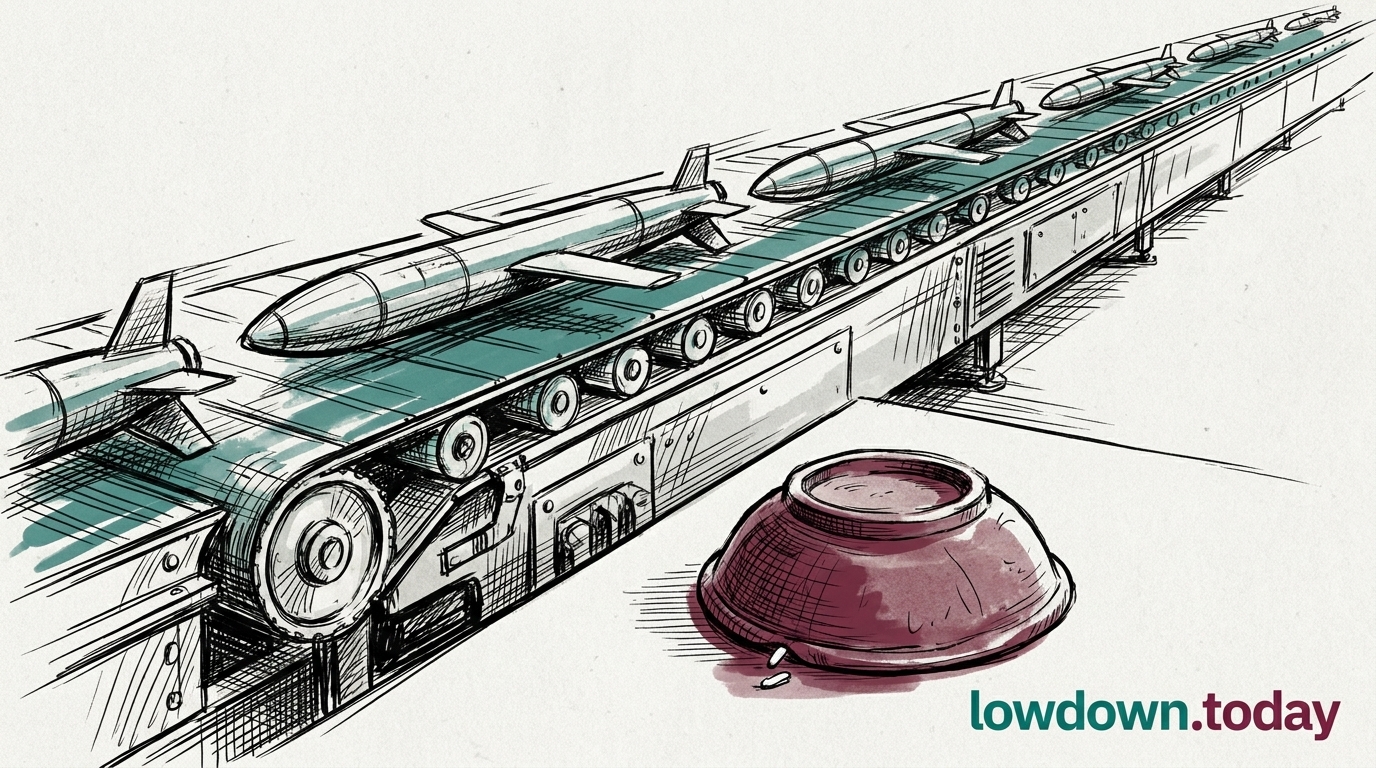
Signed a $22.9bn, seven-year contract with Raytheon on 17 August to raise Tomahawk output from about 60 a year to more than 1,000. The Acting Navy Secretary, quoted via an X post, framed it as the "Arsenal of Freedom" initiative; it replaces the 850 missiles fired by 1 April in about ten months at the new rate.
UK Maritime Trade Operations
UKMTO logged six armed men boarding a tanker 136 nautical miles east of Al Mukalla on 20 August and redirecting it toward Somalia. A vessel steered toward the Somali coast reads as an attempted seizure, a distinct hazard from the stand-off strikes the same lane has seen before.