Skip to content
Briefings are running a touch slower this week while we rebuild the foundations.See roadmap
Iran Conflict 2026
11JUN

Trump extends grid deadline to 6 April

2 min read
09:17UTC
ConflictDeveloping

President Trump extended the deadline for strikes on Iran's power grid to 6 April, the third such extension since his original 48-hour ultimatum, according to Bloomberg. 1 Trump cited three reasons: an Iranian government request, 10 oil tankers allowed through Hormuz as a 'present,' and progress in Pakistan-mediated indirect talks. The original deadline of 25 March was extended once before reaching the current April 6 date.

The tanker claim requires scrutiny. The vessels Trump described as an Iranian diplomatic gesture appear to be Pakistani-flagged ships already in the 'friendly nation' category that Iran established under its own vetting system weeks earlier . Iran has neither confirmed nor denied granting any special concession to Trump. Earlier, Iran had declared Hormuz closed to US-linked vessels while allowing transit to countries including India, Pakistan, Iraq, Malaysia, and China . Pakistani-flagged ships transiting was not a new Iranian concession; it was Iran's existing policy applied to Pakistan's existing fleet.

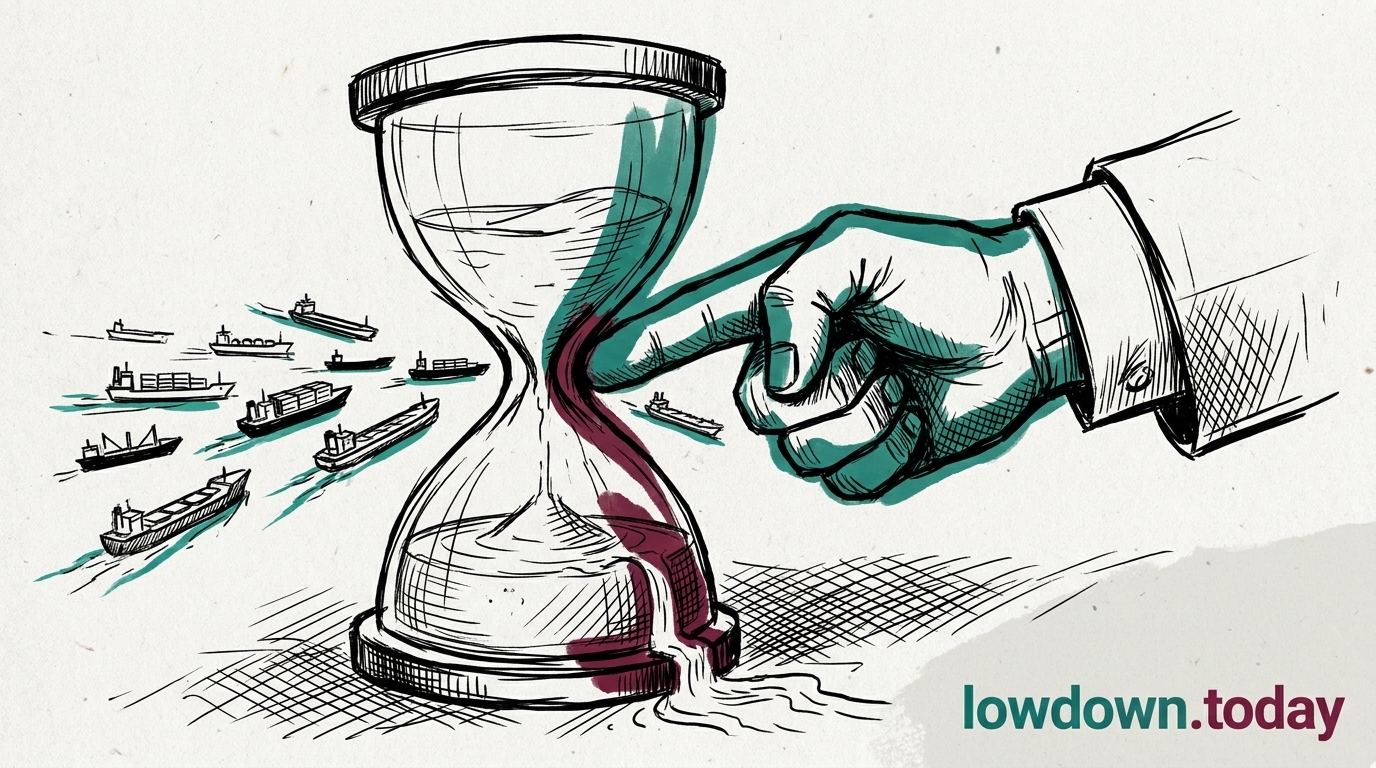
After three postponements in five days, Iran has learned that deadlines are suggestions. The credibility of the threat deteriorates with each extension because the pattern has been demonstrated: Trump sets a deadline, claims an Iranian gesture whether or not Iran acknowledges making one, and extends. Markets have largely repriced this pattern: Brent Crude fell 10.9% on the first talks announcement but has since stabilised as each deadline passes without result. The April 6 deadline arrives against a backdrop of Bushehr nuclear construction suspended , the Philippines in national energy emergency , and US gasoline at $3.98 per gallon .

Deep Analysis

In plain English

Trump set a deadline to bomb Iran's power stations if it did not reopen the Strait of Hormuz. That deadline passed. He set a new one. That one passed too. Now there is a third deadline on 6 April. Each time he has credited Iran with making some kind of gesture, but Iran has not confirmed making any. The problem is that the more times you set a deadline and do not follow through, the less seriously anyone takes the next deadline. Iran has now seen three deadlines come and go, which gives it good reason to believe 6 April will also pass without the strike.

Deep Analysis
Root Causes

The structural dilemma is that power grid strikes would trigger Iranian retaliatory strikes on Gulf desalination and energy infrastructure, as explicitly threatened by the Khatam al-Anbiya Central Headquarters in March.

The administration cannot follow through without accepting consequences it is not positioned to absorb. But each extension teaches Iran that the threat has no teeth.

First Reported In

Update #49 · Hormuz toll into law; Tangsiri killed

NPR / Houston Public Media· 27 Mar 2026
Read original
Different Perspectives
Oil markets and Lloyd's of London
Brent fell to $89.25 on ceasefire probability, not new barrels, with traders voting for Trump's deed over Tehran's denial. Lloyd's has not repriced Hormuz war-risk cover because its trigger requires a UN Security Council resolution or government certification, so tanker insurance costs remain elevated regardless of the spot move.
Pakistan and Qatar mediators
Pakistan's Mohsin Naqvi was in Tehran for his second visit in under a week, using the Pakistan-Qatar channel that delivered April's ceasefire after an identical public-denial cycle. The channel carries both civilian and military buy-in from Islamabad, the only configuration Iran's split command cannot dismiss as a partial signal.
India
India
India summoned the US Deputy Chief of Mission after three Indian sailors were killed aboard MT Settebello, the first formal grievance from a major non-belligerent directed at US enforcement. Indian seafarers supply roughly 12 per cent of the global maritime workforce; their presence on third-flag Gulf tankers is structurally inevitable regardless of bilateral diplomacy.
Islamic Revolutionary Guard Corps (IRGC)
The IRGC declared Hormuz closed on 11 June while civilian negotiators were on the same mediation channel, then issued no public comment on the MoU framework. Its silence on the framework, rather than any foreign ministry statement, is the operative approval signal; the corps' unilateral Hormuz closure shows it did not treat the diplomatic track as binding on its operations.
Iran foreign ministry (Baghaei)
Esmail Baghaei told IRNA that reports of a finalised deal were 'merely speculation' and that Iran had 'not yet made a final decision'. The denial is structurally identical to Iranian foreign ministry statements during the April ceasefire talks, which produced a binding text within 48 hours of the same language.
Trump administration / CENTCOM
Trump cancelled the third strike day and called the MoU 'very strong' and almost ready to sign, while CENTCOM kept tanker enforcement running in the same 24-hour window. The administration is simultaneously withdrawing the military pressure it claims drove the deal and sustaining the enforcement campaign it is trying to trade away.