Skip to content
Foundations rebuilt, and the first new thing is here: search across every topic, entity, and event.Try search
Iran Conflict 2026
11JUN

Brent prints $112.10 conflict high, reverses

3 min read
09:17UTC

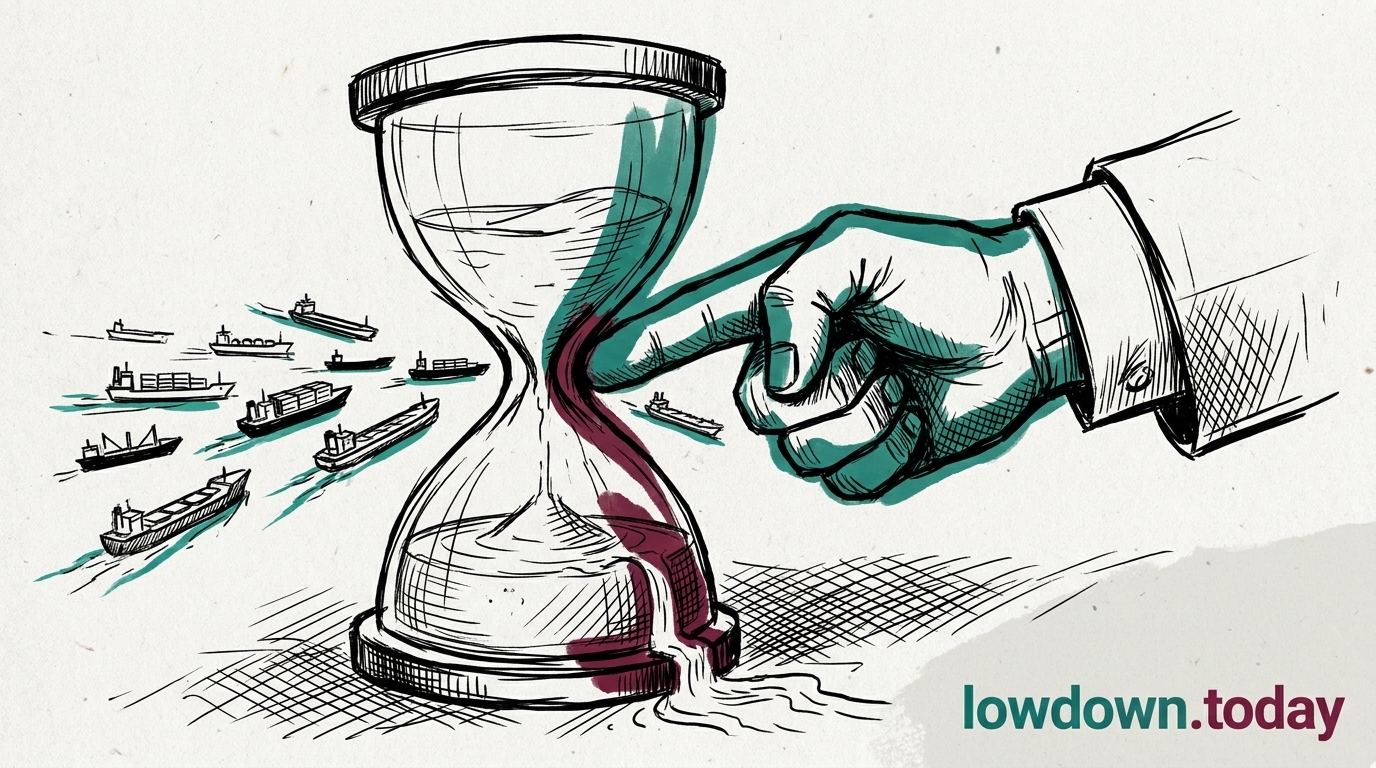
Brent crude settled $112.10 on 18 May, the highest conflict-era close, then fell to $110.98 on 19 May as no executive order, OFAC general licence or White House statement followed Tasnim's sanctions-waiver report.

ConflictDeveloping
Key takeaway

Brent paid $1.12 for waiting one session to see if Trump's post would produce paper.

Brent Crude settled at $112.10 per barrel on 18 May 2026 on ICE Futures, the highest conflict-era close on record, Trading Economics data showed. The benchmark slipped to $110.98 on 19 May after no US executive order, OFAC general licence or White House statement followed the Tasnim sanctions-waiver report from the previous session 1.

The arc plots cleanly. Brent had been at $104.21 on 11 May , rose to $109.30 on 16 May , reached $110.30 on 18 May as ADNOC committed to doubling Fujairah throughput, and then jumped a further $1.80 to the conflict-era $112.10 print after the Trump hold-off post and the Tasnim waiver leak landed within the same trading window. The single-session reversal to $110.98 came when neither the cancelled-strike post nor the waiver text produced a corroborating document on the US side.

The asymmetry matters because of what oil traders actually bid into. ICE Brent prices the most concrete piece of paper available; a Truth Social post is parsed, but it is not signed. The $112.10 print is, on the data, the moment the market accepted a presidential utterance and an Iranian state-media leak as policy. The $110.98 settle the next day is the moment it withdrew that acceptance after waiting one session for confirming text. The spread of $1.12 between the two settles is the implied price of unverified US-side claims, which is the same spread now passing through into European petrol pumps and shipping insurance, with no Iranian or US action in between to justify it.

Deep Analysis

In plain English

Oil hit its highest price since the conflict began on 18 May $112.10 a barrel after Trump posted that he had cancelled a planned strike on Iran. The next day it fell back to $110.98 when no official US documents appeared to confirm the strike had ever been scheduled. This price swing matters because the cost of a barrel of oil feeds into the price of petrol, diesel, heating oil and anything transported by lorry or ship. A $1 move in Brent crude typically translates to about half a penny per litre at the petrol pump within two to three weeks.

Deep Analysis
Root Causes

The $112.10-to-$110.98 reversal has two separable drivers.

First, the absent OFAC general licence. OFAC issues general licences before major Iran actions to protect US persons and financial institutions transacting in adjacent markets. Zero Iran OFAC general licences were issued on 18-19 May; professional oil traders use this absence as a leading indicator that the stated action is not operationally imminent.

Second, the Tasnim sanctions-waiver report, which drove part of the 18 May spike, originated with Iran's state-adjacent news agency and was not confirmed by any US-side document. Brent had already absorbed a similar cycle in March Trump post, spike, no instrument, partial reversal and the 19 May reversal is faster and larger than the March cycle, suggesting the learning curve is steepening.

Escalation

The price action is a mirror of the political action: volatile but contained within a structural floor driven by real supply disruption. Neither the spike to $112.10 nor the reversal to $110.98 changes the IEA's assessment that the market remains in deficit through Q4 2026 even if Hormuz flows resume in June.

What could happen next?
  • Consequence

    Professional oil traders now apply a documentary-verification discount to Trump's Iran Truth Social posts the 19 May reversal was faster and larger than the March cycle, indicating a steepening learning curve.

    Immediate · 0.78
  • Risk

    If a genuine military escalation produces a Truth Social post that markets treat as noise, the price signal that historically triggers de-escalation pressure on both sides will arrive late or not at all.

    Short term · 0.65
  • Consequence

    The structural Brent floor $10-12 above pre-conflict levels persists regardless of verbal-signal noise because the IEA has confirmed 1 billion barrels of cumulative supply loss.

    Long term · 0.82
First Reported In

Update #102 · Iran signs Hormuz toll; Trump posts a cancelled strike

Trading Economics / ICE Futures· 19 May 2026
Read original
Causes and effects
This Event
Brent prints $112.10 conflict high, reverses
The market priced a presidential Truth Social post and an Iranian state-media leak, then unpriced both within a single session when no US document confirmed either, setting the spread that drivers and hauliers now pay as a conflict premium.
Different Perspectives
Oil markets / Lloyd's underwriters
Futures markets priced CENTCOM's strikes-complete statement as a de-escalation signal and pushed Brent down 1.7 per cent to $94.71, even as the IRGC declared Hormuz closed. Lloyd's war-risk premiums held elevated because institutional de-listing requires a UN Security Council resolution that Russia and China have just shown they will block.
Pakistan (mediator)
Pakistan (mediator)
Interior minister Mohsin Naqvi carried dual civilian and military letters to Mojtaba Khamenei in Tehran on 6-7 June with no public response. The IRGC's Hormuz closure on 11 June shows the corps is acting independently of the channel Pakistan is using, making the mediation structurally unable to produce a binding commitment without direct IRGC access.
Russia and China
Russia and China
Russia and China voted against GOV/2026/40 at the IAEA Board, following through on the blocking position coordinated with Grossi in Geneva on 5 June; both states continue to oppose Western institutional pressure on Iran at every multilateral venue.
E3 and IAEA (UK, France, Germany)
The E3 co-sponsored IAEA resolution GOV/2026/40, adopted 21-3-10 on 10 June, demanding Iran disclose 440.9 kg of unaccounted HEU and admit inspectors to four denied facilities. The 10 abstentions and Russia-China noes leave any Security Council referral without a viable enforcement path.
IRGC / Iran military command
The corps declared Hormuz closed to all traffic on 11 June and claimed two vessels struck, overriding the MoU its own civilian negotiators were pursuing through Pakistan. The closure order used the Persian Gulf Strait Authority apparatus to convert a toll mechanism into a military prohibition.
Trump administration / CENTCOM
CENTCOM completed a second day of strikes on Tehran, Sirik and Minab, rejected the IRGC Hormuz closure as inconsistent with observed transit, and said strikes were complete. Hegseth framed the bombing explicitly as the negotiation: the method is coercive deal-making with no stated pause threshold.