Skip to content
Briefings are running a touch slower this week while we rebuild the foundations.See roadmap
Iran Conflict 2026
6JUN

Day 59: zero Iran instruments signed

3 min read
12:17UTC

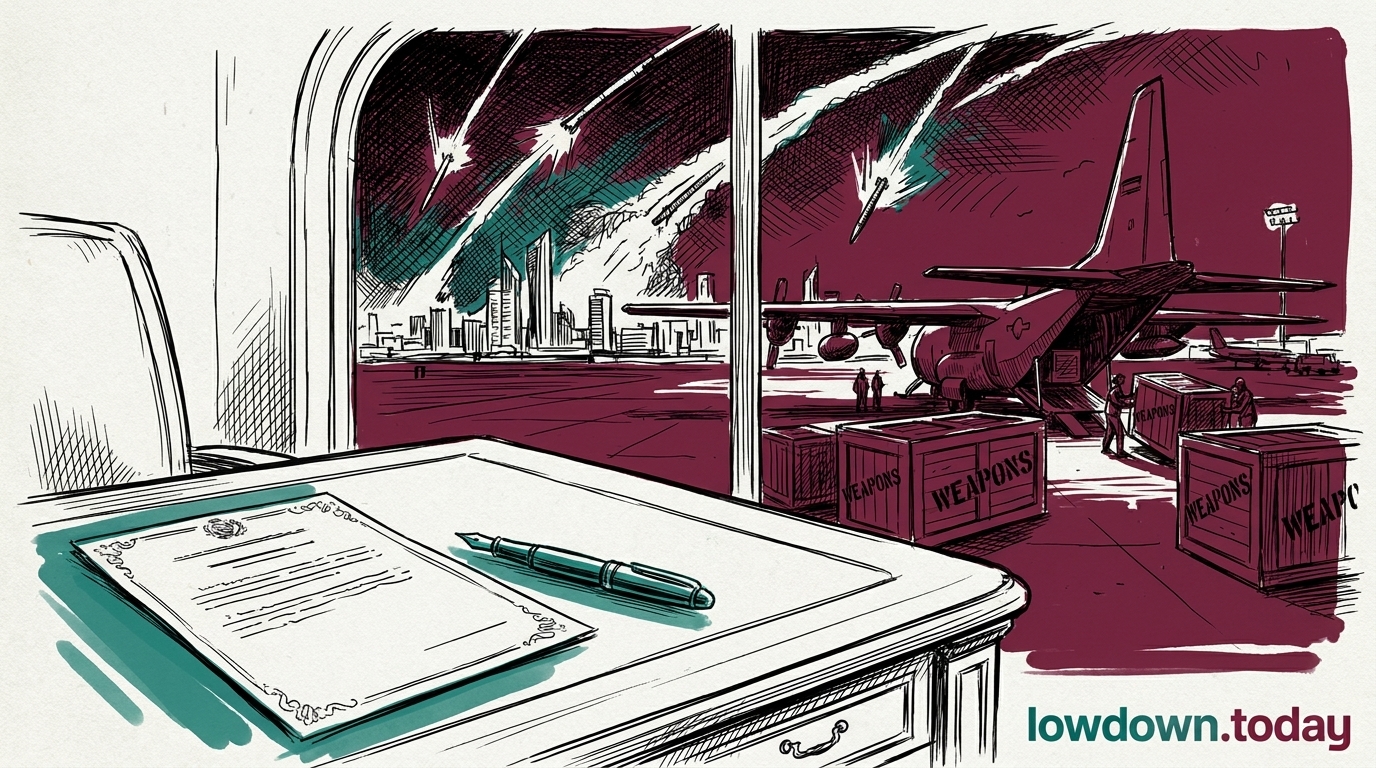
The White House presidential-actions index showed zero Iran-related signed executive instruments as of 27 April, Day 59 of the war. The signing pen has been demonstrably available for energy permits, Enbridge pipelines and a budget sequestration order across the same window.

ConflictDeveloping
Key takeaway

Trump's signing pen has touched Enbridge and energy permits this week; it has not touched the war.

The White House presidential-actions index recorded zero Iran-related signed executive instruments as of Day 59 of the war on 27 April 1. The most recent items in the index are the 20 April energy-sector Presidential Determinations and an 18 April executive order on mental-illness treatment. Across the 59-day window, Trump has signed Enbridge pipeline permits and a budget sequestration order; OFAC (the Office of Foreign Assets Control inside Treasury) has signed nothing for Iran. The signing pen has been demonstrably available all week, for everything except the war being run.

The public line and the private aside contradict on substance. Trump told journalists at the White House Correspondents' Association dinner on Saturday 25 April that Iran had sent a "much better" proposal 2; he added the offer arrived within ten minutes of his cancelling the Witkoff and Kushner Islamabad trip and that negotiations would now be conducted "over the phone". Press Secretary Karoline Leavitt told reporters on Sunday 26 April that there had been only "some progress from the Iranian side in the last couple of days". The Federal Register test is the cleanest one available: a Truth Social post becomes policy when OFAC writes it down, and on this war neither Treasury nor CENTCOM has done so. Trump's verbal shoot-kill order against Iranian mine-layers sits in spoken English; the toll line he posted to Truth Social on 12 April was not picked up by the operational order. Posts have not crossed into paper.

Cole Allen, 31, was arrested at the WHCA dinner after the same evening's shooting; the arrest is the small administrative detail that frames the 25 April "much better" remark, made on-the-record to journalists rather than as a private aside. The contradiction between Trump's framing and Leavitt's sanitised public read is what put the rhetoric/policy gap in plain view.

Deep Analysis

In plain English

After 59 days of war, the White House has not signed a single legal document specifically about the Iran conflict. Presidential actions for energy companies, healthcare and budgets have been signed throughout. Nothing on Iran. At the same time, Trump told journalists at a dinner on 25 April that Iran had sent a 'much better' proposal. Karoline Leavitt told reporters on 26 April there had been only 'some progress'. Trump's 'much better' and Leavitt's 'some progress' describe different things, on different days, to different audiences. A war run on verbal orders leaves no Federal Register entry for any court, ally, or adversary to cite. Iran's 27 April written text sits in Pakistan's diplomatic archive. Washington's response exists as a press briefing on Sunday and a dinner remark on Saturday.

Deep Analysis
Root Causes

The Federal Register test documents one structural cause: every presidential action with legal force must appear in the Federal Register. Actions that appear only on Truth Social or in spoken remarks carry no binding legal authority. Trump's 59-day avoidance of the Federal Register for Iran creates a war prosecuted entirely outside the administrative-state architecture that the administration has otherwise used aggressively across energy permits, budget sequestration, and trade instruments.

Enbridge pipeline permits, energy Presidential Determinations, and a budget sequestration order all cleared the signing desk inside the same 59-day window. The Trump administration's Iran file sits unsigned across all 59 of those days, making it the one topic whose policy exists exclusively in spoken form.

What could happen next?
  • Risk

    If the WPR deadline passes on 1 May without a signed instrument from the White House or Congress, every day of continued military operations becomes constitutionally contested, giving any federal court with jurisdiction a potential basis to enjoin CENTCOM operations.

  • Consequence

    Iran's willingness to deliver a written proposal while Washington responds verbally creates a documentary asymmetry: if a post-war inquiry or international arbitration reviews the record, Iran will hold the paper and Washington will hold the tweets.

First Reported In

Update #81 · Iran writes Phase 3; Trump posts Phase 1

White House· 27 Apr 2026
Read original
Different Perspectives
Israel
Israel
The IDF struck a Lebanese army unit on 6 June, killing a colonel, and privately told Moscow that shelling near Bushehr was accidental, per Putin's SPIEF disclosure. Israel is advancing in Lebanon past an unenforced ceasefire text while maintaining a back-channel to Russia on nuclear-site deconfliction.
Lebanon
Lebanon
President Aoun told CNN on 5 June that Iran uses Lebanon as a bargaining chip and urged Hezbollah toward diplomacy; on 6 June an IDF strike killed a Lebanese army colonel on the Khardali-Nabatieh road. The Lebanese state is publicly rejecting Iranian tutelage while the army sustains casualties from Israeli fire and the Washington framework remains unenforced.
Bahrain
Bahrain
Bahrain's US Fifth Fleet headquarters was among the targets in the 5-6 June two-country salvo; its PAC-3 magazine stands at 87 per cent depletion with an 18-month resupply gap and no comparable arms sale has been announced. The state is defending a critical US regional command on a thinning interceptor stock.
Kuwait
Kuwait
Kuwait received a $1.98bn US counter-drone sale approval on the same day IRGC missiles targeted its bases; it expelled two Iranian diplomats on 4 June and filed a formal protest. The arms approval gives Kuwait a future capability but leaves a 6-18 month delivery gap that the salvo tempo is already pressing.
Russia
Russia
Putin reaffirmed Russia's offer to hold Iran's 440.9 kg HEU at SPIEF on 6 June, said Russia is not arming Iran, and disclosed that both the US and Israel privately told Moscow that shelling near Bushehr was accidental. The restatement casts Moscow as the only remaining mediator both sides call, a position serving Russian interests whatever the nuclear file produces.
Iran
Iran
The IRGC, per Iranian state media, fired seven ballistic missiles at US bases in Kuwait and Bahrain, the largest two-country salvo of the war, and framed the launches as lawful retaliation; Foreign Minister Araghchi rejected Aoun's bargaining-chip accusation and Velayati warned Beirut against diplomatic naivety. Tehran has sent no HEU counter-proposal since Araghchi confirmed no progress on 4 June.