Skip to content
Briefings are running a touch slower this week while we rebuild the foundations.See roadmap
Iran Conflict 2026
4JUN

One Iranian missile lands inside UAE

4 min read
11:25UTC

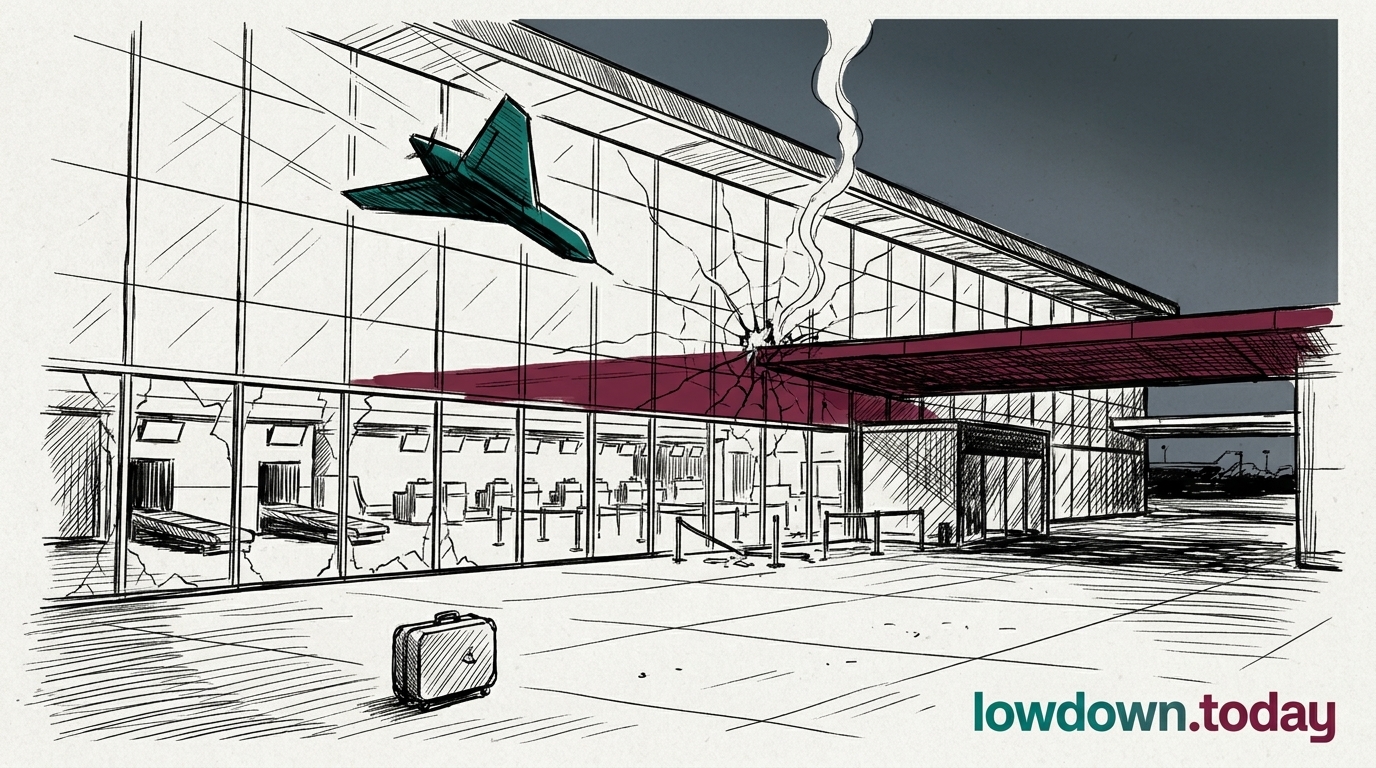
A single missile that penetrated UAE defences on Wednesday injured six civilians in Abu Dhabi — the first ballistic warhead to reach Emirati territory in this conflict.

ConflictDeveloping
Key takeaway

The first ballistic missile to land on Emirati soil is primarily a political threshold event — it ends Abu Dhabi's de facto immunity and removes the domestic basis for continued passive restraint regardless of the limited physical damage.

The UAE Ministry of Defence confirmed that of seven ballistic missiles detected on Wednesday, six were intercepted and one fell inside UAE territory — the first confirmed Ballistic missile to land on Emirati soil since the conflict began on 28 February. Separately, of 131 drones detected, 125 were intercepted; six penetrated defences and struck inside the UAE. Six civilians were injured in Abu Dhabi's ICAD 2 industrial district, a manufacturing and logistics zone south-east of the city centre.

The UAE's cumulative intercept record — 165 ballistic missiles and 541 drones without a single confirmed ballistic warhead reaching the ground — had been the strongest empirical case for layered air defence effectiveness under sustained fire. Wednesday's breach does not invalidate that record: an 85.7% same-day intercept rate for ballistic missiles and 95.4% for drones remain high by any historical standard. But the political weight of a first impact is disproportionate to its military effect. The Houthi drone and missile attacks on Abu Dhabi in January 2022 killed three people and prompted the UAE to accelerate air defence procurement and quietly recalibrate its Yemen involvement. A Ballistic missile from Iran itself carries greater political consequence.

Axios reported earlier this week that the UAE and Saudi Arabia are considering direct strikes on Iranian missile launch sites . The calculus behind that report — driven by the sheer volume of projectiles both countries have absorbed — gains weight with each penetration. Abu Dhabi spent six days demonstrating that its defence umbrella works; Wednesday demonstrated that it is not absolute. The distance between those two facts is where decisions about offensive action are made.

ICAD 2 is an industrial zone, not a residential neighbourhood, and six injuries rather than fatalities reflects both the district's lower population density and the time of impact. Fragments from intercepted Iranian missiles had already damaged the Burj Al Arab in Dubai , and an eleven-year-old girl was killed by intercept debris in Kuwait — showing that even successful intercepts carry risk. The first failed intercept against a Ballistic missile makes the threat to Emirati civilians direct in a way that falling debris does not.


Deep Analysis

In plain English

Until Wednesday, the UAE had intercepted every ballistic missile fired at it. One got through and landed in Abu Dhabi's industrial district. The physical damage was apparently limited and only six civilians were injured. But this matters enormously beyond the immediate damage: it proves Iran can successfully hit Abu Dhabi when it chooses, no defence is perfect, and the UAE's status as an untouched safe haven is over. The political pressure on Abu Dhabi's leadership to respond more aggressively will now increase substantially.

Deep Analysis
Synthesis

Cross-referencing Event 33 (interceptor depletion), this penetration may not be a one-off anomaly but an early indicator of a deteriorating intercept envelope. A PAC-3 battery engaging 7 simultaneous inbound ballistic missiles approaches the theoretical radar track-and-simultaneous-engagement saturation limit; Iran may have calibrated this salvo size specifically to exceed UAE simultaneous engagement capacity. The 6 drones landing inside UAE (from 131 incoming, a 95.4% intercept rate) reinforce this: what appears to be a high success rate still produced 6 weapon impacts on UAE soil in a single day. The compound trajectory — as stocks thin per Event 33 — points towards increasing leakage rates, not a stable defensive equilibrium.

Escalation

Abu Dhabi's strategic culture has explicitly prioritised de-escalation — the UAE quietly withdrew from frontline Yemen operations in 2019 citing economic and reputational risk calculus. A successful strike on Emirati industrial territory removes the domestic political basis for that posture. UAE leadership now faces a public audience that has seen their immunity broken and will expect a substantive response, creating pressure towards active offensive contribution to coalition operations that Abu Dhabi has so far avoided.

What could happen next?
  • Precedent

    The first successful ballistic missile strike on UAE territory ends Abu Dhabi's conflict immunity and, following the Saudi 2018 precedent, is likely to shift UAE from defensive posture to active consideration of offensive options within the coalition.

    Immediate · Assessed
  • Risk

    A confirmed successful strike reclassifies Abu Dhabi's ICAD 2 industrial district as an active conflict zone under international insurance frameworks, potentially triggering coverage exclusions and multinational operator withdrawal from petrochemical facilities.

    Immediate · Assessed
  • Risk

    If Iran has identified UAE engagement geometry from prior salvos — as the ICAD 2 impact location may suggest — subsequent salvos will likely be designed to exploit the same saturation threshold, making further penetrations structural rather than anomalous.

    Short term · Suggested
  • Consequence

    The intersection of demonstrated penetration capability and declining interceptor stocks creates a compounding vulnerability window in which each successive salvo achieves higher effective penetration rates.

    Short term · Assessed
First Reported In

Update #22 · IRGC drones hit Azerbaijan; CIA link cut

Al Jazeera· 5 Mar 2026
Read original
Causes and effects
This Event
One Iranian missile lands inside UAE
The breach of UAE air defence changes the political equation in Abu Dhabi. The UAE had absorbed the conflict's heaviest sustained bombardment with no ballistic missiles reaching the ground; that record ended Wednesday. For Emirati leadership weighing direct strikes on Iranian launch sites {{EVREF:/t/iran-conflict-2026/19/axios-reported-citing-israeli-officials-that-the-uae/}}, a missile in an Abu Dhabi industrial district strengthens the argument for offensive action.
Different Perspectives
Israel
Israel
IDF Chief Eyal Zamir declared on 3 June there was no ceasefire for his forces, and strikes killed at least 10 civilians and one Israeli soldier on 4 June. The IDF killed Hezbollah's chief engineer and warned three south Lebanon villages to evacuate on 5 June, advancing into ground the unsigned Washington framework has not caught.
Hezbollah / Lebanon
Hezbollah / Lebanon
Naim Qassem rejected the Washington Lebanon framework on 4 June as "absurd, humiliating and insulting", blocking a ceasefire instrument that required Hezbollah to withdraw north of the Litani before any Israeli withdrawal. Over one million Lebanese remain displaced; the framework's collapse prolongs that toll.
Iran
Iran
Foreign Minister Araghchi publicly coupled the Lebanon ceasefire to the Iran-US nuclear track on 4 June, carrying IRGC authority rather than his own civilian mandate. The IRGC delegation has sent no HEU counter-proposal since Araghchi confirmed no progress that same day; Mojtaba Khamenei's 21 May order to keep the 440.9 kg stockpile inside Iran remains operative.
United States
United States
Rubio placed the Iran-US deal at 95 per cent complete on 4 June while the administration signed no Iran instrument and OFAC designated only Cuban targets. Trump separately disclosed and rejected an airlift plan to collect Iran's HEU stockpile, claiming the material is "entombed", a claim the IAEA cannot verify.
China
China
Beijing's MOFCOM Blocking Rules constrain OFAC enforcement on the mainland; China has not corroborated Trump's verbal account of any bilateral summit, and the rial's failure to hold its Rubio bounce, combined with the IRGC's stablecoin rail closure, increases Chinese yuan-denominated oil-payment exposure through Hormuz.
Bahrain
Bahrain
The IRGC struck Bahrain on 3 June as its sirens sounded and its PAC-3 magazine neared exhaustion; excluded from Rubio's 2 May emergency resupply, Bahrain received a 50-round Federal Register notice on 1 June on an 18-month delivery timeline, meaning it is defending the US Fifth Fleet headquarters on the last rounds it has.



