Skip to content
Briefings are running a touch slower this week while we rebuild the foundations.See roadmap
Iran Conflict 2026
1JUN

90 min; Pentagon produced zero evidence

4 min read
08:32UTC

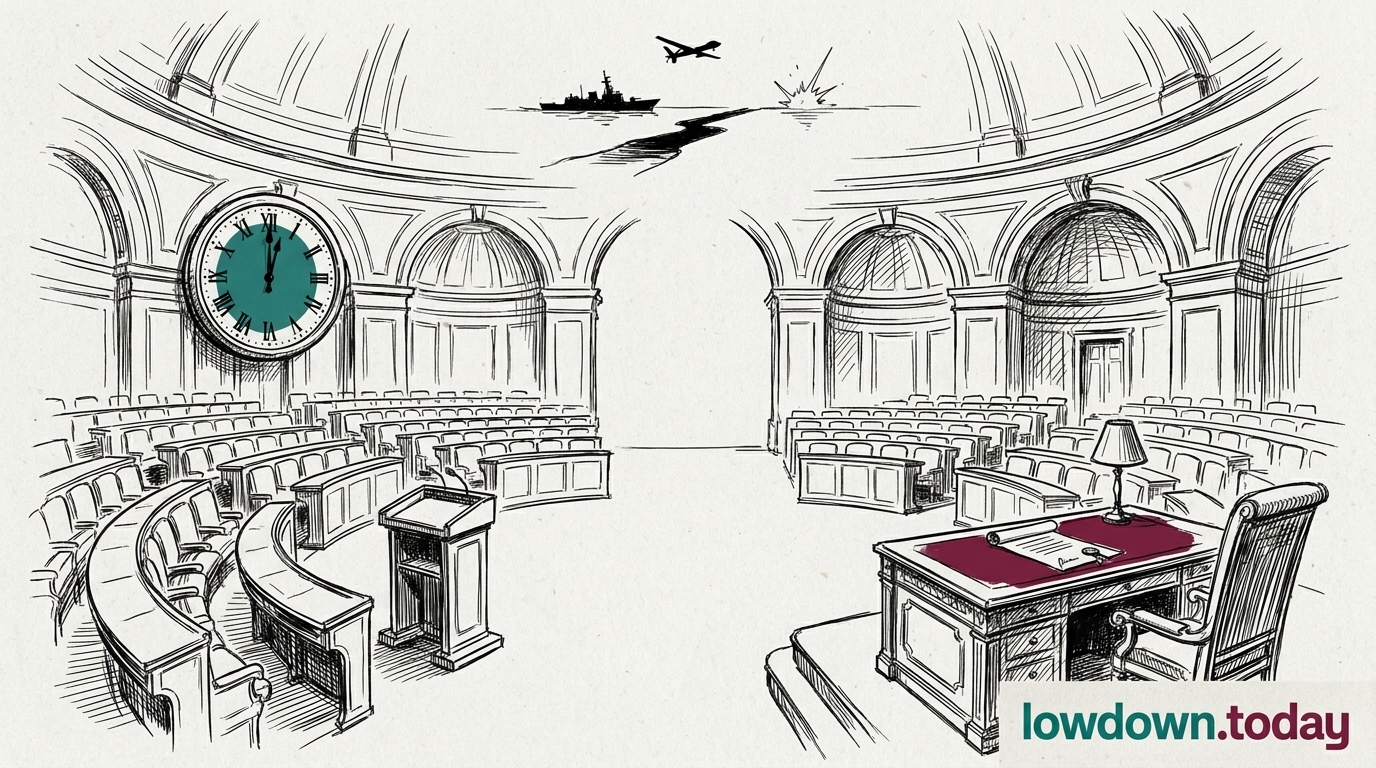
The Pentagon briefed Congress for 90 minutes on its legal basis for striking Iran. According to Newsweek, officials produced no evidence of the imminent threat cited to bypass congressional authorisation.

ConflictDeveloping
Key takeaway

The Pentagon's inability to substantiate the 'imminent threat' claim in classified briefing strips the campaign's primary legal justification and opens a durable constitutional challenge to executive war-making authority.

Pentagon officials briefed congressional staff for 90 minutes in a bipartisan session on Saturday. According to Newsweek's account of the classified briefing, they produced no evidence that Iran posed an imminent threat to the United States — the legal predicate the White House cited to launch the strikes against Iran (ID:469) without prior congressional authorisation.

Under the War Powers Resolution of 1973, the president may commit armed forces without congressional approval only in response to an attack or an imminent threat. The Administration did not seek an authorisation vote before the strikes began. The Saturday briefing — held after the campaign was already 48 hours underway — was the first formal engagement with the legislature. Congress was informed after the fact, not consulted before it. When The Administration killed Quds Force commander Qassem Soleimani in January 2020 on similar "imminent threat" grounds, senators from both parties described that briefing as among the worst they had received. The standard for "imminence" has been stretched by successive administrations — the Obama-era drone programme redefined it to include threats with no specific timetable — but no prior invocation has been used to justify a sustained air campaign against a sovereign state's military apparatus, nuclear infrastructure, and political leadership simultaneously.

Without the imminent-threat finding, the operation moves from pre-emption to prevention — from responding to what Iran was about to do to eliminating what Iran might one day be capable of doing. Preventive war has no settled legal basis in either US domestic law or international law. The Bush administration asserted a right to preventive action in its 2002 National Security Strategy, but Congress separately voted to authorise the Iraq invasion. No equivalent authorisation exists here. The gap between justification and evidence does not resolve the legality question — pre-emption doctrine is genuinely contested among international law scholars — but it changes the domestic political terms. A defensive response to imminent danger can sustain bipartisan support. A war launched by presidential decision, without evidence of necessity, requires political consensus that was never sought.

Deep Analysis

In plain English

Under US law — specifically the War Powers Resolution of 1973 — a president can order military action without asking Congress first, but only if there is an imminent threat to the United States or its forces. The White House claimed Iran was about to strike. When Pentagon officials were asked to show Congress the evidence behind that claim in a 90-minute classified briefing, they reportedly produced none. This matters enormously: if no imminent threat existed, the strikes may have been illegal under US domestic law, meaning the president launched a major war without the legal basis that would normally be required. Congress cannot stop the campaign now, but the evidentiary failure creates a paper trail that will be used in legal challenges, future investigations, and efforts to hold officials accountable.

Deep Analysis
Synthesis

The Pentagon briefing's failure to produce evidence is not primarily a military story — it is a constitutional one. The executive branch has claimed the right to initiate major offensive operations against a sovereign state without congressional authorisation, using a justification that its own officials apparently cannot substantiate in closed session. This is the most direct challenge to the War Powers Resolution since its enactment in 1973 over President Nixon's veto. The briefing's outcome transforms the legal challenge from a theoretical objection into a documented evidentiary gap, giving both domestic courts and international legal bodies a concrete basis for challenge. The longer the campaign runs — and a US defence official has already described it as lasting 'weeks, not days' — the more politically and legally costly the absence of authorisation becomes.

Root Causes

The 'imminent threat' framing was selected for legal rather than factual reasons. The War Powers Resolution's three permissible grounds for unilateral executive action are: a congressional declaration of war, specific statutory authorisation, or a national emergency created by an attack on the United States or its forces. None of those three grounds cleanly applied here; 'imminent threat' is a strained reading of the third category, previously invoked in the 2011 Libya intervention and contested even then. The administration chose this framing before the strikes, accepting the risk of post-hoc scrutiny in exchange for operational speed and the ability to act without seeking congressional consent that might have been withheld or delayed. The Pentagon's failure to produce supporting evidence in the classified briefing suggests the intelligence was either thin from the outset or has been withheld from congressional staff — both of which carry serious implications.

Escalation

The absence of substantiating evidence does not de-escalate the military campaign, but significantly escalates the domestic political and constitutional crisis surrounding it. Congressional opposition, unable to halt operations in the short term, may constrain supplemental appropriations, restrict future operational authorities, or produce committee investigations that shape how the administration manages the endgame. The deeper escalatory risk is institutional: if the executive branch can launch major offensive operations against a sovereign state on an unverifiable threat claim, and the intelligence community does not contest it in classified session, the constitutional balance shifts further and more durably towards executive unilateralism. Future administrations of either party will inherit an expanded precedent.

What could happen next?
  • Precedent

    If unchallenged, the 'imminent threat' justification without evidentiary support sets a precedent allowing future presidents to launch major offensive wars on unverifiable grounds.

    Long term · Assessed
  • Risk

    Legal challenges to the campaign's authorisation could complicate allied cooperation, as partner nations may face domestic political and legal pressure not to support an operation whose legal basis is disputed even by US intelligence officials.

    Short term · Suggested
  • Consequence

    The documented evidentiary gap will be used by congressional investigators, courts, and international legal bodies to challenge both the campaign's legality and the officials who authorised it.

    Medium term · Assessed
  • Meaning

    The executive branch has effectively claimed the right to determine what constitutes an 'imminent threat' without meaningful intelligence oversight, fundamentally altering the separation of powers in war-making.

    Immediate · Assessed
First Reported In

Update #6 · Pentagon produced no evidence for Iran war

Newsweek· 1 Mar 2026
Read original
Causes and effects
This Event
90 min; Pentagon produced zero evidence
The absence of evidence for the stated legal justification — imminent threat — removes the constitutional basis for launching military operations without congressional approval and exposes the campaign to challenge as an unauthorised war of executive choice.
Different Perspectives
Human rights monitors (Hengaw, Amnesty International, Iran HRM)
Monitors documented a second death sentence for Zahra Tabari, 68, reported cemetery record deletions at Behesht-e Zahra, and a poll showing 81.5% of medical residents want to emigrate, against a background of 200+ confirmed executions since February. Iran's security courts operate at uninterrupted wartime tempo regardless of the diplomatic track.
Pakistan (mediator)
Pakistan (mediator)
Islamabad carried Trump's revised MOU demanding HEU destruction to Iranian negotiators, formally inheriting the role of sole active mediator after Oman's forced withdrawal. Pakistan lacks Oman's banking infrastructure for frozen-asset routing and carries its own regional stakes, making it a less structurally neutral broker.
Kuwait
Kuwait
Kuwait intercepted Iranian missiles and drones for a second time in days on 1 June, with air-raid sirens sounding nationwide, after invoking Article 51 self-defence on 28 May following the Ali Al Salem ballistic-missile strike. The repeated interceptions test whether Kuwait's domestic politics can sustain hosting US forces as a de facto co-belligerent.
China (PRC)
China (PRC)
Beijing sent scholars to Shangri-La rather than its defence minister and addressed Taiwan without mentioning Iran, maintaining bilateral energy corridor protection with Tehran while refusing diplomatic exposure at multilateral forums. Trump barred China as an HEU custodian on 27 May, removing Beijing from the deal architecture while China continues supplying DPI hardware that caps Iran's internet.
Lloyd's of London / war-risk underwriters
Lloyd's held its Hormuz war-risk designation at $10-14 million per voyage while Brent recovered to $93.91, maintaining the structural divergence from futures pricing that has persisted since late May. Underwriters require a UN Security Council resolution or government certification letter, not diplomatic optimism.
Gulf Cooperation Council states (Saudi Arabia, UAE, Bahrain, Qatar)
Five Gulf states wrote to the IMO on 21 May rejecting Iran's PGSA transit authority over international waters; Saudi Arabia and the UAE have not confirmed participation in the European Hormuz mission. The GCC is navigating between US security guarantees and exposure to Iranian fire, with no Gulf state formally co-belligerent except Kuwait.