Skip to content
Briefings are running a touch slower this week while we rebuild the foundations.See roadmap
Iran Conflict 2026
1JUN

Murkowski's Iran AUMF collapses after Hegseth Article 2 testimony

3 min read
08:32UTC

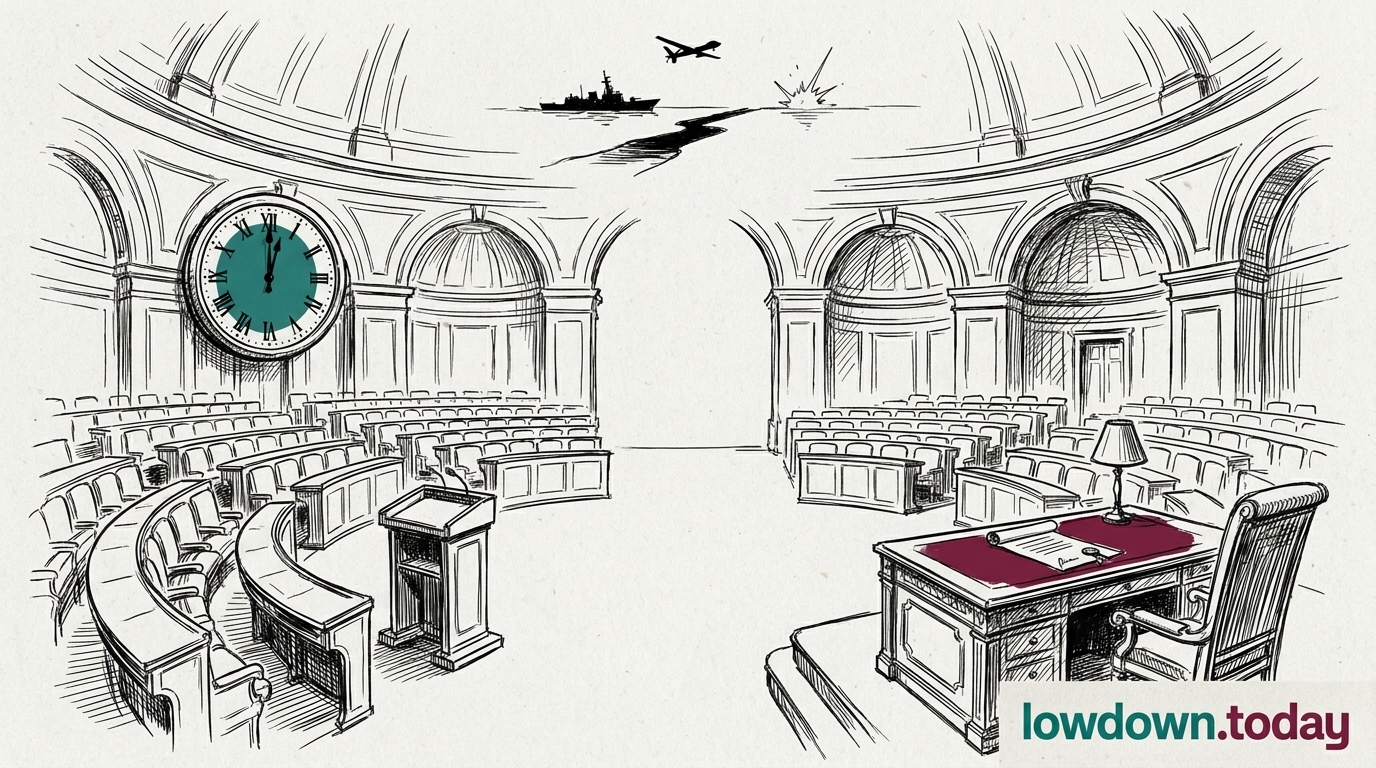
Lisa Murkowski's bipartisan Authorization for Use of Military Force on Iran remained unfiled as of 13 May after Pete Hegseth testified under oath that Article 2 of the Constitution makes an AUMF unnecessary, removing the rationale for the only legislative vehicle she had built.

ConflictDeveloping
Key takeaway

Hegseth's Article 2 argument won the legal case and collapsed Murkowski's bipartisan war-authorisation bill in the same week.

Senator Lisa Murkowski's bipartisan Iran Authorization for Use of Military Force (AUMF), drafted alongside Senator Todd Young with a 9 May filing target, remained unfiled on 13 May . The AUMF had first stalled on 11 May without explanation ; its political rationale was then removed entirely by Secretary of Defense Pete Hegseth's testimony on 12 May .

Hegseth testified under oath that Article 2 of the Constitution already covers the Iran strikes and that a Congressional AUMF is "unnecessary" 1 2. That argument collapsed the bipartisan vehicle Murkowski had spent weeks constructing. An AUMF exists to authorise what the executive has not yet claimed authority for; Hegseth's testimony placed the strikes firmly inside Article 2, making the AUMF a redundant instrument in executive-branch logic. An administration that argued itself out of the AUMF route simultaneously argued itself out of the legislative vehicle that would have imposed six limiting conditions on the war.

The causal chain is direct: Hegseth testimony on 12 May removed the AUMF's rationale; Murkowski's AUMF remained unfiled on 11 May and continued unfiled on 13 May ; Murkowski, left without a vehicle she had drafted, moved to the Democratic war-powers resolution instead. She did not invent the Democratic option on a whim; The Administration foreclosed her own option first.

Murkowski had also co-drafted the AUMF with Rand Paul ally Young and targeted a filing date that passed without action . With the AUMF stalled and WPR resolutions failing by one vote, Donald Trump faces no formal Congressional constraint on Iran operations through the 1 June WPR deadline . The war continues on Article 2 grounds, with no authorisation instrument filed and no limiting conditions codified.

Deep Analysis

In plain English

Senators can pass a law called an AUMF, an 'Authorization for Use of Military Force', to formally set conditions on how a war is fought. Senator Murkowski spent weeks writing one with conditions attached, such as requiring the president to report to Congress regularly. Then Defense Secretary Hegseth testified that the president already had all the authority he needed under the constitution. His testimony made the authorisation bill pointless. Murkowski shelved her bill, leaving Trump's Iran war running on Hegseth's Article 2 claim with no written Congressional conditions attached.

Deep Analysis
Root Causes

Hegseth's Article 2 testimony was not inadvertent; it was the logical endpoint of a 76-day pattern in which the administration ran the war entirely through verbal statements and Treasury-Commerce staff actions rather than presidential instruments.

An AUMF with six limiting conditions, including Murkowski's proposed congressional-notification requirements, would have imposed the first written constraint on executive war conduct since 28 February. The testimony foreclosed that constraint before it could be filed.

The causal chain is direct: Hegseth testifies Article 2 is sufficient ; Murkowski's AUMF loses its rationale because the administration it was meant to authorise has argued it needs no authorisation; Murkowski moves to the Democratic war-powers resolution as the only remaining vehicle. The administration's legal position foreclosed its own moderate Republican off-ramp.

What could happen next?
  • Consequence

    With the AUMF shelved and war-powers resolutions failing 49-50, Congress has no formal vehicle to impose limiting conditions on Operation Epic Fury through the 1 June WPR deadline, leaving the executive with full operational discretion.

    Immediate · 0.85
  • Precedent

    Hegseth's under-oath Article 2 testimony closes the moderate Republican legislative off-ramp: future bipartisan AUMF efforts face the same structural obstacle, since the executive has publicly argued it needs no authorisation at all.

    Medium term · 0.71
  • Risk

    An administration running an authorised-under-Article-2 blockade faces different coalition management pressures than one with a bipartisan AUMF: allied governments providing forces under NATO or coalition frameworks may require a written legal authority from Washington as a condition of continued participation.

    Medium term · 0.62
First Reported In

Update #97 · Chips for Beijing, no paper for Iran

Time· 14 May 2026
Read original
Different Perspectives
Human rights monitors (Hengaw, Amnesty International, Iran HRM)
Monitors documented a second death sentence for Zahra Tabari, 68, reported cemetery record deletions at Behesht-e Zahra, and a poll showing 81.5% of medical residents want to emigrate, against a background of 200+ confirmed executions since February. Iran's security courts operate at uninterrupted wartime tempo regardless of the diplomatic track.
Pakistan (mediator)
Pakistan (mediator)
Islamabad carried Trump's revised MOU demanding HEU destruction to Iranian negotiators, formally inheriting the role of sole active mediator after Oman's forced withdrawal. Pakistan lacks Oman's banking infrastructure for frozen-asset routing and carries its own regional stakes, making it a less structurally neutral broker.
Kuwait
Kuwait
Kuwait intercepted Iranian missiles and drones for a second time in days on 1 June, with air-raid sirens sounding nationwide, after invoking Article 51 self-defence on 28 May following the Ali Al Salem ballistic-missile strike. The repeated interceptions test whether Kuwait's domestic politics can sustain hosting US forces as a de facto co-belligerent.
China (PRC)
China (PRC)
Beijing sent scholars to Shangri-La rather than its defence minister and addressed Taiwan without mentioning Iran, maintaining bilateral energy corridor protection with Tehran while refusing diplomatic exposure at multilateral forums. Trump barred China as an HEU custodian on 27 May, removing Beijing from the deal architecture while China continues supplying DPI hardware that caps Iran's internet.
Lloyd's of London / war-risk underwriters
Lloyd's held its Hormuz war-risk designation at $10-14 million per voyage while Brent recovered to $93.91, maintaining the structural divergence from futures pricing that has persisted since late May. Underwriters require a UN Security Council resolution or government certification letter, not diplomatic optimism.
Gulf Cooperation Council states (Saudi Arabia, UAE, Bahrain, Qatar)
Five Gulf states wrote to the IMO on 21 May rejecting Iran's PGSA transit authority over international waters; Saudi Arabia and the UAE have not confirmed participation in the European Hormuz mission. The GCC is navigating between US security guarantees and exposure to Iranian fire, with no Gulf state formally co-belligerent except Kuwait.