Skip to content
Briefings are running a touch slower this week while we rebuild the foundations.See roadmap
Iran Conflict 2026
1JUN

House ties 212-212 on third Iran vote

3 min read
08:32UTC

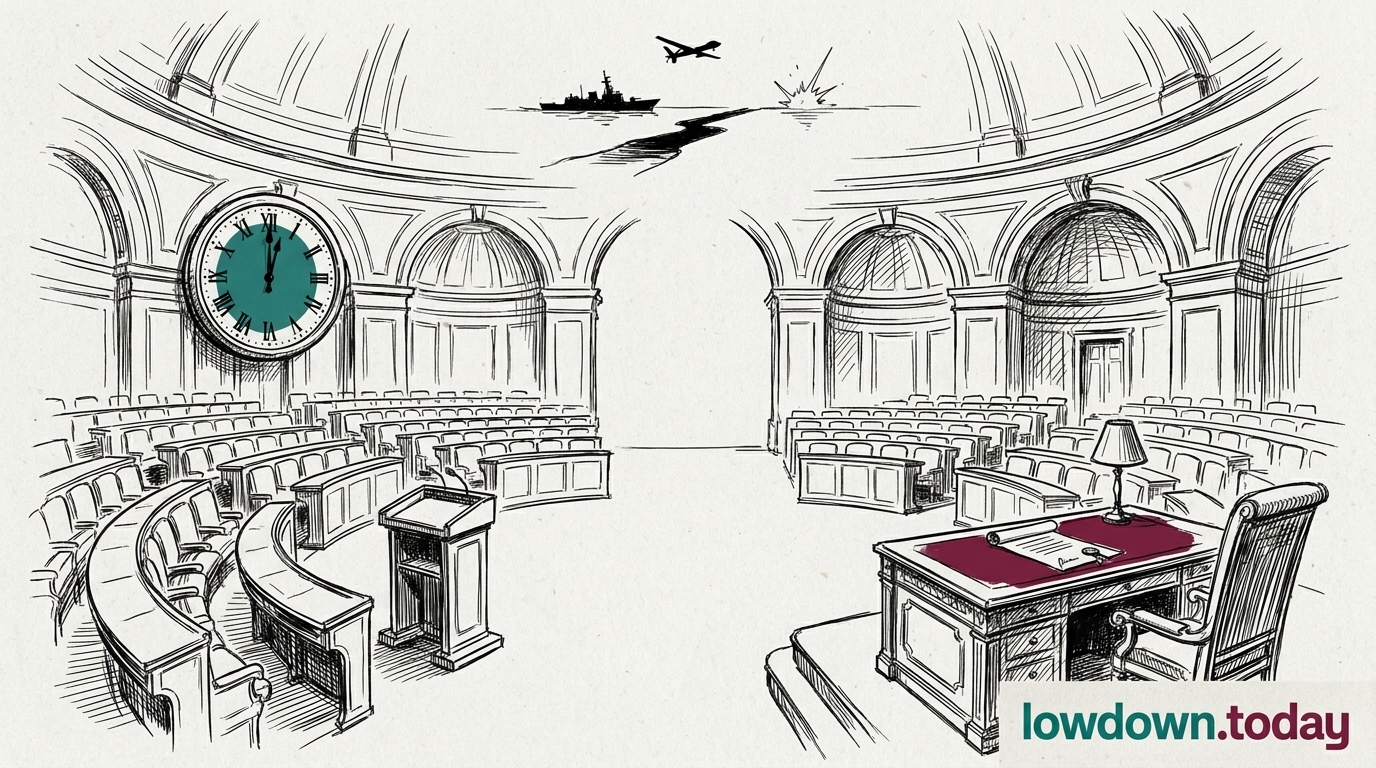
Three House Republicans crossed and one Maine Democrat held against his own caucus; the 212-212 tie is the closest margin the lower chamber has produced on Iran and still fails on the rules.

ConflictDeveloping
Key takeaway

The House has now failed three Iran war powers votes at single-digit margins; the third was the closest yet.

The House of Representatives voted 212-212 on Thursday 14 May on the parallel Iran War Powers Resolution 1. A tie fails under House rules. Three Republicans crossed: Thomas Massie of Kentucky, Brian Fitzpatrick of Pennsylvania, and Tom Barrett of Michigan. One Democrat held against his own caucus: Jared Golden of Maine. The result is the closest margin the Lower Chamber has produced on Iran across three attempts; the prior pair of votes had been 219-212 and an earlier defeat in the same pattern.

The Senate had voted 50-49 on the seventh War Powers Resolution one day earlier on Wednesday 13 May , with Alaska's Lisa Murkowski crossing for the first time among Republicans; the House tie came less than 24 hours later. Thursday's vote sits one day after the War Powers Act 60-day window formally lapsed, removing privileged floor consideration from any future resolution. With the clock run out, any future War Powers Resolution loses automatic floor privilege and is subject to leadership scheduling.

Three Republican defectors and one Democratic holdout is the same arithmetic that produced the prior tied vote, repeated this week by three different Republicans and a different Democrat. Each weekly attempt has found enough crossers to close the gap without producing the additional vote that breaks it. Massie, Fitzpatrick, and Barrett are the same fragile coalition shape Speaker Johnson's whip operation has held against across three House attempts.

Deep Analysis

In plain English

The US House of Representatives has 435 members. On 14 May, exactly half voted for a measure to force the president to seek congressional approval for the Iran war, and exactly half voted against it. Under House rules, a tie counts as a defeat for the measure that was proposed. Three Republicans voted against their own party leadership. One Democrat voted against his. Those defections cancelled each other out perfectly. This was the third time the House has produced this same tied result. Each time, the vote gets closer to passing. But because the 60-day legal deadline also passed the day before this vote, the House leadership now controls whether any future vote even gets to the floor.

Deep Analysis
Root Causes

House War Powers procedure under the original 1973 legislation granted privilege to resolutions filed within the 60-day clock. With the clock expired on 13 May, the Speaker now controls whether any Iran resolution reaches the floor.

The three consecutive 212-212 outcomes reflect not a genuine whip failure but a deliberate margin management by leadership: enough members are allowed to vote their conscience to signal responsiveness to constituents, while the final outcome is managed to fall one Democratic holdout short of passage.

Golden's continued defection is electorally rational for Maine's second congressional district, a Trump-won seat where opposition to executive war powers reads as soft on defence rather than constitutionalist. His defection has been consistent across all three House votes, suggesting it reflects a durable strategic position rather than pressure from Democratic leadership.

What could happen next?
  • Consequence

    With the WPA clock expired and the Speaker controlling floor scheduling, the three-Republican crossover coalition has no automatic vehicle for forcing a fourth vote; it requires either a discharge petition (218 signatures) or leadership consent.

    Immediate · 0.85
  • Risk

    The repeated 212-212 pattern normalises congressional impotence on war powers oversight; future administrations will cite 2026 House vote cycles as precedent for treating WPA resolutions as advisory.

    Long term · 0.68
  • Opportunity

    The three-Republican crossover bloc (Massie, Fitzpatrick, Barrett) has distinct electoral profiles, meaning each represents a different congressional constituency that could be mobilised for a discharge petition to force a floor vote without leadership consent.

    Medium term · 0.45
First Reported In

Update #98 · Three pledges, no paper, twelve sanctions

The Hill· 15 May 2026
Read original
Different Perspectives
Human rights monitors (Hengaw, Amnesty International, Iran HRM)
Monitors documented a second death sentence for Zahra Tabari, 68, reported cemetery record deletions at Behesht-e Zahra, and a poll showing 81.5% of medical residents want to emigrate, against a background of 200+ confirmed executions since February. Iran's security courts operate at uninterrupted wartime tempo regardless of the diplomatic track.
Pakistan (mediator)
Pakistan (mediator)
Islamabad carried Trump's revised MOU demanding HEU destruction to Iranian negotiators, formally inheriting the role of sole active mediator after Oman's forced withdrawal. Pakistan lacks Oman's banking infrastructure for frozen-asset routing and carries its own regional stakes, making it a less structurally neutral broker.
Kuwait
Kuwait
Kuwait intercepted Iranian missiles and drones for a second time in days on 1 June, with air-raid sirens sounding nationwide, after invoking Article 51 self-defence on 28 May following the Ali Al Salem ballistic-missile strike. The repeated interceptions test whether Kuwait's domestic politics can sustain hosting US forces as a de facto co-belligerent.
China (PRC)
China (PRC)
Beijing sent scholars to Shangri-La rather than its defence minister and addressed Taiwan without mentioning Iran, maintaining bilateral energy corridor protection with Tehran while refusing diplomatic exposure at multilateral forums. Trump barred China as an HEU custodian on 27 May, removing Beijing from the deal architecture while China continues supplying DPI hardware that caps Iran's internet.
Lloyd's of London / war-risk underwriters
Lloyd's held its Hormuz war-risk designation at $10-14 million per voyage while Brent recovered to $93.91, maintaining the structural divergence from futures pricing that has persisted since late May. Underwriters require a UN Security Council resolution or government certification letter, not diplomatic optimism.
Gulf Cooperation Council states (Saudi Arabia, UAE, Bahrain, Qatar)
Five Gulf states wrote to the IMO on 21 May rejecting Iran's PGSA transit authority over international waters; Saudi Arabia and the UAE have not confirmed participation in the European Hormuz mission. The GCC is navigating between US security guarantees and exposure to Iranian fire, with no Gulf state formally co-belligerent except Kuwait.