Skip to content
Briefings are running a touch slower this week while we rebuild the foundations.See roadmap
Iran Conflict 2026
1JUN

Murkowski AUMF still missing on Day 60

4 min read
08:32UTC

Senator Lisa Murkowski's draft Iran AUMF is still missing from Congress.gov on 29 April, a day past her own target and 24 hours from the War Powers Resolution deadline.

ConflictDeveloping
Key takeaway

Murkowski missed her own 28 April AUMF target; the bill remains unfiled 24 hours before the WPR deadline.

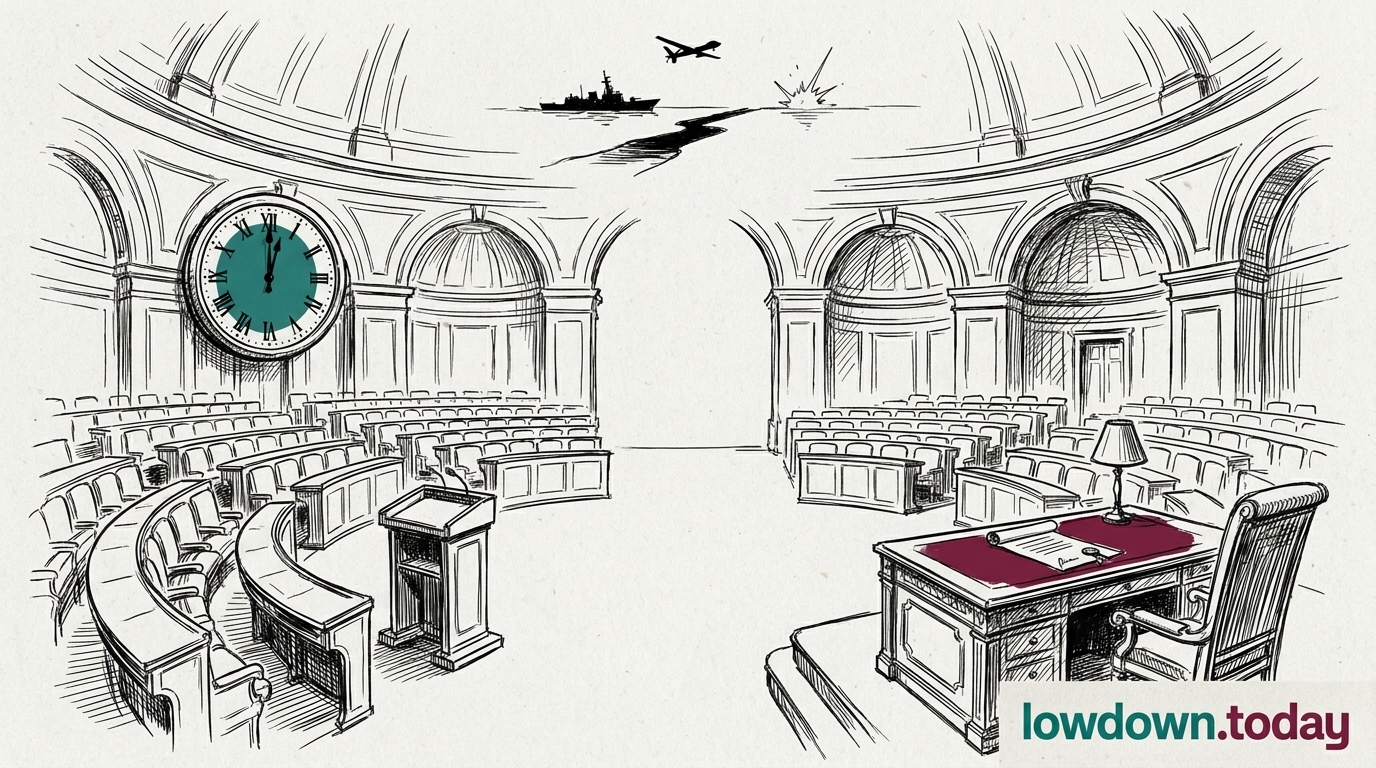
Senator Lisa Murkowski's draft Iran AUMF (Authorisation for the Use of Military Force) remains unfiled on Congress.gov as of Wednesday 29 April 2026, missing her own 28 April target by a day with the War Powers Resolution (WPR) 60-day deadline 24 hours away . The signing pen at the White House has produced no Iran executive paper across the same 60 days, matching the unfiled bill on the legislative side .

The AUMF is a joint resolution that would give legal footing to ongoing US hostilities against Iran by formally authorising the executive's use of force; without one, the Senate's 22 April rejection of the fifth WPR resolution 51-46 becomes the only congressional vote on the war. Susan Collins of Maine, Thom Tillis of North Carolina and John Curtis of Utah are named co-sponsors; Curtis was confirmed as the third Republican backer five days before the deadline . The bill needs a Senate Joint Resolution number on the public record to advance; until it has one, the 'AUMF' is a draft circulating inside Murkowski's office, not a vehicle Congress can pick up.

A filed S.J.Res. would flip the war from no-text to adversarial-text. The WPR's 60-day clock requires either a presidential withdrawal of forces or a congressional authorisation; a filed AUMF gives the Senate a procedural vehicle to vote. Murkowski had targeted 28 April for introduction per Jewish Insider reporting , three calendar days ahead of the Friday deadline to allow floor positioning. Missing the target by a day compresses that runway to roughly a single day, inside which Senate leadership must agree on a unanimous-consent track or the bill goes through full Rule XIV first reading. The Senate Foreign Relations Committee has not held a markup or hearing on a Hormuz AUMF in 60 days, an unusual gap that places the bill outside the committee process the WPR architecture assumes.

The procedural choreography that would convert the draft into a numbered resolution is missing on both ends. President Trump has signed nothing on Iran since 28 February, and Senator Murkowski has filed nothing on Iran across 60 days of war. The WPR clock will expire this Friday against an unbroken streak of paper that does not exist.

Deep Analysis

In plain English

When the US goes to war, Congress is supposed to formally authorise it through a bill called an Authorisation for the Use of Military Force. Republican Senator Lisa Murkowski of Alaska has been trying to write one, with support from Senators Susan Collins, Thom Tillis and John Curtis. Murkowski set herself a target of introducing the bill on 28 April. She missed it. As of 29 April, no bill number had appeared on Congress.gov. The legal clock for the war expires at 12:01 EDT on 1 May. When that happens, Murkowski's four-person coalition will have let the window close without producing any text to force a Senate vote.

Deep Analysis
Root Causes

The structural problem Murkowski faces is that an Iran AUMF filed under WPR pressure has two audiences with incompatible demands. Senate Republicans who support the war want an authorisation with minimal constraints.

Senate Democrats who oppose the war want a bill with geographic limits, duration caps, and oversight requirements that would effectively restrict operations. A bill that satisfies neither bloc cannot pass; a bill that satisfies Republicans passes but is indistinguishable from a blank cheque; a bill that satisfies Democrats triggers a White House veto threat.

Murkowski's draft reportedly includes reporting requirements and a 90-day duration cap subject to renewal. Those constraints are enough to make the bill unacceptable to the White House, which has privately communicated that any AUMF with operational constraints would be vetoed, removing the political incentive for Republican senators to vote for a text that will not become law.

What could happen next?
  • Risk

    If the AUMF remains unfiled when the WPR clock expires at 12:01 EDT on 1 May, the White House will have established that a 60-day military operation can conclude its mandatory authorisation window with zero signed instruments and no legal consequence, setting a precedent for all future administrations.

  • Opportunity

    Murkowski could file the AUMF on 29-30 April, after the 28 April miss but before the 1 May deadline, converting the missed target into a same-week introduction that still engages the WPR clock before expiry.

First Reported In

Update #83 · UAE quits OPEC, war signs nothing

The White House· 29 Apr 2026
Read original
Causes and effects
This Event
Murkowski AUMF still missing on Day 60
A filed bill would flip the war from no-text to adversarial-text and force Congress to vote up or down inside the WPR clock. Four named Republican supporters, Murkowski, Susan Collins, Thom Tillis and John Curtis, are still waiting on an introduced S.J.Res. while the deadline at 12:01 EDT on Friday 1 May runs against zero signed presidential paper.
Different Perspectives
Human rights monitors (Hengaw, Amnesty International, Iran HRM)
Monitors documented a second death sentence for Zahra Tabari, 68, reported cemetery record deletions at Behesht-e Zahra, and a poll showing 81.5% of medical residents want to emigrate, against a background of 200+ confirmed executions since February. Iran's security courts operate at uninterrupted wartime tempo regardless of the diplomatic track.
Pakistan (mediator)
Pakistan (mediator)
Islamabad carried Trump's revised MOU demanding HEU destruction to Iranian negotiators, formally inheriting the role of sole active mediator after Oman's forced withdrawal. Pakistan lacks Oman's banking infrastructure for frozen-asset routing and carries its own regional stakes, making it a less structurally neutral broker.
Kuwait
Kuwait
Kuwait intercepted Iranian missiles and drones for a second time in days on 1 June, with air-raid sirens sounding nationwide, after invoking Article 51 self-defence on 28 May following the Ali Al Salem ballistic-missile strike. The repeated interceptions test whether Kuwait's domestic politics can sustain hosting US forces as a de facto co-belligerent.
China (PRC)
China (PRC)
Beijing sent scholars to Shangri-La rather than its defence minister and addressed Taiwan without mentioning Iran, maintaining bilateral energy corridor protection with Tehran while refusing diplomatic exposure at multilateral forums. Trump barred China as an HEU custodian on 27 May, removing Beijing from the deal architecture while China continues supplying DPI hardware that caps Iran's internet.
Lloyd's of London / war-risk underwriters
Lloyd's held its Hormuz war-risk designation at $10-14 million per voyage while Brent recovered to $93.91, maintaining the structural divergence from futures pricing that has persisted since late May. Underwriters require a UN Security Council resolution or government certification letter, not diplomatic optimism.
Gulf Cooperation Council states (Saudi Arabia, UAE, Bahrain, Qatar)
Five Gulf states wrote to the IMO on 21 May rejecting Iran's PGSA transit authority over international waters; Saudi Arabia and the UAE have not confirmed participation in the European Hormuz mission. The GCC is navigating between US security guarantees and exposure to Iranian fire, with no Gulf state formally co-belligerent except Kuwait.