Skip to content
Briefings are running a touch slower this week while we rebuild the foundations.See roadmap
Iran Conflict 2026
1JUN

Senate rejects Iran war-powers vote 49-50; Murkowski crosses first time

3 min read
08:32UTC

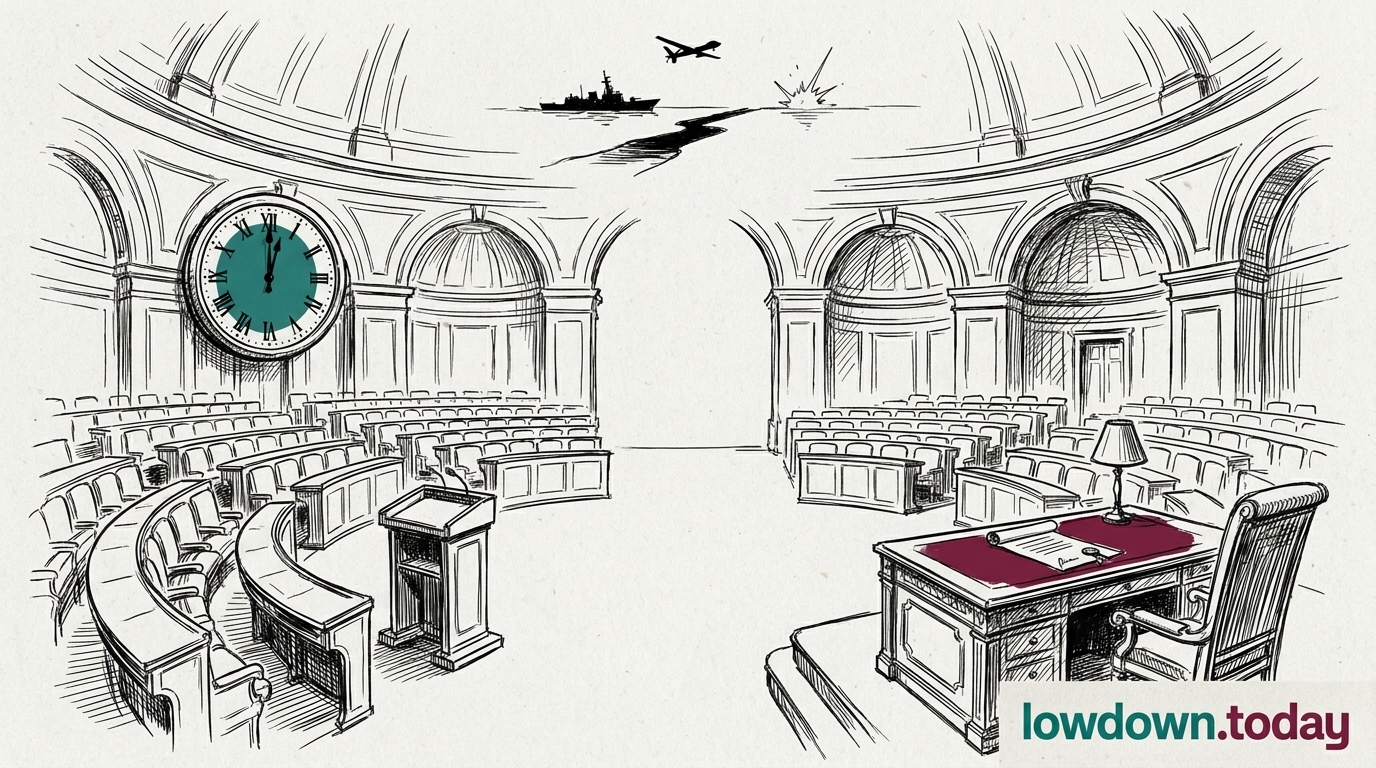
The Senate rejected the seventh Democratic resolution to halt Operation Epic Fury by a single vote, 49-50, on 13 May; Lisa Murkowski became the first Republican to cross, citing the administration's failure to brief her after the 60-day War Powers Resolution deadline passed.

ConflictDeveloping
Key takeaway

Three Republicans have now voted yes on war-powers resolutions; one more would flip the Senate against Operation Epic Fury.

Operation Epic Fury, the US Iran air campaign that began on 28 February 2026, passed the 60-day deadline set by the War Powers Resolution (the 1973 US law requiring congressional authorisation for sustained military action) without a signed authorisation on 13 May. The Senate voted 49-50 on the seventh Democratic resolution to halt the campaign, the closest result of the conflict 1 2.

Senator Lisa Murkowski (R-Alaska) voted yes for the first time, joining Susan Collins (R-Maine) and Rand Paul (R-Kentucky). Democratic Senator John Fetterman of Pennsylvania cast the decisive no vote, holding the line against progressive pressure from within his own party. Murkowski's stated reason was direct: "You've got a timeline that has taken us beyond the 60 days. I thought that perhaps we would get more clarity from The Administration in terms of where we are, and I haven't received it" 3.

Murkowski crossed having first exhausted the alternative path. She had built a bipartisan Authorization for Use of Military Force (AUMF, a Congressional war authorisation instrument) alongside Senator Todd Young, targeting a 9 May filing with six limiting conditions. That AUMF remained unfiled , . Defence Secretary Pete Hegseth's Article 2 testimony on 12 May had destroyed its political rationale by arguing the president needed no Congressional authorisation at all. Having spent weeks constructing a legislative vehicle the White House then publicly dismissed, Murkowski moved to the only option still on the floor.

Six prior resolutions failed by double-digit margins; three Republicans have now crossed. Four would win. The Republican coalition sustaining the war in the Senate is now one vote from a binding resolution at precisely the moment the diplomatic track is running on verbal assurances without signed paper.

Deep Analysis

In plain English

In the US, a 1973 law called the War Powers Resolution says the president must get Congress's approval to keep troops in combat for more than 60 days. That 60-day deadline passed on 13 May. The Senate voted to stop the Iran war: 49 senators said yes, 50 said no. Senator Lisa Murkowski, a Republican, voted to stop it for the first time. One more Republican vote would flip the result. But for now, the war continues legally under a White House argument that the president doesn't need Congress's permission at all.

Deep Analysis
Root Causes

Congress passed the War Powers Resolution over Nixon's veto in 1973 precisely because the text alone could not compel executive compliance: enforcement relies on political costs, not legal mechanisms. With Fetterman's no-vote providing the margin at 49-50, those political costs have not yet cleared the threshold that would force executive action from the Trump administration.

Murkowski's path from AUMF to war-powers yes vote is a secondary causal chain: she built a bipartisan authorisation vehicle, the White House then legally argued the vehicle was unnecessary via Hegseth's Article 2 testimony , leaving her with only the Democratic floor option. The administration's legal move foreclosed its own moderate Republican off-ramp.

What could happen next?
  • Consequence

    Three Republican crossings have now been documented; four would produce a 51-49 majority for the war-powers resolution. The next vote's Republican target is the undeclared swing senator, not a repeat of the three who have already crossed.

    Short term · 0.74
  • Risk

    Without Congressional authorisation through the 1 June WPR deadline, Trump faces no legal compulsion to seek authorisation; but a 50-50 tie or 51-49 pro-resolution vote would produce the first binding Senate signal against the war, affecting allied confidence and market pricing.

    Short term · 0.69
  • Precedent

    Kosovo 1999 established that an administration can continue an unauthorised air campaign past the WPR 60-day mark with Article 2 authority; the 2026 parallel extends that precedent to a named Hormuz blockade, which Kosovo never involved.

    Long term · 0.71
First Reported In

Update #97 · Chips for Beijing, no paper for Iran

Time· 14 May 2026
Read original
Causes and effects
This Event
Senate rejects Iran war-powers vote 49-50; Murkowski crosses first time
Six previous war-powers resolutions failed by double-digit margins; the gap is now one vote, with three Republicans having crossed, meaning the Senate majority supporting the war is thinning at the same moment Trump's diplomatic track is stalling.
Different Perspectives
Human rights monitors (Hengaw, Amnesty International, Iran HRM)
Monitors documented a second death sentence for Zahra Tabari, 68, reported cemetery record deletions at Behesht-e Zahra, and a poll showing 81.5% of medical residents want to emigrate, against a background of 200+ confirmed executions since February. Iran's security courts operate at uninterrupted wartime tempo regardless of the diplomatic track.
Pakistan (mediator)
Pakistan (mediator)
Islamabad carried Trump's revised MOU demanding HEU destruction to Iranian negotiators, formally inheriting the role of sole active mediator after Oman's forced withdrawal. Pakistan lacks Oman's banking infrastructure for frozen-asset routing and carries its own regional stakes, making it a less structurally neutral broker.
Kuwait
Kuwait
Kuwait intercepted Iranian missiles and drones for a second time in days on 1 June, with air-raid sirens sounding nationwide, after invoking Article 51 self-defence on 28 May following the Ali Al Salem ballistic-missile strike. The repeated interceptions test whether Kuwait's domestic politics can sustain hosting US forces as a de facto co-belligerent.
China (PRC)
China (PRC)
Beijing sent scholars to Shangri-La rather than its defence minister and addressed Taiwan without mentioning Iran, maintaining bilateral energy corridor protection with Tehran while refusing diplomatic exposure at multilateral forums. Trump barred China as an HEU custodian on 27 May, removing Beijing from the deal architecture while China continues supplying DPI hardware that caps Iran's internet.
Lloyd's of London / war-risk underwriters
Lloyd's held its Hormuz war-risk designation at $10-14 million per voyage while Brent recovered to $93.91, maintaining the structural divergence from futures pricing that has persisted since late May. Underwriters require a UN Security Council resolution or government certification letter, not diplomatic optimism.
Gulf Cooperation Council states (Saudi Arabia, UAE, Bahrain, Qatar)
Five Gulf states wrote to the IMO on 21 May rejecting Iran's PGSA transit authority over international waters; Saudi Arabia and the UAE have not confirmed participation in the European Hormuz mission. The GCC is navigating between US security guarantees and exposure to Iranian fire, with no Gulf state formally co-belligerent except Kuwait.