Skip to content
Briefings are running a touch slower this week while we rebuild the foundations.See roadmap
Iran Conflict 2026
31MAY

Brent closes $107.05 into Beijing summit

3 min read
09:14UTC

Brent crude closed $107.77 on 12 May on Trump's verbal rejection of Iran's 10-point MOU reply via Pakistan, then settled at $107.05 on 13 May. Goldman Sachs and Morgan Stanley flagged a structural Hormuz premium that will outlast any ceasefire.

ConflictDeveloping
Key takeaway

Brent closed $107.05 on 13 May, $2.84 above the 11 May ceasefire-alive baseline.

Brent Crude closed at $107.77 on 12 May 2026, a 3.4 per cent jump on Trump's verbal rejection of Iran's 10-point MOU reply via Pakistan , then settled at $107.05 on 13 May 1. That is $2.84 above the $104.21 close that priced the ceasefire as still alive . The verbal rejection had no signed instrument behind it; the price still moved as if one had been signed against the ceasefire.

Brent is the global oil benchmark; roughly two-thirds of internationally traded crude prices off it, as do European retail diesel and the wholesale gas contracts that feed UK household bills. For UK drivers that translates to a pump price around £1.55 per litre through summer; for UK consumers on index-linked tariffs it adds roughly £180 a year to a typical household gas bill via the wholesale contracts that price off Brent. Traders are pricing both Trump's 11 May "life support" remarks on the ceasefire and the OFAC Hong Kong designations two days later .

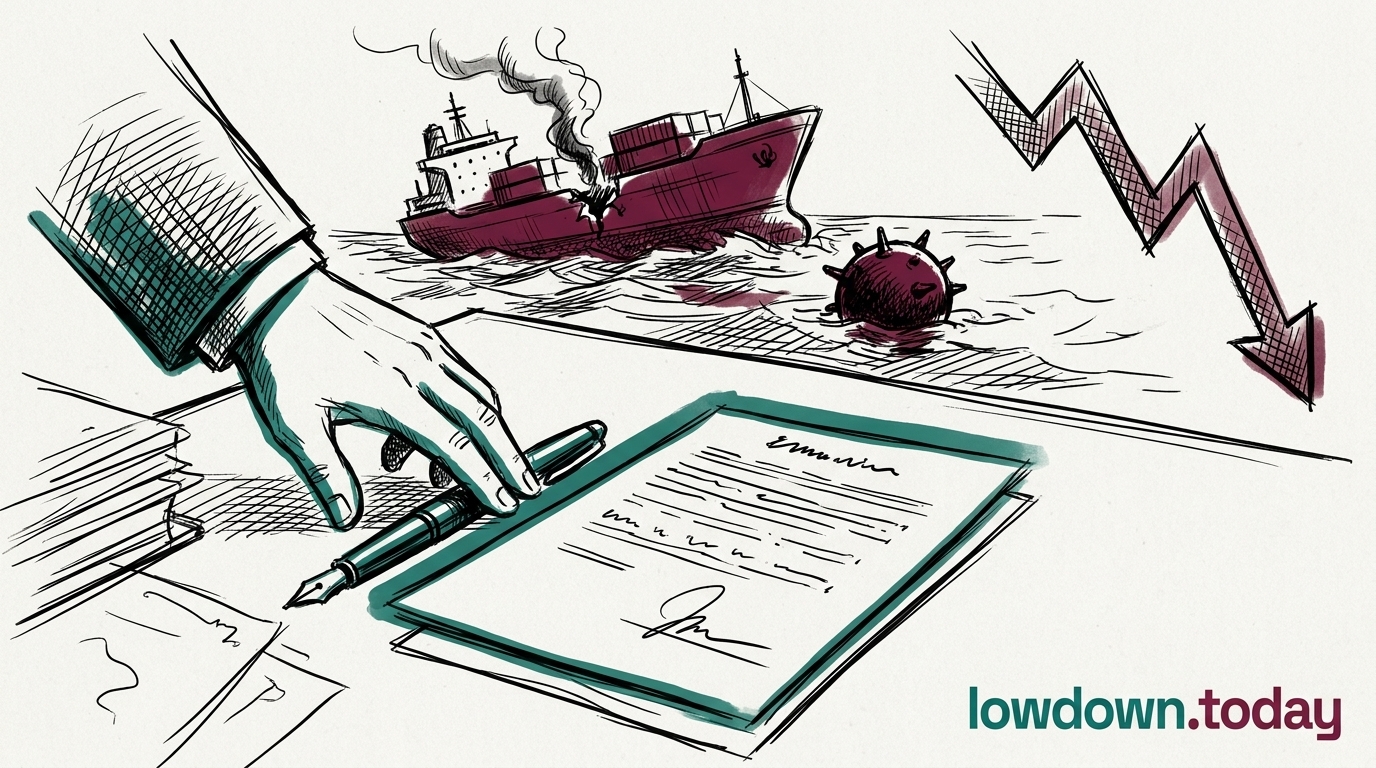
Goldman Sachs and Morgan Stanley both noted on 13 May that the structural Hormuz premium will persist beyond any ceasefire because P&I (Protection and Indemnity) insurers cannot reopen war-risk cover for the strait until written rules of engagement exist for the European mission and the US blockade. The insurance freeze, not summit hope, sets the floor for Brent through the rest of May. The market is pricing the absence of signed paper for the rest of May.

Deep Analysis

In plain English

The price of oil on world markets is tracked via a benchmark called Brent crude. When Brent goes up, everything that uses oil, including petrol, diesel, home heating, and many food products, tends to get more expensive too. Brent closed at $107.05 on 13 May. Before the Iran conflict began about 75 days ago, it was around $67. That $40 difference is being called the "Hormuz premium", the extra cost the market adds because nobody can get war-risk insurance to ship oil through the strait right now. Two big investment banks, Goldman Sachs and Morgan Stanley, said on 13 May that this premium will not go away just because a ceasefire is signed. The shipping insurance industry needs to see written rules about how the strait will be managed before they will insure tankers again. Until that paperwork exists, oil stays expensive.

What could happen next?
  • Consequence

    The two-layer Brent premium, kinetic and structural insurance, means a signed ceasefire alone will not restore pre-war pump prices; the insurance layer requires a separate written rules-of-engagement document from the European coalition.

  • Risk

    UK Q3 2026 Ofgem price-cap calculations will incorporate the current Brent forward curve, locking elevated household energy costs through September 2026 regardless of any ceasefire signed in May or June.

First Reported In

Update #96 · Hegseth: no AUMF needed. Trump flies east

CNBC· 13 May 2026
Read original
Different Perspectives
Iran human rights monitors (Amnesty International, Iran HRM, Hengaw)
Monitors documented 30 women held on capital moharebeh charges in a basement prison ward, Benyamin Naqdi's death sentence with a forced-confession broadcast, and 39 political executions since February. Iran's security courts have processed protest cases at uninterrupted wartime tempo regardless of the diplomatic track.
Lloyd's of London (war-risk underwriters)
Lloyd's held its Hormuz war-risk designation at $10-14 million per voyage while Brent fell 19%, maintaining a structural divergence from futures pricing. Underwriters require a UN Security Council resolution or government certification letter, not diplomatic optimism, before de-listing the strait.
Oman (Sultan Haitham's government)
Muscat issued a mine alert in its own territorial waters while denying any Hormuz toll plan after US Treasury threatened sanctions. A suspected mine in Omani waters on the same weekend as US financial pressure forces Muscat to demonstrate sovereignty without appearing to choose sides.
China (PRC)
China (PRC)
Beijing sent scholars rather than its defence minister to Shangri-La for the second year running and addressed Taiwan and multilateralism without mentioning Iran. China maintains its bilateral energy corridor protection with Tehran while refusing the diplomatic exposure of a public position at multilateral forums.
Iran Supreme National Security Council
The SNSC framed the unsigned MOU as a 10-point Iranian victory with enrichment already recognised, and the foreign ministry rejected Trump's nuclear conditions within hours. Tehran treats each unsigned day as validation that Iran has retained its stockpile without surrendering it.
Trump administration (CENTCOM/White House)
Trump posted three non-negotiable public conditions while CENTCOM disabled a commercial ship and Hegseth threatened resumed strikes from Singapore. The administration treats the unsigned MOU as leverage to extract maximum Iranian concessions before any ceasefire instrument is committed to paper.