Skip to content
You can now search across every topic, entity and event.What's new
European Tech Sovereignty
27MAY

Three internet tiers, one negotiating line

3 min read
15:19UTC

Euronews documented Iran's wartime internet on 20 May as a three-tier system: free for senior officials, 40,000 tomans per GB for licensed professionals, 500,000 tomans for the public.

TechnologyDeveloping
Key takeaway

The three-tier internet is the structural reason Iran's negotiating posture and its domestic mood run on different information.

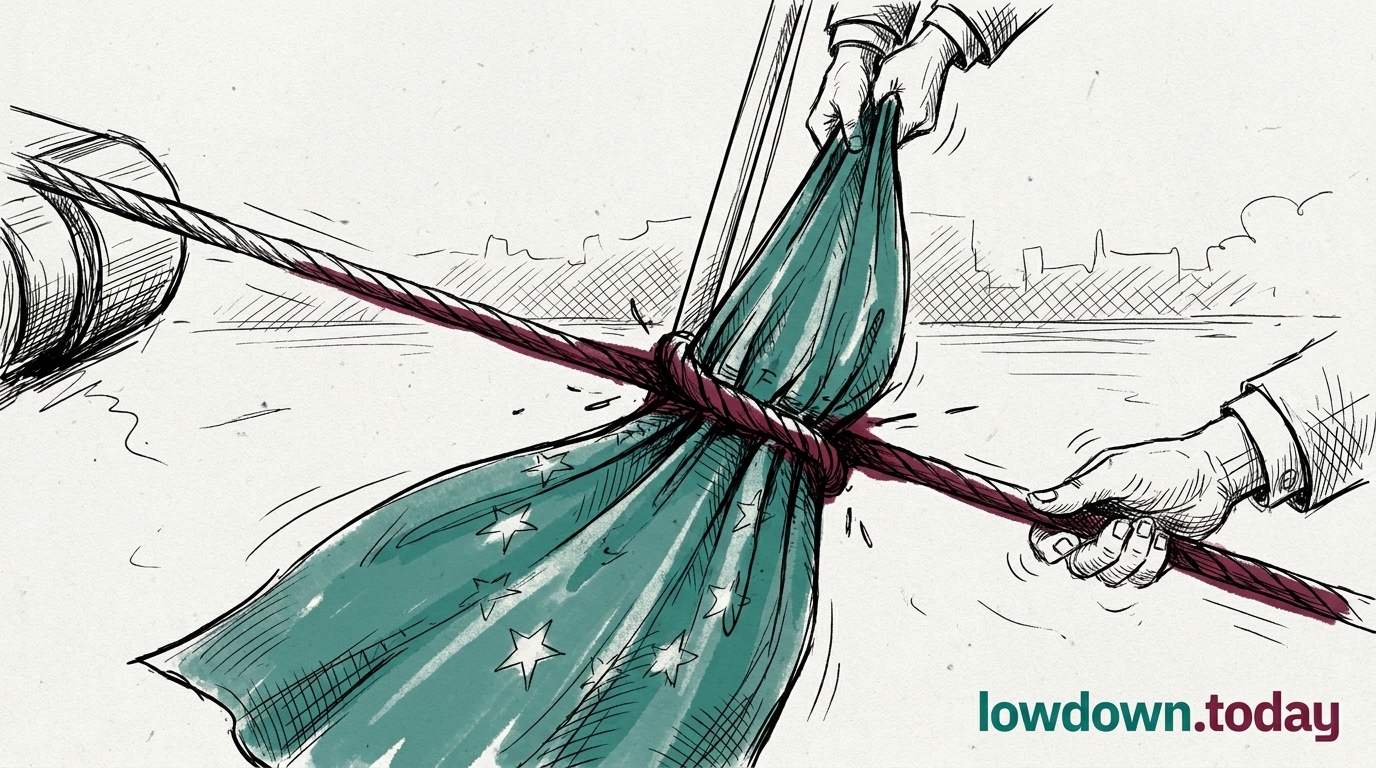
Euronews documented Iran's wartime internet on Wednesday 20 May as a three-tier system 1. The top tier, branded 'White Internet', is reserved for senior officials and select journalists at no charge with full unfiltered access. 'Internet Pro' is sold to licensed professionals, doctors, lawyers, academics and businesses, at 40,000 tomans per gigabyte (roughly €0.20), with curated access to about ten international platforms. The general public pays commercial VPN providers around 500,000 tomans per gigabyte (roughly €2.50), 12.5 times the professional rate, for unreliable connections.

Cumulative economic cost of the wartime internet restriction has exceeded $1 billion by Day 82, Euronews reported, building on the early-blackout daily run-rate of $30-35 million Iran's central bank acknowledged in March. The internet blackout cleared the 2,000-hour cumulative milestone on or around 19 May, on the trajectory previously documented in The National's NetBlocks-based reporting .

An Iranian doctor pays €0.20 per gigabyte on Internet Pro to look up a clinical paper; the unemployed school-leaver across the street pays €2.50 on a commercial VPN to read the same article. ATM networks and hospital systems route through a 1 per cent loyalist tier that doubles as IRGC command-and-control infrastructure. The architecture creates three audiences for any settlement Tehran might sign: an official cadre with global information access; a licensed professional class with curated access; and 88 million citizens whose information set is whatever survives the VPN throttling.

The gap matters because Tehran's negotiating posture, routed through Esmaeil Baghaei's 20 May press briefings and Pakistan's mediating channel, invokes the population as the constituency for any settlement. Baghaei's 20 May 'corrective points' briefing is unreadable to the 88 million Iranians the briefing is meant to represent. Mohammad Bagher Ghalibaf declared on 17 May that Iran's '70-day resistance' had accelerated a 'transformation unseen in a century', a domestic-mobilisation message audible to the cadre that does not pay 500,000 tomans per gigabyte to hear it. The three tiers preserve the regime's external coherence at the cost of the domestic legibility a settlement would eventually require.

Deep Analysis

In plain English

Iran has not simply switched off the internet during the war. It has created three different levels of access, depending on who you are. Senior officials and approved journalists get the full, unfiltered internet for free. Doctors, lawyers, and approved businesses can buy access to a limited set of international platforms at €0.20 per gigabyte. For everyone else, the only option is a virtual private network service that costs 12.5 times more. The practical result is that Iran's foreign ministry officials are negotiating with Washington and giving press briefings using a completely unrestricted internet connection. Meanwhile, most Iranian people cannot access news websites to read about those same negotiations. This creates a stark information gap inside the country: the government speaks to the world on a clean line, while the population it claims to represent cannot see what is being decided on their behalf.

Deep Analysis
Root Causes

Iran's tiered internet architecture emerged from institutional lessons drawn from the November 2019 Mahsa Amini-era protests, when a blanket shutdown costing an estimated $1.5 billion in three days failed to prevent protest coordination while generating significant international condemnation.

The 2026 tiered model explicitly preserves economic productivity for licensed professionals while eliminating mass coordination capacity a more surgical application of connectivity restriction than 2019's blunt instrument.

The structural enabler is Iran's National Information Network (NIN), a domestic intranet built over a decade specifically to allow government-controlled connectivity independent of the international internet. The tiered system routes 'White Internet' traffic through NIN's direct international pipes while funnelling professional and public access through increasingly constrained gateways.

What could happen next?
  • Meaning

    The tiered architecture creates a structural information asymmetry: Iran's negotiators operate with full global information access while the domestic population whose legitimacy they invoke cannot access international reporting on the negotiations.

    Immediate · Assessed
  • Consequence

    The cumulative $1 billion economic cost, compounding with Hormuz revenue losses and sanctions pressure, narrows Iran's fiscal space for sustaining the war and could force earlier negotiating concessions than the public posture suggests.

    Medium term · Reported
  • Risk

    The tiered system's architecture, once operational at this scale, will be harder to dismantle post-war than a simple blanket shutdown; it represents a permanent infrastructure for state-tiered information control that outlasts the immediate conflict.

    Long term · Reported
First Reported In

Update #104 · Three days to Hengli

Euronews· 21 May 2026
Read original
Different Perspectives
United States (Google/Alphabet)
Alphabet lost its final Android appeal on 2 July with no further court to hear it, a result its Computer and Communications Industry Association allies frame as precedent, not deterrence, since the €4.1bn fine changed nothing about Google's Play Store terms across eight years of litigation.
UK Department for Science, Innovation and Technology
DSIT opened its £96m second Sovereign AI wave on 3 July, switching from April's equity stakes to fixed-price contracts because Britain has no domestic hyperscaler or Bpifrance-style lender to fund capacity another way. It is betting on buying outcomes it controls alone rather than joining an EU-wide framework.
German federal government
Berlin backed both German deliverables this week, Infineon's fab and Aleph Alpha's merger, but is finding one far harder to close than the other. It wants enforceable protective rights inside Cohere's cap table before the merger closes, a legal instrument the Bundeskartellamt has no filing to review yet.
European Commission
European Commission
The Commission banked a clean CJEU win on the eight-year Android case on 2 July, removing Google's last comparator argument before President von der Leyen rules on the far larger DMA self-preferencing fine due 27 July. Brussels treats Infineon's early Dresden delivery as proof the Chips Act mechanism works, at the node Europe already led.
Bruegel (EU industry sceptics)
Bruegel economist Mario Mariniello argued the EU sovereignty package mimics US and Chinese strategy while EU cloud providers hold roughly 15% of their home market; using nationality as a proxy for security without fixing the underlying capital and energy gaps that drive the dependency creates €86bn of migration cost without the security benefit it is sold as delivering.
France
France
France published a joint sovereignty definition with Germany at VivaTech and mobilised €13bn under Tibi Phase 3, placing SAP's partnership with Mistral as the working proof that a German enterprise-software giant running a French sovereign model inside public administration is what digital sovereignty looks like in practice.
