Skip to content
You can now search across every topic, entity and event.What's new
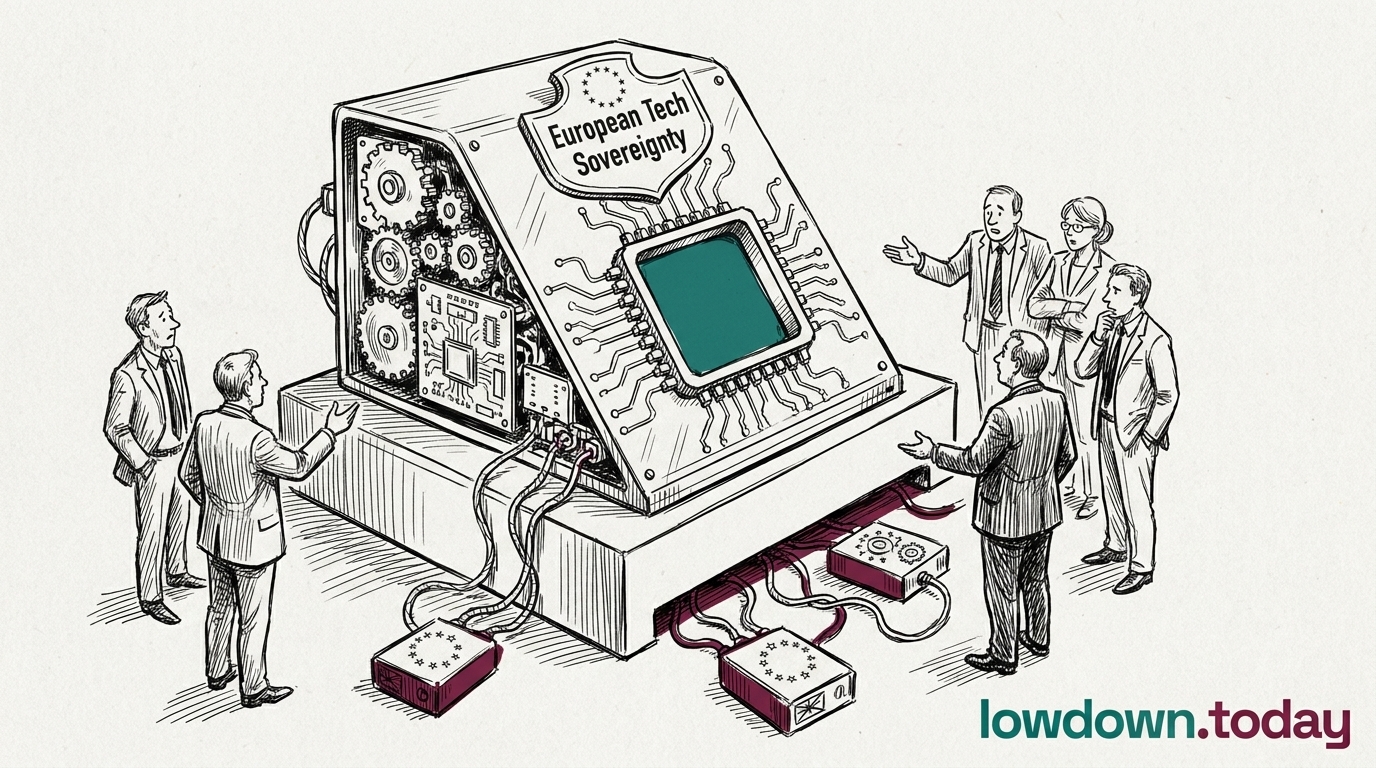
European Tech Sovereignty
23APR

Five energy PDs signed; no Iran paper

3 min read
09:21UTC

Lowdown Bureau / Regulatory. Trump signed five domestic-energy instruments the day before the ceasefire expires, proving the signing machinery was available.

TechnologyDeveloping
Key takeaway

Five signed instruments in one day, none on Iran, settle the question of whether the machinery was operational.

Donald Trump signed five Presidential Determinations on Monday invoking the Defense Production Act to mobilise domestic energy supply: petroleum production, liquefied natural gas (LNG), natural gas, coal supply chains, and grid infrastructure. Presidential Determinations are formal executive instruments published in the Federal Register; they commit funds, authorise contracting, and carry statutory weight. Trump's signing of five Presidential Determinations in a single day is an unusually dense output, and no Iran-specific executive instrument was produced on the same day or any other day since the 28 February start of the war.

Strait of Hormuz disruption is the Iran-driven condition these instruments respond to. Monday's traffic collapse has tightened American LNG and petroleum routing across the Pacific and Atlantic. The five PDs address that disruption by pointing the Defense Production Act inward at US supply chains rather than outward at the cause. The Defense Production Act machinery exists to address foreign-origin threats to American industrial capacity; the instruments signed this week use it for domestic mobilisation without naming Iran, the war, or the strait.

The 51-day instrument gap has, by this point in the war, acquired its own evidence. Josh Hawley is pressing an Authorization for Use of Military Force (AUMF) floor vote push by 29 April, citing the absence of any presidential instrument anchoring the campaign . Lisa Murkowski has drafted an Iran AUMF. The five energy PDs are the clearest single demonstration that the signing apparatus was available the day before the ceasefire expired, and that it was pointed somewhere else.


Deep Analysis

In plain English

President Trump signed five orders on 20 April telling the US government to help build up America's ability to produce oil, natural gas, coal, and electricity more quickly. These orders use a law called the Defense Production Act, originally written for wartime manufacturing, to direct government money and contracts towards energy production. Notably, none of these orders mentioned Iran. Despite a 52-day war with Iran that has disrupted global oil flows, Trump has signed zero orders specifically about Iran. The orders signed on 20 April are about American domestic energy supply, not about the conflict. This matters because it means the US blockade of the Strait of Hormuz; one of the world's most important oil shipping routes; has no signed presidential document behind it. It operates through military orders rather than laws, which creates legal and political uncertainty.

Deep Analysis
Root Causes

The zero-instrument gap reflects a specific structural choice: any Iran-tagged executive instrument creates a Federal Register entry that starts formal Congressional notification under the WPR framework. The administration has opted to operate through CENTCOM orders, which are classified, rather than public executive instruments that would trigger the 60-day clock's notification requirements.

The five DPA energy determinations on 20 April follow the same pattern: they are real mobilisation instruments, not performance, but they were selected precisely because they do not touch Iran and therefore do not create WPR exposure. The administration has created a coherent legal structure around the blockade that avoids any instrument requiring Congressional reporting; at the cost of operating with no civilian legal authority that could survive a court challenge.

What could happen next?
  • Risk

    Operating a naval blockade without a signed presidential instrument means any court challenge to CENTCOM's Hormuz enforcement actions has no positive executive authority to cite; the blockade rests on classified orders and appropriations, not a legal framework that can be publicly defended.

  • Opportunity

    The DPA LNG determination allows the Department of Energy to sign 20-year off-take contracts with US terminal operators by 1 July 2026, potentially unlocking $40-60 billion in private LNG infrastructure investment during the Hormuz disruption window.

First Reported In

Update #75 · Ceasefire ends in the water, a day early

The White House· 21 Apr 2026
Read original
Causes and effects
Different Perspectives
United States (Google/Alphabet)
Alphabet lost its final Android appeal on 2 July with no further court to hear it, a result its Computer and Communications Industry Association allies frame as precedent, not deterrence, since the €4.1bn fine changed nothing about Google's Play Store terms across eight years of litigation.
UK Department for Science, Innovation and Technology
DSIT opened its £96m second Sovereign AI wave on 3 July, switching from April's equity stakes to fixed-price contracts because Britain has no domestic hyperscaler or Bpifrance-style lender to fund capacity another way. It is betting on buying outcomes it controls alone rather than joining an EU-wide framework.
German federal government
Berlin backed both German deliverables this week, Infineon's fab and Aleph Alpha's merger, but is finding one far harder to close than the other. It wants enforceable protective rights inside Cohere's cap table before the merger closes, a legal instrument the Bundeskartellamt has no filing to review yet.
European Commission
European Commission
The Commission banked a clean CJEU win on the eight-year Android case on 2 July, removing Google's last comparator argument before President von der Leyen rules on the far larger DMA self-preferencing fine due 27 July. Brussels treats Infineon's early Dresden delivery as proof the Chips Act mechanism works, at the node Europe already led.
Bruegel (EU industry sceptics)
Bruegel economist Mario Mariniello argued the EU sovereignty package mimics US and Chinese strategy while EU cloud providers hold roughly 15% of their home market; using nationality as a proxy for security without fixing the underlying capital and energy gaps that drive the dependency creates €86bn of migration cost without the security benefit it is sold as delivering.
France
France
France published a joint sovereignty definition with Germany at VivaTech and mobilised €13bn under Tibi Phase 3, placing SAP's partnership with Mistral as the working proof that a German enterprise-software giant running a French sovereign model inside public administration is what digital sovereignty looks like in practice.



