Skip to content
You can now search across every topic, entity and event.What's new
European Tech Sovereignty
8SEP

Brent at $92 as premiums idle tankers

3 min read
15:06UTC

Brent reached $92.09 on Wednesday morning, a fourth straight daily gain, while war-risk premiums of 3% to 10% of hull value keep legal cargo sitting where it is.

TechnologyDeveloping
Key takeaway

Gulf cargo stays put because of what it costs to insure, not because of what blocks it.

Brent crude traded at $92.09 at 01:30 GMT on Wednesday 22 July, up 1.2% and its highest since 11 June, a fourth consecutive daily gain 1.

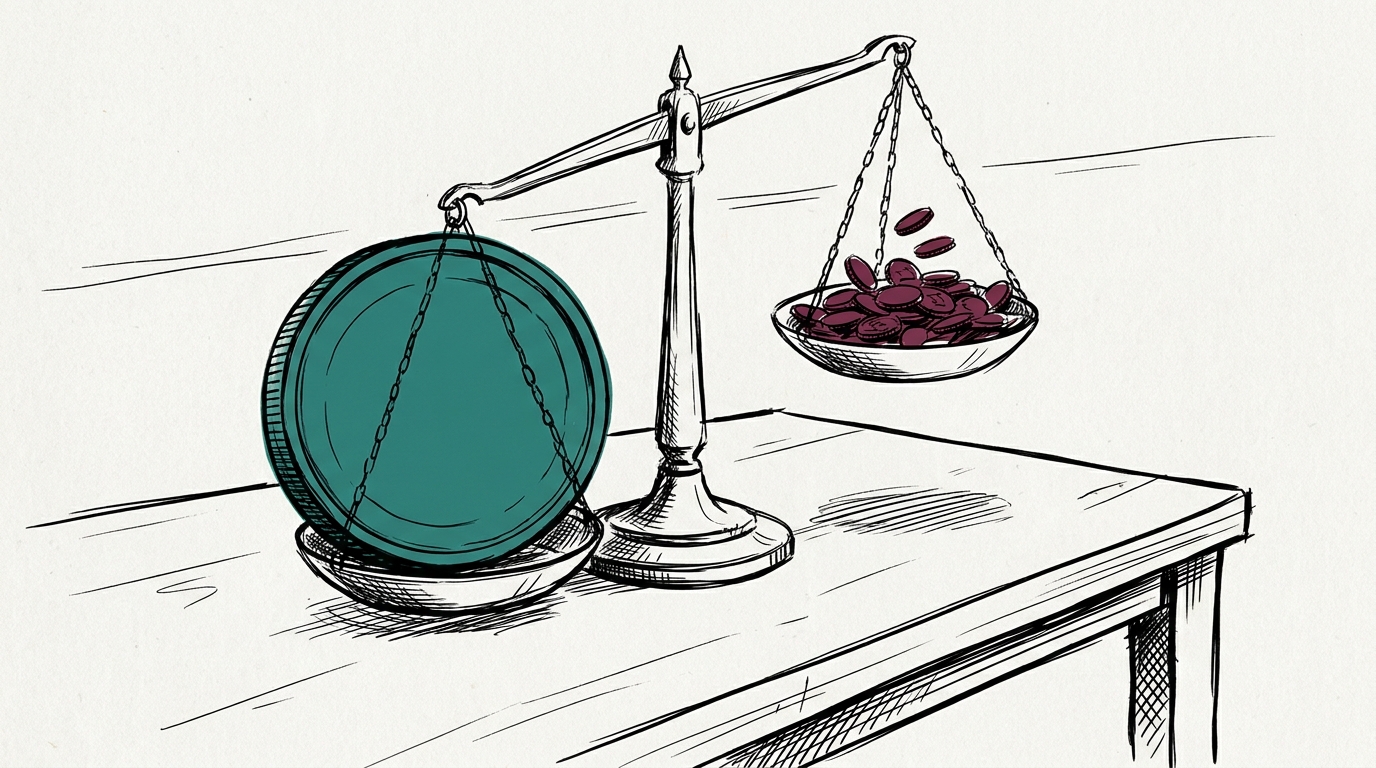
War-risk premiums for a Strait of Hormuz transit now run at 3% to 10% of a vessel's hull value, against 0.25% before the war 2. On a $100 million tanker that is $3m to $10m a voyage where it used to be about $250,000. The largest vessels are quoted $10m to $14m, and the charge falls on the charterer rather than the owner.

Whoever books the ship pays that premium up front and adds it to the delivered cost of the barrels. A buyer with any alternative supplier declines the cargo, and the charter is never fixed. So a legal, licensed, fully insurable parcel of crude sits where it is, because nobody at either end of the voyage will carry a $10 million charge the barrels cannot recover. The Lloyd's Market Association is explicit that cover remains available: what suppresses transits is price and crew willingness, not capacity 3. Underwriting resets slowly, and crews have longer memories than markets.

CENTCOM (US Central Command) frames the same water differently. Its 21 July statement says US forces have facilitated the transit of roughly 900 commercial vessels and 450 million barrels of crude "since early May", redirected eight vessels and disabled one 4. No date window is attached to the 900-vessel figure, so it cannot be set against the 66% weekly fall in transits recorded on 21 July . The two counts cover different things over different periods.

In a note dated 20 July, Daan Struyven of Goldman Sachs set out an upside case of Brent above $120 by the fourth quarter, conditional on Hormuz disruption persisting and Persian Gulf flows staying below roughly 45% of pre-war levels 5. Goldman's base case is $80 in the fourth quarter and about $75 in 2027 6. The higher number describes what happens if nothing changes, not what the bank expects.

Deep Analysis

In plain English

Brent crude, the main international oil price benchmark, rose to $92.09 a barrel, its highest level since 11 June and the fourth straight daily rise. Oil often gets more expensive when investors worry that war could disrupt supply, even before that disruption actually happens. A lot of this price rise comes down to insurance, not ships actually being stopped. Sailing through the Gulf now costs shipping companies far more in war-risk insurance than before the war, and that extra cost is passed on. Insurers say enough cover is technically available, it has simply become expensive enough that some owners choose not to sail. Goldman Sachs, a major investment bank, has said oil could go above $120 a barrel later this year, but only if the situation gets significantly worse. Its actual expectation for now is closer to $80.

Deep Analysis
Root Causes

War-risk premiums of 3-10% of hull value, not a shortage of naval capacity or insurance cover, are what is keeping tankers from sailing the Gulf, according to the Lloyd's Market Association. For the largest vessels, insurers are seeking $10-14 million per Hormuz voyage, a cost charged to the charterer rather than the shipowner.

Because that liability sits with charterers and crews rather than a fixed physical bottleneck, the decision to sail is a commercial one made voyage by voyage, which is why price continues climbing even as CENTCOM reports it is still moving substantial volumes through the strait.

What could happen next?
  • Consequence

    If Gulf flows fall and stay below roughly 45% of pre-war levels through Q4, Goldman's contingent $120+ scenario becomes the operative case rather than its $80 base case.

  • Opportunity

    Because the Lloyd's Market Association says insurance capacity remains available, a de-escalation could unwind the price premium quickly, as happened after the 1990 Gulf War spike.

First Reported In

Update #159 · A second strait closes by radio alone

CENTCOM· 22 Jul 2026
Read original
Different Perspectives
Poland
Poland
Poland leads a self-announced AI Gigafactory consortium with a EUR 100 million phase-one commitment, matched by Czechia and joined by Hungary at EUR 25 million. EuroHPC has confirmed no consortium for the call closing 12 November, so the bloc exists only in national announcements so far.
UK Government (DCMS)
Secretary of State Lisa Nandy told the Commons on 3 September she has inherited the sovereign AI brief from Liz Kendall, but gave no assessment, figure or date on frontier-model access. It is the first public claim of ownership since DSIT's abolition, without the substance the committee asked for.
ASML
ASML
ASML CEO Christophe Fouquet credited Intel Foundry, not a European fab, with shipping the first high-volume logic product made on High-NA EUV, the tool only ASML builds. Europe holds the chokepoint tool; the company that spent it into volume production first is American.
Luxembourg
Luxembourg
Luxembourg joined Mistral's Series D as a new investor on 8 September, the same government that co-funds EuroHPC's MeluXina-AI supercomputer. One small member state now funds the sovereign compute Mistral may need and holds equity in the company using it.
Samsung Electronics
Samsung Electronics
Samsung led Mistral's Series D on 8 September and the same day expanded its ASML collaboration on next-generation lithography. One Korean company now sits atop Europe's largest AI funding round and inside its most sensitive chip-tooling relationship.
Mistral AI
Mistral AI
Mistral closed a EUR 3 billion Series D above a EUR 21 billion valuation on 8 September, with Samsung leading and Luxembourg joining as a new state investor. The company markets itself as Europe's non-American AI option even as the round's lead capital comes from South Korea and two US private-equity firms.
