Skip to content
You can now search across every topic, entity and event.What's new
European Oil Markets
15JUN

Russia raids reserves to cover deficit

3 min read
11:33UTC

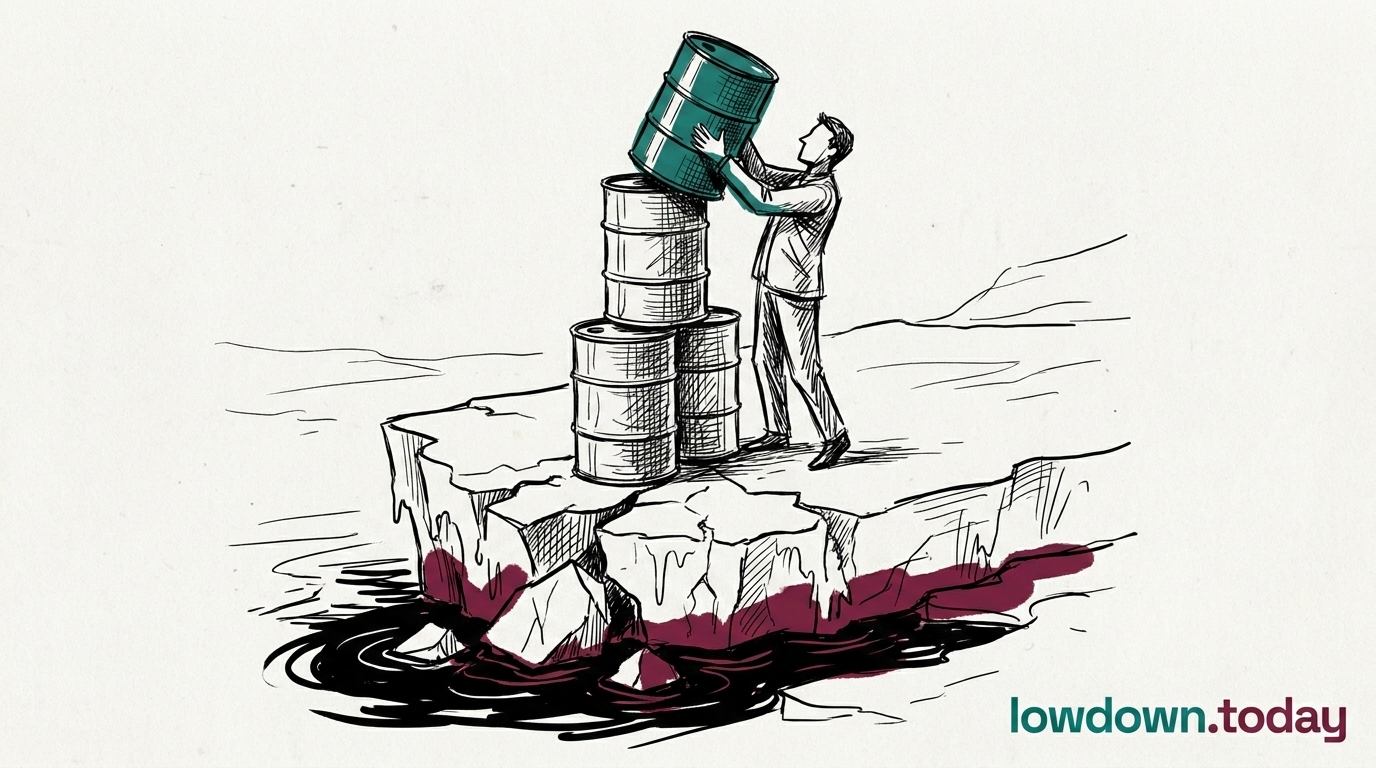
Russia's Finance Ministry credited FX and gold into the National Wealth Fund in June, lifting its liquid portion 45% to RUB 4.13tn, enough to cover the full-year deficit from savings.

EconomicDeveloping
Key takeaway

Russia is covering its half-year shortfall from savings, which buys time, not security.

Russia's Finance Ministry credited delayed foreign-exchange proceeds and gold into the National Wealth Fund in June, lifting its liquid portion from RUB 2.84 trillion to RUB 4.13 trillion, a 45% jump in a single month 1. The National Wealth Fund (NWF) is Moscow's sovereign rainy-day reserve. The one-off injection of RUB 1.3 trillion is enough to cover the full-year budget deficit without a formal revision.

The accounting move matters more than the headline rise. Crediting existing FX and gold shifts assets across the ledger; it does not book new earnings. Oil and gas revenue for the first half came to RUB 4.73 trillion against a RUB 10.94 trillion annual forecast, a shortfall of RUB 2.62 trillion now filled from savings rather than sales. The last clean Urals print was $82.02 in May , still above the $60 fiscal-rule floor that would force deeper spending cuts, so the pressure is on revenue mix and refining, not a sub-floor price.

Reshetnikov warned in early May the liquid NWF could fall to roughly $12.5bn by year-end, and a top-up that papers a half-year gap fits that trajectory rather than refuting it. The sanctions plumbing behind the price, the lapsed crude waiver and shadow-fleet listings, sits with the oil-market desk . What the war briefing tracks is plainer: the cost is real, and Moscow is paying it in reserves and petrol queues, not a revenue crash.


Deep Analysis

In plain English

Russia has a 'rainy-day fund' called the National Wealth Fund (NWF), built up from oil revenues over many years. In June 2026, the Finance Ministry moved RUB 1.3 trillion (roughly $14 billion) into this fund from other government accounts, a 45% jump in one month. Russia's oil and gas revenues in the first half of 2026 came to RUB 4.73 trillion, about RUB 2.62 trillion below the government's annual target. To close that gap without publicly revising the budget, the government transferred reserves from elsewhere on the balance sheet. Russia's NWF still holds roughly $46 billion in liquid assets, but those assets are being drawn down rather than replenished.

What could happen next?
  • Consequence

    Russia's H2 oil and gas revenue must produce approximately RUB 6.21 trillion to meet the annual forecast, roughly 31% more than H1 delivered under current conditions.

  • Risk

    If H2 revenue shortfall is comparable to H1, the NWF liquid portion falls to a level where a formal budget revision becomes politically unavoidable.

First Reported In

Update #21 · Ukraine's drones reach Russia's petrol pumps

Ukrainska Pravda· 24 Jun 2026
Read original
Different Perspectives
Sanctions compliance officer reviewing a Lukoil International GmbH bid
OFAC's amended FAQ 1224 gives a compliance desk its first published standard: full severance from Lukoil and a US-jurisdiction blocked account for sale proceeds. The conditions name neither ISAB nor Italy, so a Priolo Gargallo-linked bid answers a different question than a Neftochim Burgas or Petrotel Ploiesti one.
Managed-money funds on Brent Last Day
CFTC data for the week to 21 July showed managed money flipping 74,400 contracts to a net long of 15,665 against 1,410 short on the Brent Last Day contract, code 06765T. A fund that held that short through July has now covered it, and the spent short base raises the bar for the next leg higher.
Saudi crude exporters
Saudi-linked tanker transits through Bab el-Mandeb fell to about 7.5 a day after the 24 July underwriting withdrawal, pushing more barrels onto the longer route round the Cape or through the Yanbu terminal. Every diverted barrel ties up a ship for longer, and a fleet that turns slower charges more.
Tanker owners on the Bab el-Mandeb route
Lloyd's-market syndicates withdrew war-risk cover from Saudi-linked hulls on 24 July, leaving owners of that class of vessel to sail Bab el-Mandeb uninsured or not at all. Tanker transits on the route fell to roughly 7.5 a day, and cover, once withdrawn, does not return on a shipowner's timetable.
Eni
Eni
Eni's board approved second-quarter results on 29 July, swinging refining EBIT to a EUR0.08bn profit from a year-earlier loss even as group profit doubled, and named Red Sea freight cost as a cap on that improvement. A refiner absorbing higher shipping costs on Saudi-linked crude while its numbers improve treats the freight line as a drag, not a crisis.
Asian buyers (India, Japan, China, South Korea)
Asian refiners are absorbing 62% of Yanbu's 3.75m b/d flow, the bulk of Saudi Arabia's rerouted crude now clearing east rather than into the Atlantic basin. That destination split leaves Asian buyers more exposed to any single Yanbu-specific disruption than under the kingdom's normal multi-terminal export pattern.



