Skip to content
You can now search across every topic, entity and event.What's new
European Oil Markets
15JUN

Five energy PDs signed; no Iran paper

3 min read
11:33UTC

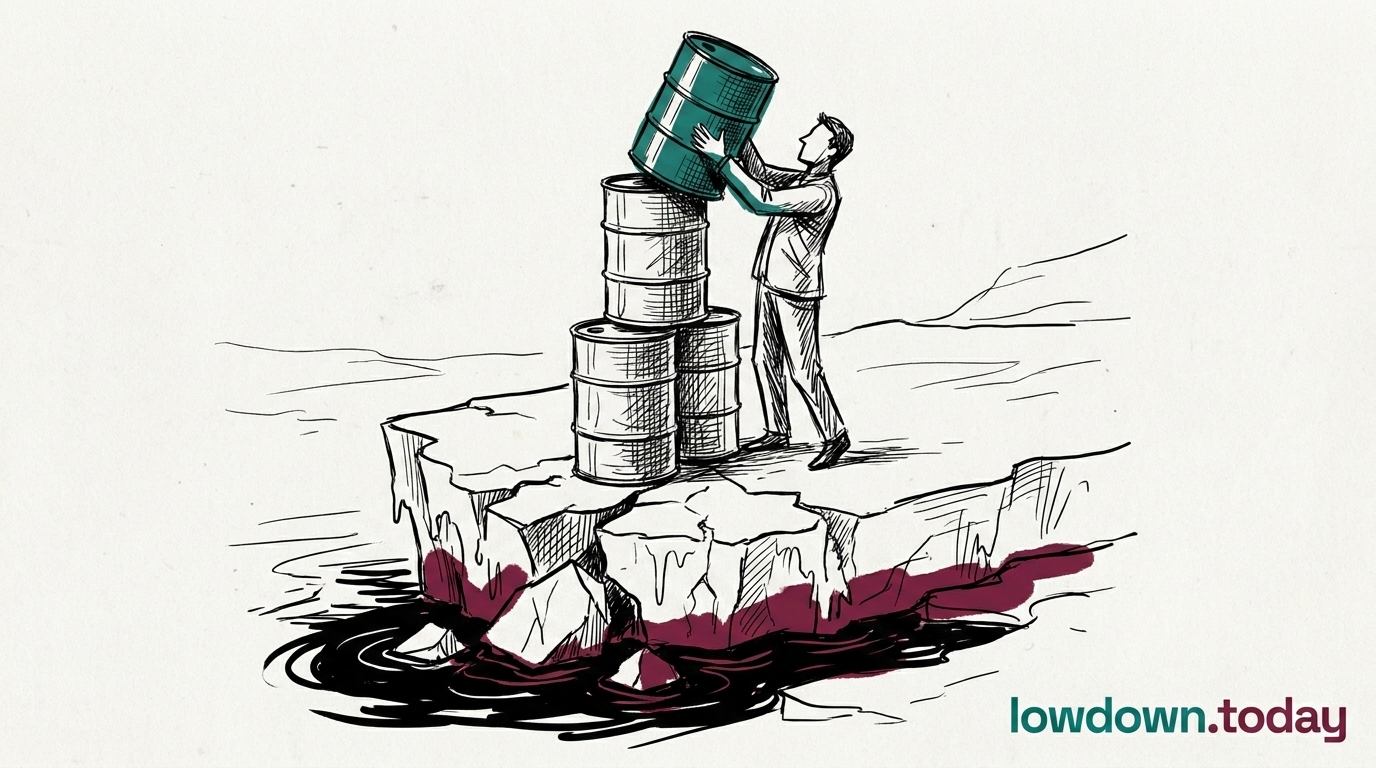
Lowdown Bureau / Regulatory. Trump signed five domestic-energy instruments the day before the ceasefire expires, proving the signing machinery was available.

EconomicDeveloping
Key takeaway

Five signed instruments in one day, none on Iran, settle the question of whether the machinery was operational.

Donald Trump signed five Presidential Determinations on Monday invoking the Defense Production Act to mobilise domestic energy supply: petroleum production, liquefied natural gas (LNG), natural gas, coal supply chains, and grid infrastructure. Presidential Determinations are formal executive instruments published in the Federal Register; they commit funds, authorise contracting, and carry statutory weight. Trump's signing of five Presidential Determinations in a single day is an unusually dense output, and no Iran-specific executive instrument was produced on the same day or any other day since the 28 February start of the war.

Strait of Hormuz disruption is the Iran-driven condition these instruments respond to. Monday's traffic collapse has tightened American LNG and petroleum routing across the Pacific and Atlantic. The five PDs address that disruption by pointing the Defense Production Act inward at US supply chains rather than outward at the cause. The Defense Production Act machinery exists to address foreign-origin threats to American industrial capacity; the instruments signed this week use it for domestic mobilisation without naming Iran, the war, or the strait.

The 51-day instrument gap has, by this point in the war, acquired its own evidence. Josh Hawley is pressing an authorization for use of military force (AUMF) floor vote push by 29 April, citing the absence of any presidential instrument anchoring the campaign . Lisa Murkowski has drafted an Iran AUMF. The five energy PDs are the clearest single demonstration that the signing apparatus was available the day before the ceasefire expired, and that it was pointed somewhere else.


Deep Analysis

In plain English

President Trump signed five orders on 20 April telling the US government to help build up America's ability to produce oil, natural gas, coal, and electricity more quickly. These orders use a law called the Defense Production Act, originally written for wartime manufacturing, to direct government money and contracts towards energy production. Notably, none of these orders mentioned Iran. Despite a 52-day war with Iran that has disrupted global oil flows, Trump has signed zero orders specifically about Iran. The orders signed on 20 April are about American domestic energy supply, not about the conflict. This matters because it means the US blockade of the Strait of Hormuz; one of the world's most important oil shipping routes; has no signed presidential document behind it. It operates through military orders rather than laws, which creates legal and political uncertainty.

Deep Analysis
Root Causes

The zero-instrument gap reflects a specific structural choice: any Iran-tagged executive instrument creates a Federal Register entry that starts formal Congressional notification under the WPR framework. The administration has opted to operate through CENTCOM orders, which are classified, rather than public executive instruments that would trigger the 60-day clock's notification requirements.

The five DPA energy determinations on 20 April follow the same pattern: they are real mobilisation instruments, not performance, but they were selected precisely because they do not touch Iran and therefore do not create WPR exposure. The administration has created a coherent legal structure around the blockade that avoids any instrument requiring Congressional reporting; at the cost of operating with no civilian legal authority that could survive a court challenge.

What could happen next?
  • Risk

    Operating a naval blockade without a signed presidential instrument means any court challenge to CENTCOM's Hormuz enforcement actions has no positive executive authority to cite; the blockade rests on classified orders and appropriations, not a legal framework that can be publicly defended.

  • Opportunity

    The DPA LNG determination allows the Department of Energy to sign 20-year off-take contracts with US terminal operators by 1 July 2026, potentially unlocking $40-60 billion in private LNG infrastructure investment during the Hormuz disruption window.

First Reported In

Update #75 · Ceasefire ends in the water, a day early

The White House· 21 Apr 2026
Read original
Causes and effects
Different Perspectives
Sanctions compliance officer reviewing a Lukoil International GmbH bid
OFAC's amended FAQ 1224 gives a compliance desk its first published standard: full severance from Lukoil and a US-jurisdiction blocked account for sale proceeds. The conditions name neither ISAB nor Italy, so a Priolo Gargallo-linked bid answers a different question than a Neftochim Burgas or Petrotel Ploiesti one.
Managed-money funds on Brent Last Day
CFTC data for the week to 21 July showed managed money flipping 74,400 contracts to a net long of 15,665 against 1,410 short on the Brent Last Day contract, code 06765T. A fund that held that short through July has now covered it, and the spent short base raises the bar for the next leg higher.
Saudi crude exporters
Saudi-linked tanker transits through Bab el-Mandeb fell to about 7.5 a day after the 24 July underwriting withdrawal, pushing more barrels onto the longer route round the Cape or through the Yanbu terminal. Every diverted barrel ties up a ship for longer, and a fleet that turns slower charges more.
Tanker owners on the Bab el-Mandeb route
Lloyd's-market syndicates withdrew war-risk cover from Saudi-linked hulls on 24 July, leaving owners of that class of vessel to sail Bab el-Mandeb uninsured or not at all. Tanker transits on the route fell to roughly 7.5 a day, and cover, once withdrawn, does not return on a shipowner's timetable.
Eni
Eni
Eni's board approved second-quarter results on 29 July, swinging refining EBIT to a EUR0.08bn profit from a year-earlier loss even as group profit doubled, and named Red Sea freight cost as a cap on that improvement. A refiner absorbing higher shipping costs on Saudi-linked crude while its numbers improve treats the freight line as a drag, not a crisis.
Asian buyers (India, Japan, China, South Korea)
Asian refiners are absorbing 62% of Yanbu's 3.75m b/d flow, the bulk of Saudi Arabia's rerouted crude now clearing east rather than into the Atlantic basin. That destination split leaves Asian buyers more exposed to any single Yanbu-specific disruption than under the kingdom's normal multi-terminal export pattern.



