Skip to content
You can now search across every topic, entity and event.What's new
European Oil Markets
11JUN

US pump prices 36% above pre-war

2 min read
08:58UTC

American petrol prices now run 36% above their pre-war level, and the Strategic Petroleum Reserve sits at its lowest since 1983.

EconomicDeveloping
Key takeaway

American pump prices are a third above pre-war levels with the strategic reserve at a 1983 low.

US petrol prices have climbed to 36% above pre-war levels, and the Strategic Petroleum Reserve now sits at its lowest level since 1983, CNN reported on 25 July 1. Brent Crude crossed $100 a barrel on 23 July before easing to $98.38 as mediation reports circulated .

Congress created the reserve after the 1973 oil embargo, and it sits in salt caverns along the Gulf Coast so that a president facing a supply shock can put barrels on the market without asking anyone's permission. Drawing it down to a 1983 level removes that option at the moment a blockade the United States is itself enforcing keeps crude near three figures. Refilling it means buying at those prices, which no administration does willingly in an election cycle.

Pump prices are also the channel through which this war reaches American voters who are not following it. Congressional opposition to the campaign has been measurable and unable to bind the executive; petrol at a third above its pre-war price does not need a roll call to apply pressure. The two constraints now converge on the same building: an air campaign paused for want of munitions, and a fuel price rising because the sea lane that campaign closed has not reopened.


Deep Analysis

In plain English

Petrol prices in the US have climbed to 36% above what they were before the war with Iran started. Normally, when prices spike like this, the government can release oil from its Strategic Petroleum Reserve, a stockpile built for emergencies, to bring prices back down. But that reserve is now at its lowest level since 1983, because it has been drawn down over several years for other reasons. That means the government has much less ability to soften the blow at the pump this time.

Deep Analysis
Root Causes

The Strategic Petroleum Reserve's depletion did not start with this war. Successive administrations drew it down for budget and price-management reasons over the past several years, leaving a reserve sized for a short emergency, not for a Hormuz blockade with a Houthi front now expanding into Saudi Aramco infrastructure directly.

That pre-existing depletion is the structural reason petrol prices are transmitting more directly to the pump now than in earlier oil shocks: the SPR release valve that historically absorbed part of the shock is largely unavailable this time.

What could happen next?
  • Consequence

    With the SPR near its lowest level since 1983, Washington has limited capacity to blunt further petrol-price rises through reserve releases alone.

  • Risk

    Sustained high petrol prices heading into any political negotiation over the war raise domestic pressure on the administration independent of battlefield developments.

First Reported In

Update #162 · Munitions, not Iran, halted US bombing

CNN· 26 Jul 2026
Read original
Causes and effects
This Event
US pump prices 36% above pre-war
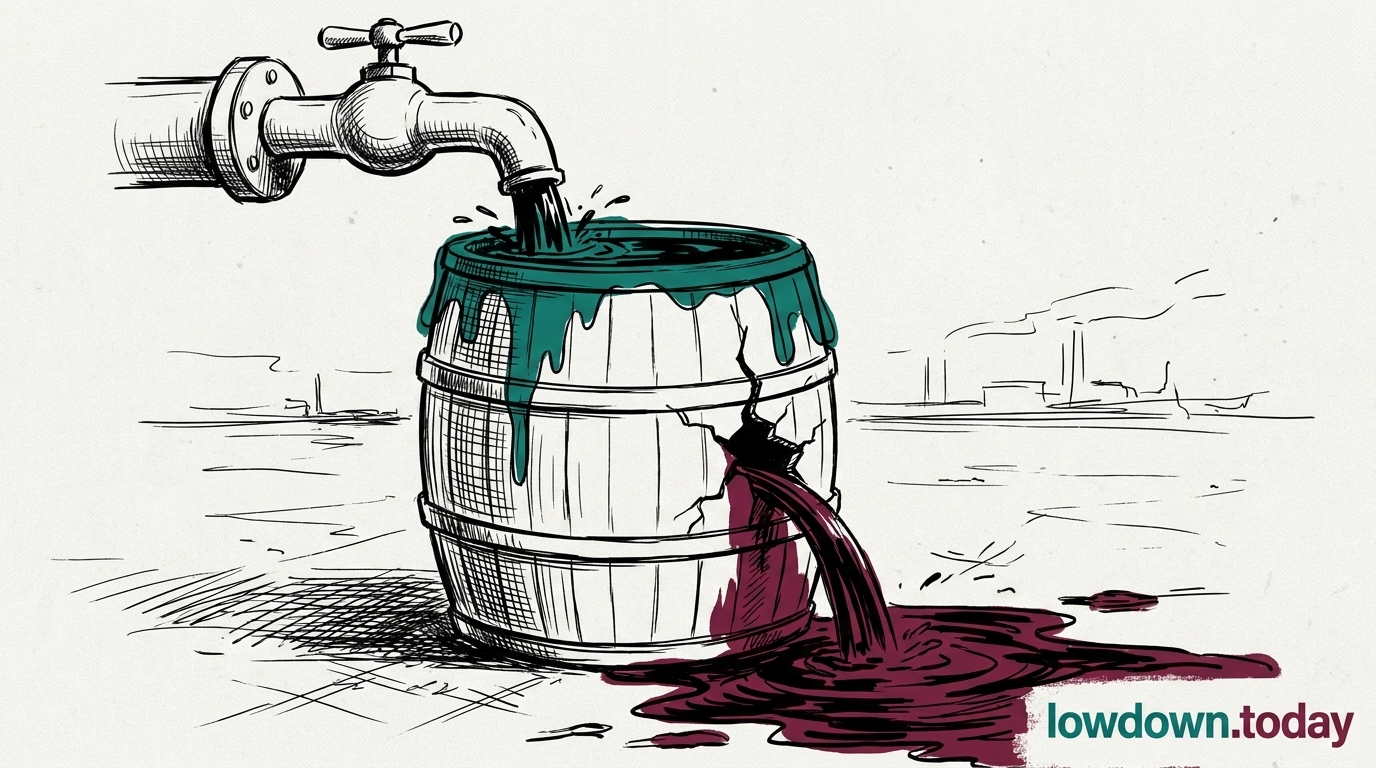
The buffer a president reaches for when fuel prices bite is emptier than at any point in four decades.
Different Perspectives
US money managers (CFTC-tracked)
US money managers had trimmed WTI net long positioning into July's rally, doubting the Hormuz premium would hold without freight or war-risk confirmation, and the crude stock build reported for the week to 17 July gives that scepticism a fundamentals basis. The 25 July CFTC data will show whether Brent's move above $100 changed their calculus.
Asian distillate buyers (Singapore)
Singapore's distillate holders kept retaining middle-distillate barrels as the East-West arbitrage window narrowed further this week, a pattern that sharpened as Fujairah light distillates hit a record low. Cargoes are being held rather than released west into the tightening Mediterranean market.
Bulgaria
Bulgaria
Bulgaria secured the removal of Lukoil founder Vagit Alekperov and Patriarch Kirill from the 21st package, with President Rumen Radev calling a personal listing 'shooting ourselves in the foot'. Sofia is protecting its position in Lukoil's EUR 3bn compensation claim over the 2023 Neftohim Burgas nationalisation.
Russia
Russia
Russia loses the roughly $14 a barrel of legal headroom the price-cap formula would have released toward $58, even as Urals continues trading below Moscow's $59 budget floor. The shadow-fleet insurance workaround that lets sanctioned crude clear above $44 in practice remains untouched by the freeze itself.
European Union
European Union
The EU adopted its 21st sanctions package on 23 July, freezing the $44 Russia oil cap for 12 months rather than letting the formula drift it toward $58, and listed shadow-fleet support vessels for the first time. The package cleared only after three failed Coreper votes.
Marine war-risk underwriters (Lloyd's-linked syndicates)
War-risk syndicates lifted southern Red Sea hull premiums 150% to about 0.75% of hull value after the 20 July blockade declaration, still a seventh of the roughly 5% Hormuz band. Underwriters reset on realised loss, not declared threat, so the 23 July Encelia and Layla strikes set up the next re-mark.



