Skip to content
You can now search across every topic, entity and event.What's new
European Oil Markets
11JUN

Stockpile warning, then a bombing halt

3 min read
08:58UTC

General Dan Caine raised America's munitions stockpile with Trump at a Friday meeting; the bombing campaign went on hold the next night.

EconomicDeveloping
Key takeaway

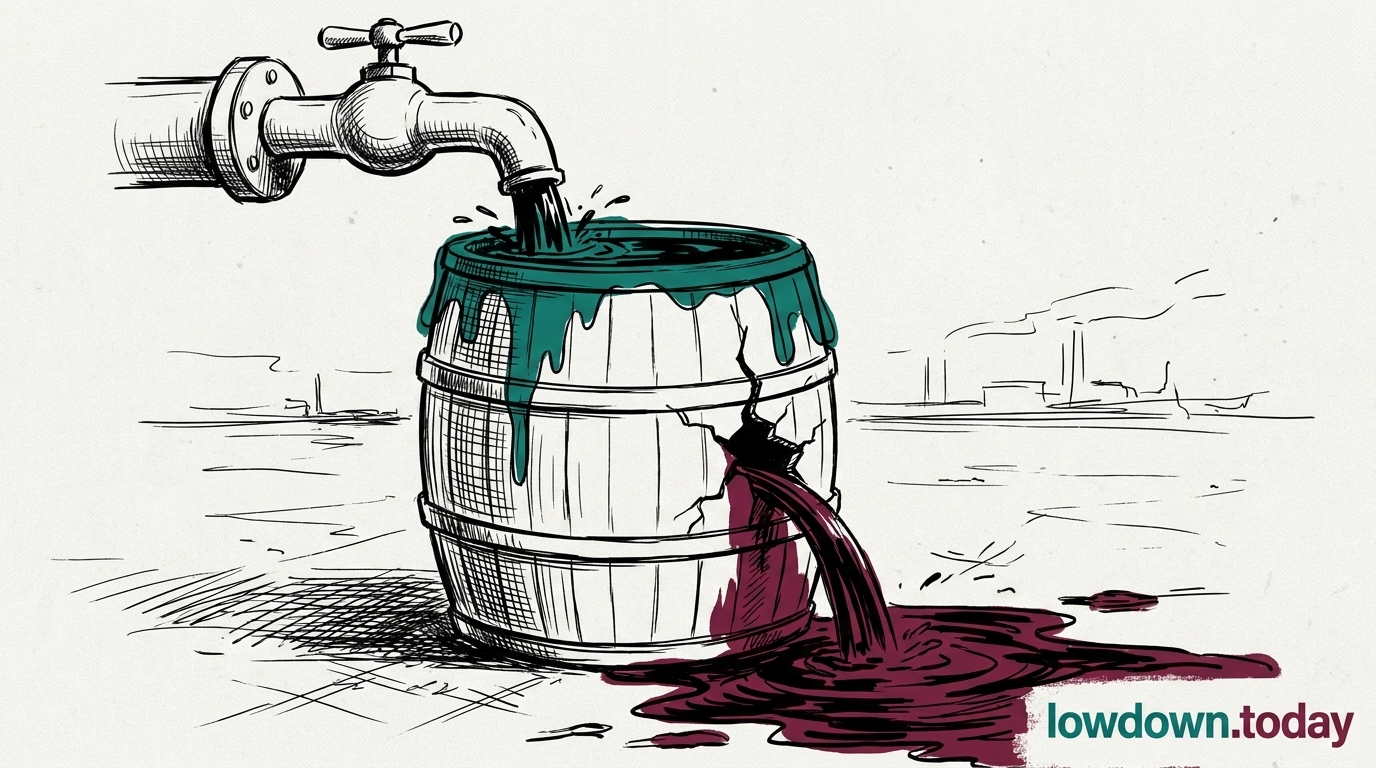
Caine's stockpile warning, not Iranian pressure, explains a halt Washington has attached no agreement to.

The Pentagon paused its bombing campaign against Iran from Saturday 25 July, a Defense Department source told CNN, describing operations as "on a hold" rather than concluded 1. The decision followed a Friday meeting at which General Dan Caine, Chairman of the Joint Chiefs of Staff and the President's most senior military adviser, raised America's munitions stockpile and the risk of further escalation with Trump 2.

Pentagon spokesman Sean Parnell told reporters the United States "retains a deep arsenal of capabilities" despite the halt 3. CENTCOM (US Central Command, the US military headquarters responsible for the Middle East) had already gone quiet for a single night on 24 July while Trump weighed a larger operation . What has changed is the framing: a night without sorties has become a decision with a reason attached to it, and a denial nobody issues unless the question has already been put.

The White House gives a different account. Its communications director tied the pause to "successful sanctions" and thirteen straight days of strikes achieving their aim, not to what is left in American magazines 4. War Secretary Pete Hegseth had priced the campaign at $37.5 billion before the Senate Appropriations Committee , a figure that reads Caine's warning less as caution than as arithmetic.

No ceasefire instrument covers the halt, and nothing has been signed. If the binding constraint is inventory rather than policy, resupply schedules now govern strike tempo, and the production rate of precision munitions becomes a better predictor of the next wave than any negotiating position. Both official accounts stay on the record for now; only what the Pentagon does next will separate them.


Deep Analysis

In plain English

The US military has paused its bombing campaign against Iran. This is not a ceasefire, and Iran has not agreed to anything. Instead, General Dan Caine, the most senior US military officer, warned President Trump on Friday that continuing the campaign risked running down America's stock of precision weapons and interceptors, the kind used to strike targets accurately and shoot down incoming fire. The Pentagon insists it still has plenty of capability left, which is exactly the kind of thing officials say when someone has raised doubts about it. Iran, meanwhile, is not standing down: its security chief says strikes will continue until "total surrender".

Deep Analysis
Root Causes

US precision-guided munition and interceptor production runs on peacetime procurement schedules; PAC-3 output has historically numbered in the hundreds per year, not thousands, while a sustained campaign against a state with layered air defences consumes standoff weapons at a rate procurement cycles were never sized for.

War Secretary Pete Hegseth's own $37.5 billion cost figure to the Senate is the fiscal signature of that mismatch: emergency wartime spending is a symptom of a production base built for deterrence, not for thirteen consecutive nights of strikes.

What could happen next?
  • Meaning

    A halt driven by supply constraints signals a ceiling on US strike tempo that Iran can now factor into its own posture.

    Immediate · Reported
  • Risk

    If Iran reads the pause as exhaustion rather than restraint, as its security chief's rhetoric suggests, it may calculate that continued strikes carry lower cost than before.

    Short term · Reported
  • Consequence

    A resumed campaign, if munitions allow, would need to wait for restocking or a supplemental appropriation beyond the $37.5 billion already spent.

    Medium term · Suggested
First Reported In

Update #162 · Munitions, not Iran, halted US bombing

CNN· 26 Jul 2026
Read original
Causes and effects
This Event
Stockpile warning, then a bombing halt
A campaign halted for want of ordnance rather than for a deal will resume when supply allows, not when diplomacy does.
Different Perspectives
US money managers (CFTC-tracked)
US money managers had trimmed WTI net long positioning into July's rally, doubting the Hormuz premium would hold without freight or war-risk confirmation, and the crude stock build reported for the week to 17 July gives that scepticism a fundamentals basis. The 25 July CFTC data will show whether Brent's move above $100 changed their calculus.
Asian distillate buyers (Singapore)
Singapore's distillate holders kept retaining middle-distillate barrels as the East-West arbitrage window narrowed further this week, a pattern that sharpened as Fujairah light distillates hit a record low. Cargoes are being held rather than released west into the tightening Mediterranean market.
Bulgaria
Bulgaria
Bulgaria secured the removal of Lukoil founder Vagit Alekperov and Patriarch Kirill from the 21st package, with President Rumen Radev calling a personal listing 'shooting ourselves in the foot'. Sofia is protecting its position in Lukoil's EUR 3bn compensation claim over the 2023 Neftohim Burgas nationalisation.
Russia
Russia
Russia loses the roughly $14 a barrel of legal headroom the price-cap formula would have released toward $58, even as Urals continues trading below Moscow's $59 budget floor. The shadow-fleet insurance workaround that lets sanctioned crude clear above $44 in practice remains untouched by the freeze itself.
European Union
European Union
The EU adopted its 21st sanctions package on 23 July, freezing the $44 Russia oil cap for 12 months rather than letting the formula drift it toward $58, and listed shadow-fleet support vessels for the first time. The package cleared only after three failed Coreper votes.
Marine war-risk underwriters (Lloyd's-linked syndicates)
War-risk syndicates lifted southern Red Sea hull premiums 150% to about 0.75% of hull value after the 20 July blockade declaration, still a seventh of the roughly 5% Hormuz band. Underwriters reset on realised loss, not declared threat, so the 23 July Encelia and Layla strikes set up the next re-mark.



