Skip to content
You can now search across every topic, entity and event.What's new
European Oil Markets
11JUN

62 wounded vanish from Pentagon toll

3 min read
08:58UTC

The department's published wounded count fell from 482 to 420 overnight, with no names, no incident and one phrase of explanation: "temporary data disruptions".

EconomicDeveloping
Key takeaway

Sixty-two wounded troops left the Pentagon's public toll with no names and no incident attached.

The Pentagon's published count of Americans wounded in the Iran war fell from 482 to 420 overnight on 24 July, CBS News reported, in the same database update that cut the war's official dead from 18 to 14 1. Acting press secretary Joel Valdez attributed the change to "temporary data disruptions", offering no names, no incident and no revised methodology 2.

Four deaths cannot account for 62 wounded, and the department has not tried to make them. The four names removed were 1st Lt Tyler James Feehan, 25, and Pvt Isabella Gonzales, 19, both named on 20 July after Iran struck Muwaffaq Salti Air Base in Jordan on 17 July ; Sgt Angel S. Rampersad, 28, moved from Duty Status Whereabouts Unknown to believed killed in that same attack ; and Sgt Michael Emmanuel Swinton, 30, killed on 19 July at Erbil Air Base in Iraq during a controlled detonation of a downed Iranian one-way drone, a separate incident in a different country. The Department of War posthumously promoted Swinton to Staff Sergeant, then removed him from the count 3.

Three military officials told The New York Times the removal of the dead was deliberate, on the reasoning that the four deaths fell after the April ceasefire declaration and outside the war's official window 4. Valdez's technical-fault explanation covers the wounded. Two different answers now cover two halves of one night's revision, and the department has published no cutoff rule that would let an outsider check either.

That sits on top of an earlier failure: on 21 July the tracking system briefly showed zero troops wounded for the whole of July, against Parnell's own on-record figure of "nearly 100" the same week. An anonymous US official told the Associated Press the true wounded total "could be more than 500", above every figure the department has published 5. Casualty systems built for declared wars run on a single published rule for what counts and from when; an undeclared campaign running past an unacknowledged ceasefire boundary has no such rule, which is precisely why "technical fault" and "post-ceasefire cutoff" can both be offered for the same database change without either being disprovable. Senate Democrats have written to Hegseth demanding an accounting.


Deep Analysis

In plain English

The Pentagon keeps an official count of how many US troops have been killed or wounded in the Iran conflict. That count has changed in confusing ways three times recently. First it briefly showed zero wounded for the whole of July, even though the Pentagon's own spokesman had said "nearly 100" on the record days earlier. Then the number of dead dropped from 18 to 14, because officials say those four died after a ceasefire was declared in April, a technical rule rather than any dispute about what happened to them. Then, the same night, the wounded count dropped too, from 482 to 420, with no explanation beyond "temporary data disruptions". Four fewer dead does not explain 62 fewer wounded.

Deep Analysis
Root Causes

The Pentagon's casualty database ties a service member's official killed-in-action status to declared periods of hostility; three military officials told the New York Times the four dead were removed because their deaths fell after Trump's late-April ceasefire declaration, a technical cutoff rather than a factual dispute about how they died.

No equivalent public rule governs the wounded count, which is why a 62-person swing there has no comparable explanation on offer: the system has a documented process for reclassifying the dead and none at all for the wounded.

What could happen next?
  • Consequence

    Senate Democrats have written to War Secretary Hegseth demanding an explanation, raising the chance of a congressional oversight hearing.

    Short term · Reported
  • Risk

    A third unexplained change to the casualty count erodes public confidence in official figures at exactly the moment Congress is voting on continued US involvement.

    Immediate · Assessed
  • Meaning

    The gap between the two explanations, a ceasefire-cutoff rule for the dead and an unnamed "disruption" for the wounded, suggests the department does not have a single coherent accounting method.

    Immediate · Reported
First Reported In

Update #162 · Munitions, not Iran, halted US bombing

CBS News· 26 Jul 2026
Read original
Causes and effects
This Event
62 wounded vanish from Pentagon toll
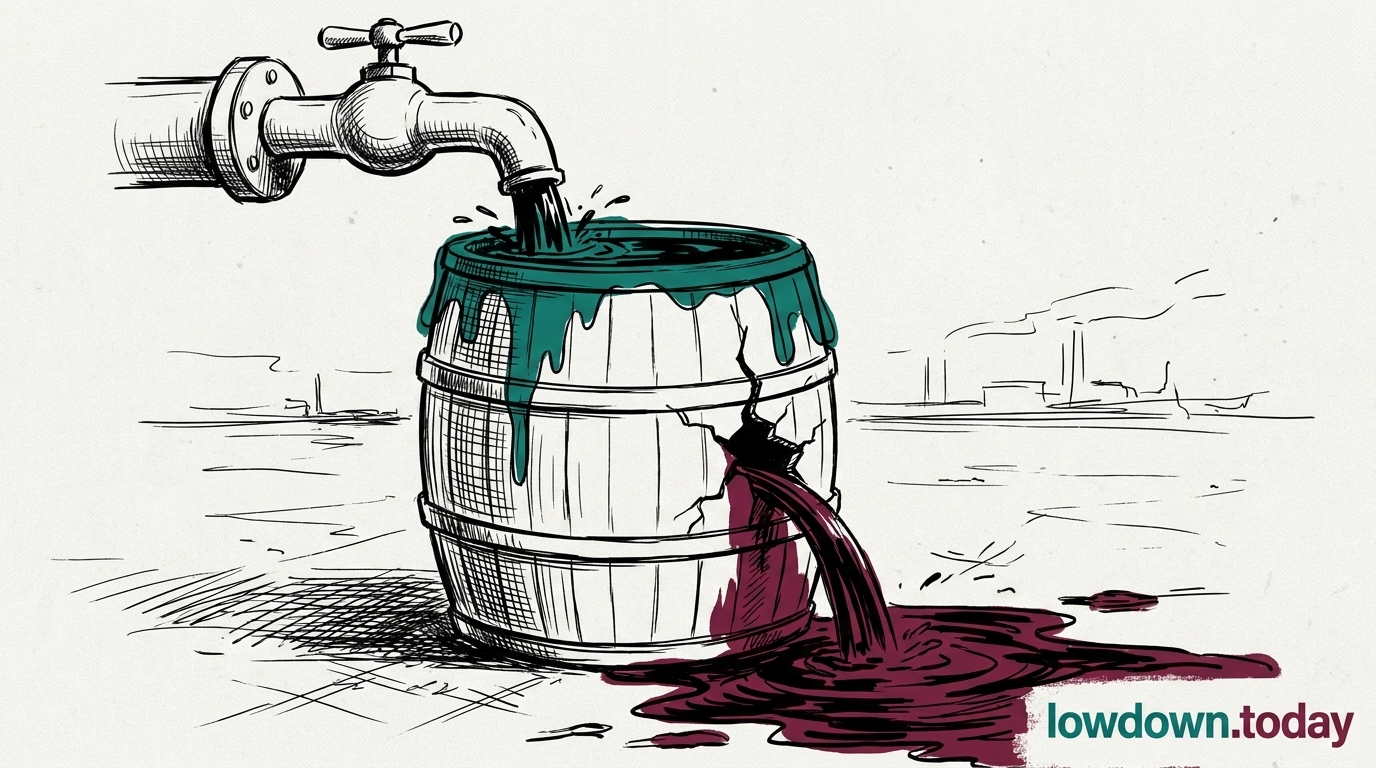
A wounded count that moves by 62 without an accounting is a larger unexplained revision than the four dead who drew all the scrutiny.
Different Perspectives
US money managers (CFTC-tracked)
US money managers had trimmed WTI net long positioning into July's rally, doubting the Hormuz premium would hold without freight or war-risk confirmation, and the crude stock build reported for the week to 17 July gives that scepticism a fundamentals basis. The 25 July CFTC data will show whether Brent's move above $100 changed their calculus.
Asian distillate buyers (Singapore)
Singapore's distillate holders kept retaining middle-distillate barrels as the East-West arbitrage window narrowed further this week, a pattern that sharpened as Fujairah light distillates hit a record low. Cargoes are being held rather than released west into the tightening Mediterranean market.
Bulgaria
Bulgaria
Bulgaria secured the removal of Lukoil founder Vagit Alekperov and Patriarch Kirill from the 21st package, with President Rumen Radev calling a personal listing 'shooting ourselves in the foot'. Sofia is protecting its position in Lukoil's EUR 3bn compensation claim over the 2023 Neftohim Burgas nationalisation.
Russia
Russia
Russia loses the roughly $14 a barrel of legal headroom the price-cap formula would have released toward $58, even as Urals continues trading below Moscow's $59 budget floor. The shadow-fleet insurance workaround that lets sanctioned crude clear above $44 in practice remains untouched by the freeze itself.
European Union
European Union
The EU adopted its 21st sanctions package on 23 July, freezing the $44 Russia oil cap for 12 months rather than letting the formula drift it toward $58, and listed shadow-fleet support vessels for the first time. The package cleared only after three failed Coreper votes.
Marine war-risk underwriters (Lloyd's-linked syndicates)
War-risk syndicates lifted southern Red Sea hull premiums 150% to about 0.75% of hull value after the 20 July blockade declaration, still a seventh of the roughly 5% Hormuz band. Underwriters reset on realised loss, not declared threat, so the 23 July Encelia and Layla strikes set up the next re-mark.



