Skip to content
Briefings are running a touch slower this week while we rebuild the foundations.See roadmap
European Oil Markets
29MAY

Brent loses $14 in four sessions

3 min read
14:36UTC

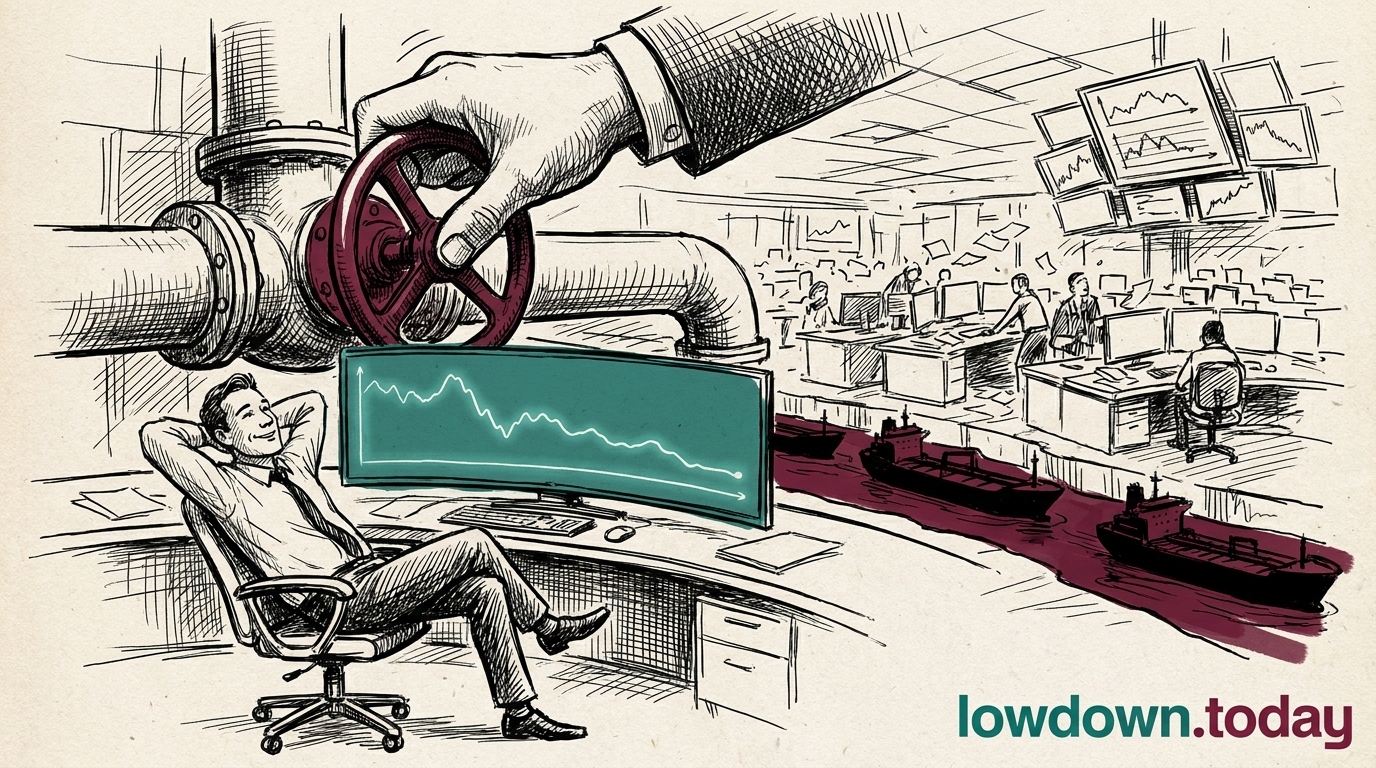
Brent fell from $110.34 on Wednesday 20 May to $96.14 on Sunday 24 May after Trump called the Iran deal 'largely negotiated', deflating the Hormuz war premium that the light-sweet complex had carried.

EconomicDeveloping
Key takeaway

Brent shed $14 on the Iran MOU; the war premium is discounted, not gone, with uranium still outside the deal.

Brent fell from $110.34 on Wednesday 20 May to $96.14 on Sunday 24 May, a $14 week, with WTI shedding over 6% to $90.30 1. The driver sat next door in the diplomacy: Donald Trump called the Iran deal "largely negotiated" on Saturday 23 May, framing a memorandum of understanding as phase one with the Hormuz-reopening narrative doing the rest 2. The diplomacy sits in the Iran file; the spreads it knocked sit with us.

The Brent-Dubai EFS is narrowing from the $6-plus peak it held in early May , because the light-sweet Hormuz bid deflates faster than sour Dubai, which never carried the same war premium. Brent-WTI is compressing toward $1-2 from the old $4-5 band as WTI catches up. That spread is the one that pays for the trade: above roughly $4 the round-trip economics justify hauling Atlantic barrels east on VLCCs, and below it they stop working. We will not put a precise current EFS print on the page because the assessment is paywalled, but the direction is not in doubt.

The MOU is phase one of a 30-60 day process and leaves the highly-enriched-uranium stockpile untouched 3, so the war premium is discounted, not dead, and a single failed-flow headline re-arms the EFS. The market that ran the long-Brent, short-WTI trade against has watched the Atlantic-basin premium that funded it evaporate inside a week, and the freight complex still reads a war it no longer fully believes in.


Deep Analysis

In plain English

Oil prices fell sharply in the last week of May after US President Trump announced an early-stage deal with Iran that could reopen the Strait of Hormuz ; the narrow sea passage through which roughly a fifth of the world's oil flows. Brent crude, the main international price benchmark, dropped from about $110 to $96 in four days. The move reflects markets pricing in the possibility of cheaper Iranian oil returning. However, the deal is not final: Iran's nuclear stockpile was left out, and broader talks are expected to take 30-60 days. Diesel prices across Europe may ease slightly on the news, but the underlying shortage of middle distillates means any relief could be temporary.

Deep Analysis
Root Causes

The EFS blowout above $6 reflected two compounding effects: (1) Asian refiners bidding aggressively for Atlantic light-sweet crudes as Hormuz-sourced barrels (mostly medium-sour Gulf grades) were unavailable; (2) European refiners simultaneously short of Middle East sourcing (695kbd import gap, BP outage), driving NWE gasoil and Atlantic crude basis higher.

Trump's 23 May MOU announcement deflated only the geopolitical risk premium in flat Brent. The structural distillate deficit in Europe (9% below US 5yr average, 38% import collapse) is supply-side, not geopolitical ; it persists regardless of diplomatic signal. This is why the ICE Gasoil crack held near $54/bbl even as Brent fell $14: the crack spread widens mechanically when flat price falls faster than physical distillate premiums.

What could happen next?
  • Risk

    If Hormuz mine clearance stalls within the 30-60 day MOU window, Brent will spike back above $100 and the EFS will re-widen toward the $6+ peak, punishing any long position built on the Iran deal narrative.

    Short term · Assessed
  • Consequence

    The EFS narrowing removes the primary economic incentive for Atlantic-basin crude to route east on VLCCs; TD3C spot freight will soften from the WS458.75 peak as the light-sweet bid deflates.

    Short term · Reported
  • Opportunity

    The ICE Gasoil crack is structurally wider relative to flat price as Brent falls; refiners with Mediterranean and NWE crude intake locked at pre-MOU prices and gasoil sold at current forward prices capture asymmetric margin.

    Short term · Assessed
First Reported In

Update #2 · GL 134C reverses the cliff, Brent -$14

CNBC· 26 May 2026
Read original
Different Perspectives
Energy Aspects / sell-side macro desk
The divergence between a sub-$95 Brent print and a crack holding near $54/bbl is the trade: hold the crack long against crude, with the June OFAC calendar as optionality on top; the six-extension base rate and the 17 June / 27 June deadline stack both argue for carry rather than a directional cliff bet on the flat price.
Indian downstream (Chennai refiners, Rishabh Triexim LLP)
OFAC's 28 May designation of Chennai-based Bagrecha and Rishabh Triexim is the first time a named Indian end-buyer has been placed on the SDN list in this enforcement cycle; it raises the compliance exposure of Indian financial institutions handling Iranian crude payments and is expected to recalibrate risk appetite among Indian trading houses running the discounted-crude circuit.
Rosneft / Russian export ministry
Each hull listing under the EU 21st package and each Iran SDN action tightens the grey-tonnage pool that Russian crude depends on post-GL134B; the re-flagging and hull-substitution response to prior packages has a longer lead time than the pace of new listings, so the freight premium on compliant Baltic Aframax tonnage widens before Moscow can respond.
EU Council sanctions directorate
The 21st package's choice of shadow-fleet listings and bank restrictions over a price-cap revision reflects the carry-not-cap doctrine that survived the April unanimity failure; the Brussels directorate routes pressure through freight and financing costs rather than cap arithmetic, compounding OFAC's tonnage-pool drain without requiring G7 consensus on a new cap number.
Med refiner (ISAB / Priolo Gargallo operators)
Six consecutive GL rollovers without a completed sale leave ISAB running under a sanctions-perimeter procurement overhang; no commercial buyer can meet FAQ 1224's blocked-account condition at sub-$95 Brent without sovereign backing, so the Italian complex continues processing Adriatic sour grades under contingent authorisation with no clear exit.
OFAC / US Treasury
OFAC / US Treasury
GL 131F's sixth extension and the simultaneous 28 May Iran SDN action reflect OFAC's dual-programme cadence: authorise-without-compelling on the Russian refinery track, while closing the final buyer leg on the Iranian crude circuit. The compound June calendar is the deliberate architecture, not an oversight.