Skip to content
You can now search across every topic, entity and event.What's new
European Energy Markets
31JUL

Trump says 'Make Iran Great Again'

3 min read
09:44UTC

Trump's first constructive framing of Iran's future arrives after every diplomatic channel — direct, back-channel, and multilateral — has been closed, exposed, or rejected.

EconomicDeveloping
Key takeaway

A genuine war-termination signal from the White House has no diplomatic infrastructure through which it can travel to Tehran, making it strategically inert regardless of presidential intent.

President Trump rated the military operation "12-15 on a ten-point scale" and used the phrase "Make Iran Great Again" — the first time since strikes began on 28 February that the president has framed Iran's future in constructive rather than purely destructive terms.

The rhetorical arc over eight days has moved in a single direction: from declaring Iran "demolished ahead of schedule" , through demands for unconditional surrender and personal addresses to IRGC commanders offering immunity or death, to a slogan that implies a future for the Iranian state rather than its elimination. Whether this represents an actual political endgame or performative branding cannot be determined from a phrase.

What can be determined is that no mechanism exists to translate the words into diplomacy. Foreign Minister Araghchi — the official who had earlier signalled flexibility through Oman — publicly ruled out negotiations, stating Iran will not talk while under attack . When Iranian intelligence operatives reached the CIA through a third country's service, Trump posted "Too Late!" within hours of the New York Times publishing the contact . CNN confirmed no direct communication between Special Envoy Steve Witkoff, Jared Kushner, and any Iranian counterpart. The Egypt-Turkey-Oman mediation framework has attracted no confirmed participants.

Trump himself supplied the historical parallel. He told Axios he wanted involvement in appointing Iran's next leader "like with Delcy in Venezuela" — the 2019 back-channel with Diosdado Cabello that produced no political change in Caracas. The pattern is structurally identical: maximum military and economic pressure, escalating rhetorical ambition about the target state's future, and no interlocutor capable of or willing to negotiate the transformation being described. In Venezuela, the gap between rhetoric and diplomatic machinery lasted years and yielded nothing. In Iran, the same gap exists during an active air war with 3,000 targets struck and no channel through which to stop.


Deep Analysis

In plain English

Trump's 'Make Iran Great Again' phrase is the first time he has framed this conflict as building something rather than destroying something. That is significant — but for a peace signal to work, there must be someone on the other side who can receive and respond to it through an agreed channel. Currently, Iran's most flexible diplomat has publicly refused talks, there is no US embassy in Tehran, and no agreed intermediary country has confirmed its role. The signal exists; the address does not.

Deep Analysis
Synthesis

The phrase creates a strategic ambiguity that all parties will interpret according to their priors simultaneously: Iran's hardliners as evidence of weakness, potential Iranian moderates as a conditional opening, and US allies as either a coherent signal or White House incoherence. In the absence of a channel to resolve the ambiguity, all interpretations coexist — a condition that increases miscalculation risk rather than reducing it, because each actor will act on their own reading.

Root Causes

The diplomatic vacuum is both structural and contingent. Structurally: no US-Iran bilateral channel has existed since 1980, the Swiss protecting power arrangement was not activated at the war's onset, and the Egypt-Turkey-Oman format excludes direct US participation. Contingently: the war's opening tempo foreclosed the informal back-channels — Omani interlocution, Iraqi facilitation — that normally survive formal diplomatic ruptures.

Escalation

The civil-military misalignment risk is the novel escalatory vector the body does not address: if military commanders interpret continued operational orders as authorisation to escalate while the president is signalling openness to resolution, strikes could foreclose the diplomatic opening the phrase may be attempting to create — a gap between presidential intent and operational reality that has precedent in the early Vietnam bombing pauses.

What could happen next?
  • Meaning

    The rhetorical shift marks the first time the White House has framed a post-war Iran as a desirable outcome rather than a punished one — a necessary but insufficient precondition for any eventual negotiated settlement.

    Immediate · Assessed
  • Risk

    Civil-military misalignment — military operations escalating while presidential rhetoric signals openness — could produce strikes that structurally foreclose the diplomatic opening the phrase may be testing.

    Short term · Suggested
  • Risk

    Allied governments parsing the phrase as incoherence rather than signal may begin hedging their political support for US operations, creating coalition fragmentation at a critical moment in the air campaign.

    Short term · Suggested
  • Opportunity

    If the phrase reflects genuine presidential intent, it could be operationalised through a Track 1.5 channel — academic or think-tank intermediaries with Iranian counterpart access — faster than a formal diplomatic architecture could be constructed.

    Short term · Suggested
First Reported In

Update #25 · Russia shares targeting data on US forces

Reuters· 7 Mar 2026
Read original
Causes and effects
This Event
Trump says 'Make Iran Great Again'
The first constructive rhetorical framing of Iran's future in Trump's wartime statements arrives without any diplomatic mechanism to pursue it. Every potential conduit — Araghchi's direct rejection, the CIA back-channel exposed and rebuffed, multilateral mediation with no participants — is closed. The structural gap between escalating rhetorical ambition and absent diplomatic infrastructure defines the conflict's political deadlock.
Different Perspectives
Spain's LNG terminal operators
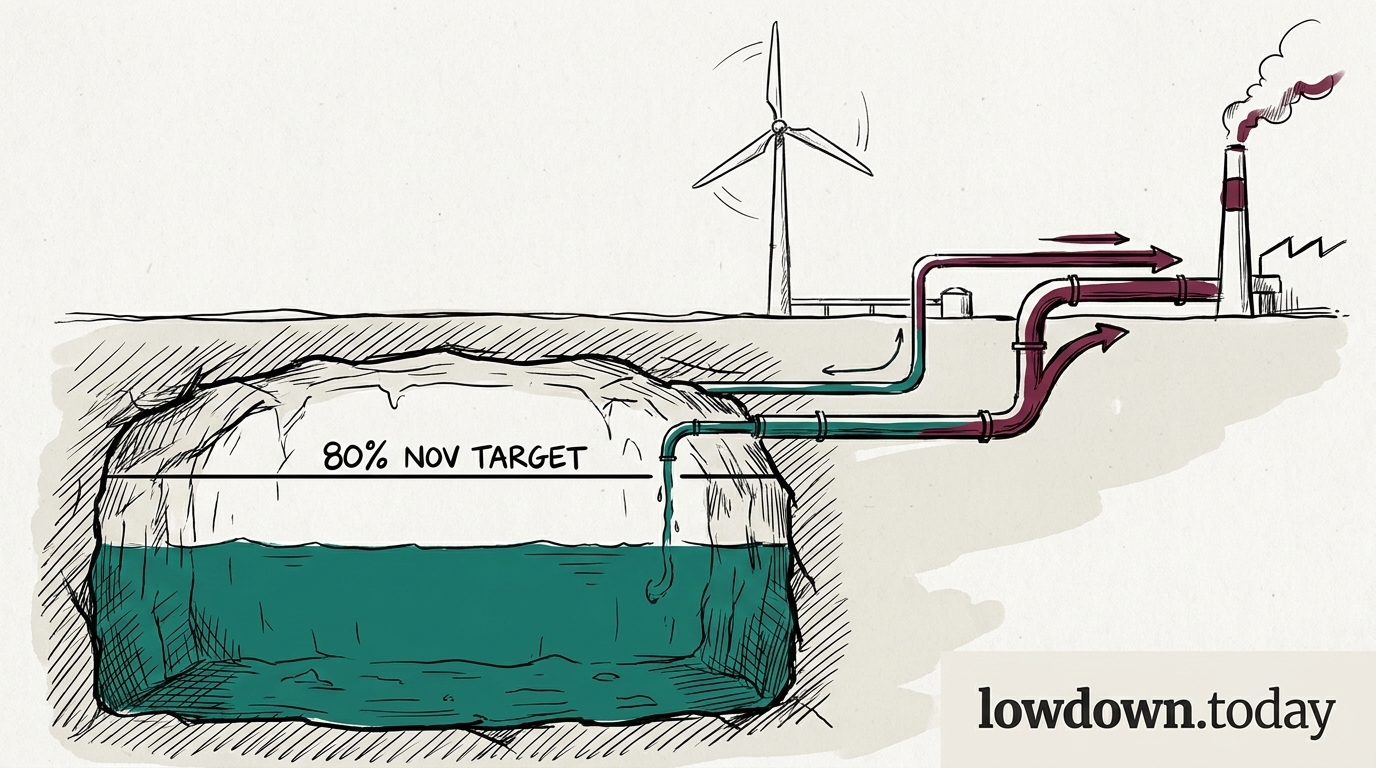
Spain's 9,145 GWh terminal inventory is the largest single stock in the EU LNG network, an option value that can reroute cargoes wherever the winter strip pays best rather than a cavern gas obligation tied to a fixed date. That flexibility matters more as Germany's cavern shortfall pushes more of the winter security question onto import infrastructure.
European Commission
European Commission
Brussels holds the bloc to 90% on a flexible window while Germany, holding roughly a quarter of EU storage capacity, tracks toward missing its own lower 80% figure by 21 points. A national shortfall this size in the anchor market matters more to bloc security than the flexible timetable alone can absorb.
French power exporters and CRE
French day-ahead rose in step with Germany but by less, reopening a EUR 7-17 premium that makes northward export flows commercially attractive again after the EUR 43.09 discount evaporated in days. CRE separately authorised RTE and Enedis to buy flexibility locally, betting the coming winter's binding constraint is grid congestion rather than a shortage of firm capacity.
TTF trading desk
TTF trading desk
A visible national shortfall like Germany's 21-point gap is a directional signal, not noise, for a desk holding the summer-winter spread. TTF's flat EUR 58-60 range through this week's German price swings says the market has not yet chosen to reprice refill risk into the front of the curve.
German cavern and CCGT operators
German caverns kept buying prompt gas at TTF near EUR 58-60 through the inversion; the wind collapse to 2.4 GW then flipped the spark spread to plus EUR 29 and put turbines back in the same queue. Every day turbines win that bid, injection at a third of the 877 GWh/day pace needed falls further behind.
Slovakia
Slovakia
Slovakia says it dropped its hold-out on the 21st sanctions package only after Ursula von der Leyen personally signed written gas-price and supply guarantees. The Council of the European Union's own 17,238-character release on the package names neither Slovakia nor any guarantee, leaving Bratislava's account unconfirmed by the institutional record.



