Skip to content
You can now search across every topic, entity and event.What's new
European Energy Markets
31JUL

Pakistan urged US to protect Iran envoys

2 min read
09:44UTC
EconomicDeveloping

The Wall Street Journal confirmed, via US officials, that Pakistan asked the US to press Israel to remove Foreign Minister Abbas Araghchi and Parliamentary Speaker Mohammad Bagher Ghalibaf from a joint US-Israeli assassination target list, and that the US complied, temporarily. 1 Both officials were 'temporarily removed from a Joint US-Israeli Target List for several days' while Trump explored indirect talks, per US officials speaking to the Journal.

Iran had categorically denied any negotiations and Ghalibaf had dismissed talks as an attempt to 'escape the quagmire' . Yet Pakistan had already positioned itself as intermediary and confirmed it was relaying a 15-point US proposal . The public disclosure that the kill list is jointly operated, and that Washington can override Israeli targeting for diplomatic reasons, transforms targeted killing from a military tactic into a bargaining instrument.

Israel killed Tangsiri on the same day those protections were secured. The two events are not contradictory but they establish a hierarchy: the man managing the Hormuz blockade was expendable; the men who might negotiate its end were not. Iran now knows which of its officials the US considers necessary for talks and which it will allow Israel to kill. That knowledge reshapes Iranian internal power dynamics in ways that are difficult to predict but almost certainly corrosive to internal cohesion.

The political risk for the protected officials is also real: Araghchi and Ghalibaf can now be accused by hardliners of collaboration with Washington, given that their protection from the joint list is now public knowledge. The confirmation creates a domestic political vulnerability that may constrain their room to negotiate even if they wished to.


Deep Analysis

In plain English

The US and Israel share a list of Iranian officials they plan to kill. Pakistan asked the US to take two Iranian politicians off that list temporarily so peace talks could proceed, and the US agreed. The fact that this list exists, is jointly managed by Washington and Tel Aviv, and responds to diplomatic pressure from Islamabad is now confirmed public knowledge. For Iran, this means that the diplomatic protection of its officials can be revoked by Washington at any time, which makes trusting the talks considerably harder. For Israel's critics, it confirms that Washington has more control over Israeli targeting than it publicly admits.

Deep Analysis
Root Causes

The structural cause is the collision between two requirements: maintaining credible military deterrence (which requires unpredictability) and conducting diplomacy (which requires protected channels).

Public confirmation of the list's existence makes both functions harder. Targets know the criteria; adversaries know the constraints.

First Reported In

Update #49 · Hormuz toll into law; Tangsiri killed

Al Jazeera· 27 Mar 2026
Read original
Different Perspectives
Spain's LNG terminal operators
Spain's 9,145 GWh terminal inventory is the largest single stock in the EU LNG network, an option value that can reroute cargoes wherever the winter strip pays best rather than a cavern gas obligation tied to a fixed date. That flexibility matters more as Germany's cavern shortfall pushes more of the winter security question onto import infrastructure.
European Commission
European Commission
Brussels holds the bloc to 90% on a flexible window while Germany, holding roughly a quarter of EU storage capacity, tracks toward missing its own lower 80% figure by 21 points. A national shortfall this size in the anchor market matters more to bloc security than the flexible timetable alone can absorb.
French power exporters and CRE
French day-ahead rose in step with Germany but by less, reopening a EUR 7-17 premium that makes northward export flows commercially attractive again after the EUR 43.09 discount evaporated in days. CRE separately authorised RTE and Enedis to buy flexibility locally, betting the coming winter's binding constraint is grid congestion rather than a shortage of firm capacity.
TTF trading desk
TTF trading desk
A visible national shortfall like Germany's 21-point gap is a directional signal, not noise, for a desk holding the summer-winter spread. TTF's flat EUR 58-60 range through this week's German price swings says the market has not yet chosen to reprice refill risk into the front of the curve.
German cavern and CCGT operators
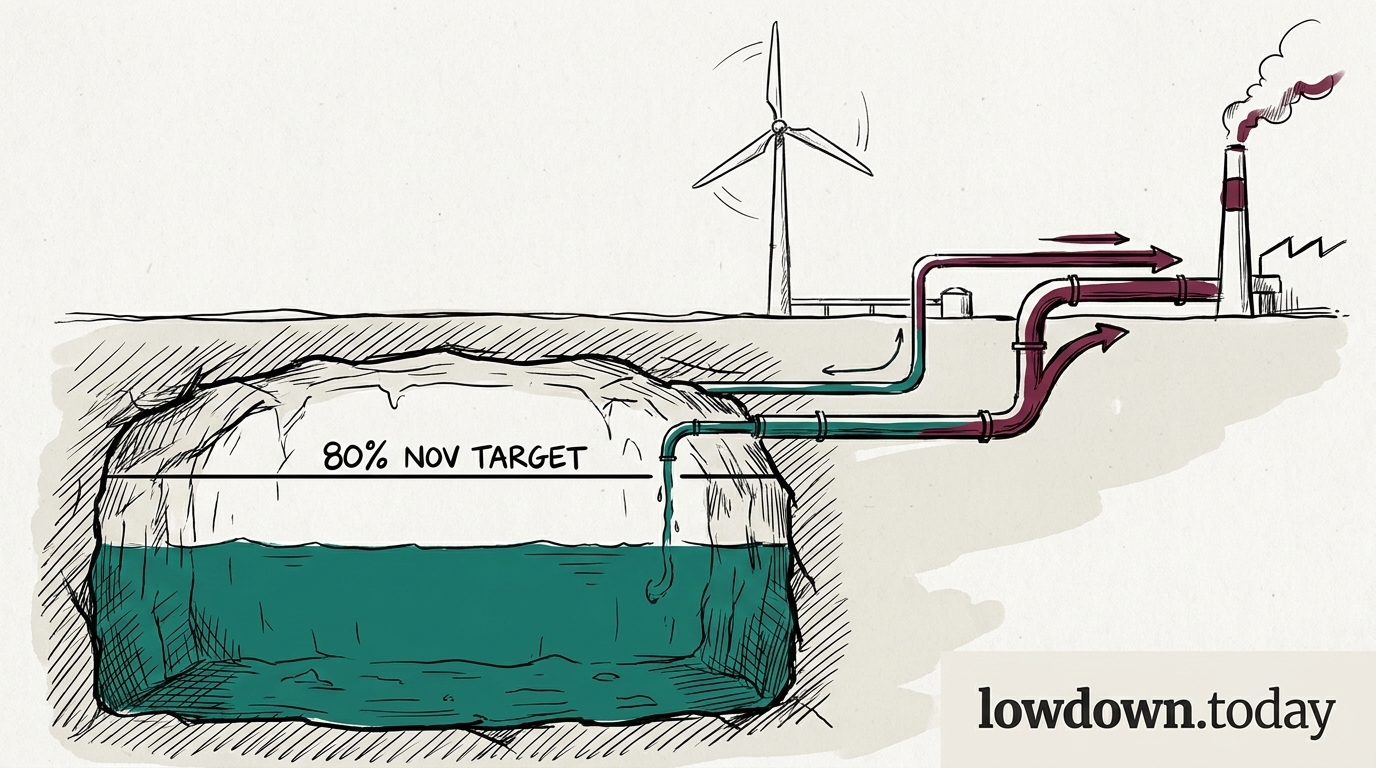
German caverns kept buying prompt gas at TTF near EUR 58-60 through the inversion; the wind collapse to 2.4 GW then flipped the spark spread to plus EUR 29 and put turbines back in the same queue. Every day turbines win that bid, injection at a third of the 877 GWh/day pace needed falls further behind.
Slovakia
Slovakia
Slovakia says it dropped its hold-out on the 21st sanctions package only after Ursula von der Leyen personally signed written gas-price and supply guarantees. The Council of the European Union's own 17,238-character release on the package names neither Slovakia nor any guarantee, leaving Bratislava's account unconfirmed by the institutional record.



