Skip to content
You can now search across every topic, entity and event.What's new
European Energy Markets
31JUL

IRGC seizes Epaminondas and MSC Francesca

2 min read
09:44UTC

Iranian forces took two vessels and damaged a third in the Strait of Hormuz on 22 April with no LNG movement resuming.

EconomicDeveloping
Key takeaway

Three vessels seized or damaged on 22 April close any near-term route for queued cargoes to reach Europe.

Iranian forces seized the Epaminondas and MSC Francesca and damaged the Euphoria on 22 April 2026 in the Strait of Hormuz 1. The three-vessel action followed the pattern the IRGC Navy had established four days earlier against commercial shipping. Donald Trump extended the Iran-US ceasefire at Pakistan's request on 21 April with no new deadline confirmed; the extension did not open the chokepoint.

The commercial consequence is narrow: no LNG movements resumed through the strait in the 22 April window, and the queue of loaded cargoes stranded since mid-April stays outside the European regasification envelope. On the same morning that AccelerateEU published without a storage mechanism , the variable leg of TTF's pricing calendar ticked further against release.

Full escalation mechanics live in the sibling Iran briefing. The Europe-side read is that the ceasefire extension is nominal while active seizures continue, which means an Atlantic-only arrangement carries through Friday's new Russia measure with no Gulf release valve available to the curve.


Deep Analysis

In plain English

Iran's military seized two cargo ships and damaged a third in the Strait of Hormuz on 22 April. No gas tankers were among them, but the seizures confirm the strait remains dangerous for commercial shipping. The 14 tankers loaded with gas that were waiting to pass through in mid-April are still stuck, and European gas buyers cannot receive that gas until the strait reopens.

Deep Analysis
Root Causes

IRGC vessel seizures follow a documented escalation ladder Iran deployed in 2019-2020 against tankers connected to states that had sanctioned Iranian oil exports.

The structural condition enabling the 22 April three-vessel action is the same as then: Iran holds the initiative in shallow Gulf waters where its fast-boat and helicopter assets have a tactical advantage over commercial vessels, and the risk-cost calculus for maritime insurers makes flag states reluctant to authorise transit rather than routing around the strait.

The Trump ceasefire extension at Pakistan's request on 21 April created a nominal political cover for seizure operations to continue under the formal ceasefire umbrella: Iran can seize vessels while the ceasefire persists because the ceasefire text covers military hostilities, not commercial interdiction.

What could happen next?
  • Consequence

    With three vessels seized or damaged on 22 April and the ceasefire extension nominally in force, insurance underwriters face a precedent that a ceasefire does not halt commercial interdiction, increasing war-risk premiums on all Gulf-adjacent Atlantic routing.

  • Risk

    The 14 queued loaded cargoes remain stranded through at least the 25 April Russian-ban entry date, compressing the combined supply removal into a single week rather than sequential arrivals the market could price separately.

First Reported In

Update #4 · AccelerateEU skips gas; three removals land

Al Jazeera· 22 Apr 2026
Read original
Different Perspectives
Spain's LNG terminal operators
Spain's 9,145 GWh terminal inventory is the largest single stock in the EU LNG network, an option value that can reroute cargoes wherever the winter strip pays best rather than a cavern gas obligation tied to a fixed date. That flexibility matters more as Germany's cavern shortfall pushes more of the winter security question onto import infrastructure.
European Commission
European Commission
Brussels holds the bloc to 90% on a flexible window while Germany, holding roughly a quarter of EU storage capacity, tracks toward missing its own lower 80% figure by 21 points. A national shortfall this size in the anchor market matters more to bloc security than the flexible timetable alone can absorb.
French power exporters and CRE
French day-ahead rose in step with Germany but by less, reopening a EUR 7-17 premium that makes northward export flows commercially attractive again after the EUR 43.09 discount evaporated in days. CRE separately authorised RTE and Enedis to buy flexibility locally, betting the coming winter's binding constraint is grid congestion rather than a shortage of firm capacity.
TTF trading desk
TTF trading desk
A visible national shortfall like Germany's 21-point gap is a directional signal, not noise, for a desk holding the summer-winter spread. TTF's flat EUR 58-60 range through this week's German price swings says the market has not yet chosen to reprice refill risk into the front of the curve.
German cavern and CCGT operators
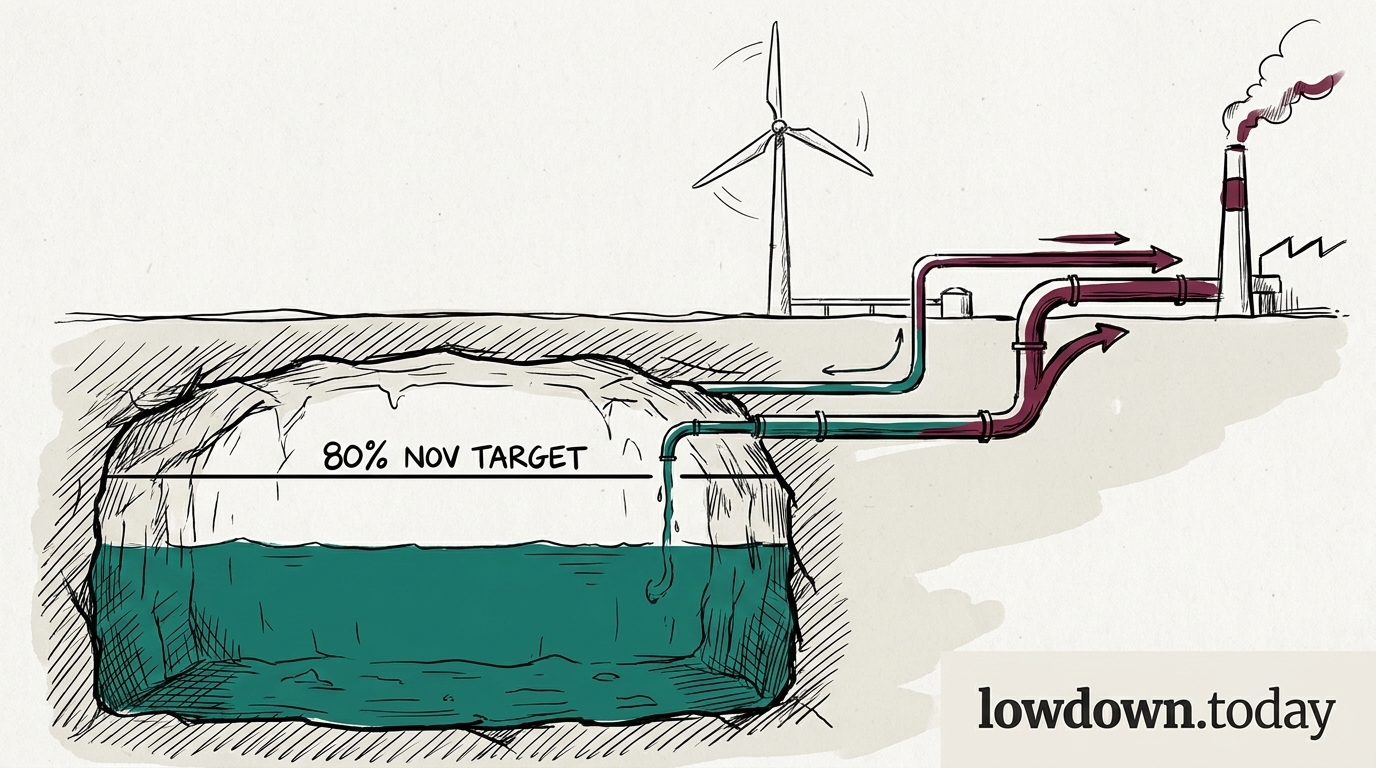
German caverns kept buying prompt gas at TTF near EUR 58-60 through the inversion; the wind collapse to 2.4 GW then flipped the spark spread to plus EUR 29 and put turbines back in the same queue. Every day turbines win that bid, injection at a third of the 877 GWh/day pace needed falls further behind.
Slovakia
Slovakia
Slovakia says it dropped its hold-out on the 21st sanctions package only after Ursula von der Leyen personally signed written gas-price and supply guarantees. The Council of the European Union's own 17,238-character release on the package names neither Slovakia nor any guarantee, leaving Bratislava's account unconfirmed by the institutional record.



