Skip to content
You can now search across every topic, entity and event.What's new
European Energy Markets
31JUL

Iran Suspends All IAEA Access; Nuclear Programme Goes Dark

2 min read
09:44UTC

Iran's Majlis voted 221-0 to suspend all cooperation with the IAEA on 3 April. President Pezeshkian signed it into law the same day. No inspections, no cameras, no reports.

EconomicAssessed
Key takeaway

Iran's 221-0 IAEA suspension makes the nuclear programme legally unverifiable, directly contesting Trump's victory claim.

Iran's Majlis voted 221-0 on 3 April to suspend all cooperation with the International Atomic Energy Agency (IAEA). President Pezeshkian signed the legislation the same day. The vote was unanimous; the bill was signed within hours. There are now no IAEA inspections, no surveillance cameras, and no reporting obligations covering Iran's nuclear programme.

The IAEA had already confirmed that 440 kg of 60%-enriched uranium moved beyond inspector access over the preceding eight months . That material was unverifiable before the Majlis vote. It is now unverifiable by law. The distinction matters: prior opacity was a compliance failure subject to diplomatic pressure; this is a statutory exclusion not amenable to the same tools.

The NPT withdrawal bill remains pending in the Majlis, but parliament has not convened since 28 February. Iran does not need formal NPT withdrawal to achieve what matters. Full IAEA blackout, with enrichment infrastructure intact and 440 kg of near-weapons-grade material untracked, is operationally equivalent to an NPT exit for proliferation assessment purposes.

Trump declared the nuclear goal attained on 1 April . Iran's response, enacted within two days, was to make the nuclear programme legally unobservable. That sequence is not coincidental. The Majlis vote is Iran's legal counter-declaration: the stated US objective has not been achieved, and no verification mechanism exists even if it were.


Deep Analysis

In plain English

A US news organisation says the military is reporting far fewer wounded soldiers to Congress than have actually been hurt. The gap is 72%. The military sent Congress a document that left out a major recent attack on a US air base. Whether this is an error or a deliberate choice matters enormously for whether Congress can exercise its constitutional oversight role.

Deep Analysis
Root Causes

Casualty underreporting serves two simultaneous political functions: it reduces domestic political pressure for de-escalation, and it reduces the evidentiary basis for War Powers Resolution challenges. Congress cannot force a vote if it does not have accurate casualty data to trigger the political will for one.

The exclusion of Prince Sultan from the casualty statement is particularly significant because Prince Sultan was a major strike — the E-3 Sentry was destroyed there. Excluding it from the congressional statement is not a definition dispute; it is a choice.

Escalation

The casualty reporting gap is not directly escalatory, but it increases the probability of legislative confrontation. When accurate figures eventually surface — through court challenges, leaks, or inspector general investigations — the credibility gap will constrain the administration's ability to manage the congressional response to the April deadline convergence.

What could happen next?
  • Risk

    Congressional Armed Services Committees will eventually receive the accurate figures; the timing of that disclosure relative to the War Powers Resolution threshold near 29 April is critical.

    Short term · High
  • Consequence

    The exclusion of Prince Sultan from the congressional statement may constitute a material omission; inspector general referral is possible if a committee member pursues it.

    Short term · Medium
  • Precedent

    If the undercount is accepted without congressional challenge, it establishes a precedent that CENTCOM can exclude major attacks from casualty reports to Congress with no accountability.

    Long term · Medium
First Reported In

Update #57 · Bridge strike kills eight; Army chief fired

IRNA / Iran Majlis· 3 Apr 2026
Read original
Different Perspectives
Spain's LNG terminal operators
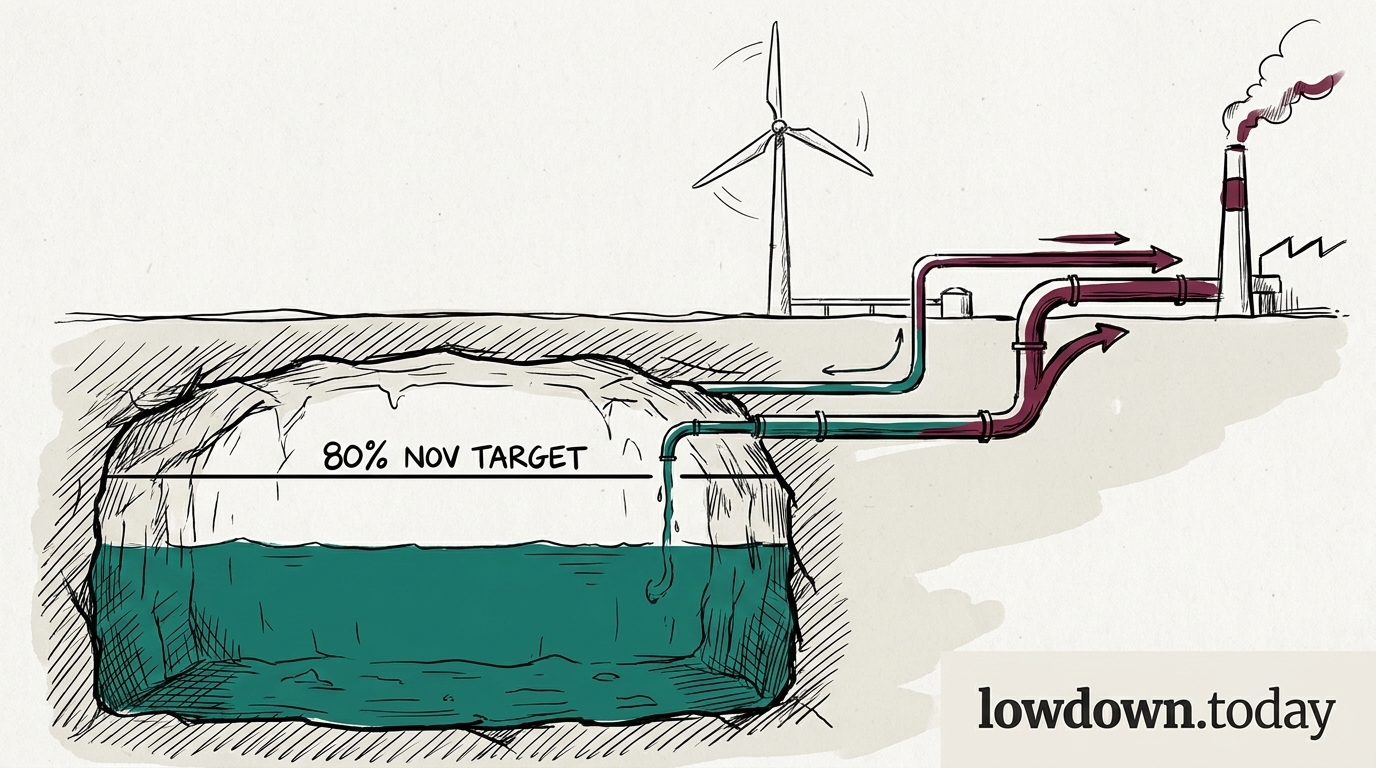
Spain's 9,145 GWh terminal inventory is the largest single stock in the EU LNG network, an option value that can reroute cargoes wherever the winter strip pays best rather than a cavern gas obligation tied to a fixed date. That flexibility matters more as Germany's cavern shortfall pushes more of the winter security question onto import infrastructure.
European Commission
European Commission
Brussels holds the bloc to 90% on a flexible window while Germany, holding roughly a quarter of EU storage capacity, tracks toward missing its own lower 80% figure by 21 points. A national shortfall this size in the anchor market matters more to bloc security than the flexible timetable alone can absorb.
French power exporters and CRE
French day-ahead rose in step with Germany but by less, reopening a EUR 7-17 premium that makes northward export flows commercially attractive again after the EUR 43.09 discount evaporated in days. CRE separately authorised RTE and Enedis to buy flexibility locally, betting the coming winter's binding constraint is grid congestion rather than a shortage of firm capacity.
TTF trading desk
TTF trading desk
A visible national shortfall like Germany's 21-point gap is a directional signal, not noise, for a desk holding the summer-winter spread. TTF's flat EUR 58-60 range through this week's German price swings says the market has not yet chosen to reprice refill risk into the front of the curve.
German cavern and CCGT operators
German caverns kept buying prompt gas at TTF near EUR 58-60 through the inversion; the wind collapse to 2.4 GW then flipped the spark spread to plus EUR 29 and put turbines back in the same queue. Every day turbines win that bid, injection at a third of the 877 GWh/day pace needed falls further behind.
Slovakia
Slovakia
Slovakia says it dropped its hold-out on the 21st sanctions package only after Ursula von der Leyen personally signed written gas-price and supply guarantees. The Council of the European Union's own 17,238-character release on the package names neither Slovakia nor any guarantee, leaving Bratislava's account unconfirmed by the institutional record.



