Skip to content
You can now search across every topic, entity and event.What's new
European Energy Markets
31JUL

Hengaw: 6,900 dead in first month

2 min read
09:44UTC

The Kurdish rights group broke five days of silence with its 8th war report. Buried in it: at least 1,700 wartime arrests that have received almost no international attention.

EconomicAssessed
Key takeaway

Iran is fighting two wars; the internal one receives no coverage.

Hengaw published its 8th war casualties report on approximately 28 March: 6,900 killed, including 720 civilians, in the first month of war. 1 The publication resolved five days of silence that had prompted concern about the group's operational capacity . The civilian daily death rate has risen to approximately 20 per day, double the pace of the first three weeks.

The casualty figure came in below the projected range of 7,300 to 7,800 from the previous update. The gap may reflect degraded network access inside Iran, a methodological review, or an overestimated projection rate. Hengaw's methodology has been the conflict's most consistent independent tracking, and the lower figure does not diminish its significance.

The more consequential finding received almost no international coverage. On 26 March, Hengaw documented at least 1,700 wartime arrests. More than 300 are Kurdish, detained across five border provinces: Ilam, Kermanshah, Kurdistan, West Azerbaijan, and Tehran. Seventy identities have been verified. The Kurdish concentration is not random. These are Iran's western border provinces with Iraq and Turkey, historically the regions where IRGC control is most fragile during military stress.

The pattern echoes the crackdowns that followed the Mahsa Amini protests in 2022, when Kurdistan province led the uprising. But this time the arrests happen under the cover of a shooting war, with the Supreme Leader invisible for 17 days and 93,000 civilian properties already damaged . the government that has sustained over 10,000 air strikes on its territory is simultaneously suppressing its own population. The external war and the internal one feed each other.


Deep Analysis

In plain English

A Kurdish human rights group called Hengaw has been keeping track of deaths and arrests inside Iran since the war started. Their latest report documents 6,900 people killed in the first month, including 720 civilians. Hidden inside the same report is something that has received almost no attention in international media: at least 1,700 people have been arrested across Iran since the war began. More than 300 of them are Kurdish, detained across Iran's western border provinces. These provinces border Iraq and Turkey and have historically been areas where the Iranian government has less control. the government is arresting people it considers a threat from within while fighting a war from outside at the same time. The Supreme Leader has not appeared in public for seventeen days.

What could happen next?
  • Meaning

    The IRGC is simultaneously managing an external war and conducting internal suppression in historically fragile border provinces, dividing its operational attention at a moment of maximum external pressure.

  • Risk

    Wartime suppression of Kurdish border provinces risks activating precisely the internal resistance the IRGC is trying to pre-empt, creating a self-fulfilling security crisis.

First Reported In

Update #52 · Trump wants Iran's oil; 3,500 Marines land

Hengaw· 30 Mar 2026
Read original
Different Perspectives
Spain's LNG terminal operators
Spain's 9,145 GWh terminal inventory is the largest single stock in the EU LNG network, an option value that can reroute cargoes wherever the winter strip pays best rather than a cavern gas obligation tied to a fixed date. That flexibility matters more as Germany's cavern shortfall pushes more of the winter security question onto import infrastructure.
European Commission
European Commission
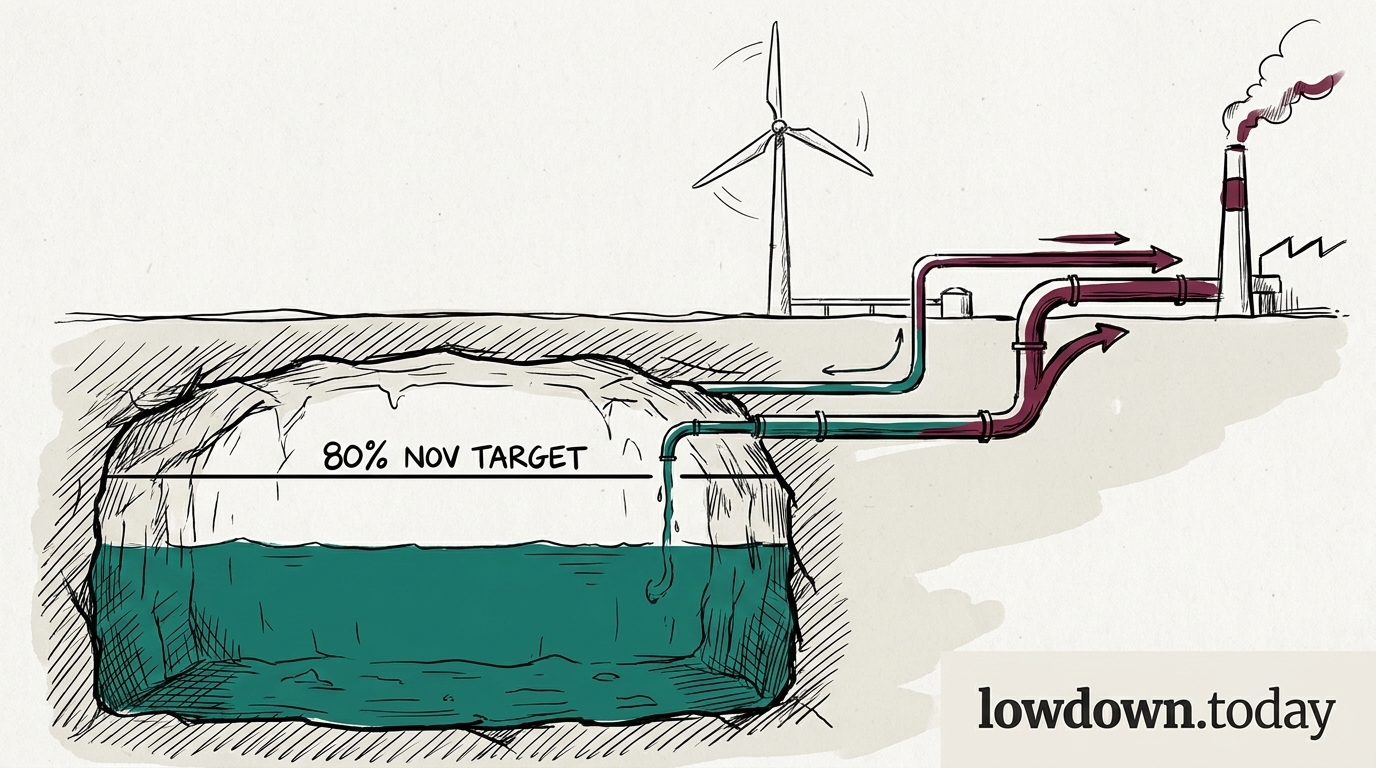
Brussels holds the bloc to 90% on a flexible window while Germany, holding roughly a quarter of EU storage capacity, tracks toward missing its own lower 80% figure by 21 points. A national shortfall this size in the anchor market matters more to bloc security than the flexible timetable alone can absorb.
French power exporters and CRE
French day-ahead rose in step with Germany but by less, reopening a EUR 7-17 premium that makes northward export flows commercially attractive again after the EUR 43.09 discount evaporated in days. CRE separately authorised RTE and Enedis to buy flexibility locally, betting the coming winter's binding constraint is grid congestion rather than a shortage of firm capacity.
TTF trading desk
TTF trading desk
A visible national shortfall like Germany's 21-point gap is a directional signal, not noise, for a desk holding the summer-winter spread. TTF's flat EUR 58-60 range through this week's German price swings says the market has not yet chosen to reprice refill risk into the front of the curve.
German cavern and CCGT operators
German caverns kept buying prompt gas at TTF near EUR 58-60 through the inversion; the wind collapse to 2.4 GW then flipped the spark spread to plus EUR 29 and put turbines back in the same queue. Every day turbines win that bid, injection at a third of the 877 GWh/day pace needed falls further behind.
Slovakia
Slovakia
Slovakia says it dropped its hold-out on the 21st sanctions package only after Ursula von der Leyen personally signed written gas-price and supply guarantees. The Council of the European Union's own 17,238-character release on the package names neither Slovakia nor any guarantee, leaving Bratislava's account unconfirmed by the institutional record.



