Skip to content
You can now search across every topic, entity and event.What's new
European Energy Markets
31JUL

Germany bids capacity into a legal gap

3 min read
09:44UTC

Bundesnetzagentur opened Germany's first 4.5 GW StromVKG capacity auction on 21 July with bids due 8 September, before Brussels has cleared the scheme for state aid.

EconomicDeveloping
Key takeaway

Germany opened 15-year capacity auctions on 21 July before Brussels cleared the subsidy scheme, risking clawback from 8 September.

Bundesnetzagentur (BNetzA), Germany's federal network regulator, opened the first 4.5 GW StromVKG capacity auction on 21 July, bids due 8 September 1. StromVKG, the German capacity-market law, covers dispatchable gas and long-duration storage of ten hours or more on 15-year contracts. BNetzA opened it without EU state-aid clearance and without Berlin consulting Brussels first.

BNetzA had itself confirmed the clearance gap on 10 July , nine days before opening bids into it; the law had passed on 9 July with a 41% higher bid ceiling . BNetzA president Klaus Mueller said the auctions would run "as quickly and carefully as possible" 2.

A gas plant that cannot clear on the spot spark needs a capacity payment to stay in the mix, and StromVKG backstops precisely the merchant-signal failure the German injection stall now documents. Fifteen-year commitments signed from 8 September carry clawback risk if The Commission later refuses clearance. Some counsel argue the scheme's levy-based financing may not involve state resources at all, which would place it outside Article 107 review and moot the pending-clearance risk entirely. Should The Commission instead judge the levy to draw on state resources, every contract awarded from 8 September falls back into Article 107 exposure.


Deep Analysis

In plain English

Germany wants gas-fired power plants and long-duration storage to be available even when the grid is under strain, so it is paying selected operators to be ready, a 'capacity market', funded through a surcharge added to network charges rather than general taxation. The EU normally has to check this kind of scheme in advance to make sure it doesn't unfairly favour German companies over rivals elsewhere in Europe, a process called state-aid clearance. Germany's regulator opened the first round of bidding for these contracts before that EU check was finished. Germany's legal argument is that because private grid operators, not the government directly, collect and pay out the money, the scheme falls outside the rules that require the check. Britain tried something similar in the 2010s and its scheme got frozen by a court for nearly two years once a legal challenge succeeded, which is the risk German bidders are now taking on.

Deep Analysis
Root Causes

BNetzA's own auction documentation, last revised 10 July, already flags the missing state-aid clearance, meaning the regulator opened bidding with the gap disclosed rather than overlooked. That sequencing choice rests on the PreussenElektra-line legal argument that TSO-administered surcharges are not state resources, a reading the Commission has not confirmed for this specific scheme.

The deeper structural driver is timing pressure: StromVKG's 9 July Bundestag passage raised the bid ceiling 41% and left BNetzA with a legislative mandate to open the first tranche promptly, creating an incentive to proceed on the TSO's own legal reading rather than wait for a Commission process that, on the UK precedent, can run well over a year.

Escalation

Direction is toward eventual Commission scrutiny rather than away from it: BNetzA's own documentation flags the gap rather than disputing its existence, which typically precedes a formal Commission inquiry once a competitor or third party lodges a complaint, as happened in the UK case.

What could happen next?
  • Risk

    Capacity contracts awarded before Commission clearance carry retroactive clawback exposure if the surcharge is later found to be state aid, on the UK Tempus Energy precedent.

    Long term · Reported
  • Consequence

    Legal uncertainty is likely already priced into the auction's clearing level via the 41% bid-ceiling increase passed on 9 July.

    Immediate · Reported
  • Precedent

    A formal Commission inquiry, should one open, would likely follow the UK pattern of a mid-scheme suspension rather than blocking the mechanism outright.

    Medium term · Suggested
First Reported In

Update #29 · Germany's caverns stop buying gas

ESS News· 23 Jul 2026
Read original
Different Perspectives
Spain's LNG terminal operators
Spain's 9,145 GWh terminal inventory is the largest single stock in the EU LNG network, an option value that can reroute cargoes wherever the winter strip pays best rather than a cavern gas obligation tied to a fixed date. That flexibility matters more as Germany's cavern shortfall pushes more of the winter security question onto import infrastructure.
European Commission
European Commission
Brussels holds the bloc to 90% on a flexible window while Germany, holding roughly a quarter of EU storage capacity, tracks toward missing its own lower 80% figure by 21 points. A national shortfall this size in the anchor market matters more to bloc security than the flexible timetable alone can absorb.
French power exporters and CRE
French day-ahead rose in step with Germany but by less, reopening a EUR 7-17 premium that makes northward export flows commercially attractive again after the EUR 43.09 discount evaporated in days. CRE separately authorised RTE and Enedis to buy flexibility locally, betting the coming winter's binding constraint is grid congestion rather than a shortage of firm capacity.
TTF trading desk
TTF trading desk
A visible national shortfall like Germany's 21-point gap is a directional signal, not noise, for a desk holding the summer-winter spread. TTF's flat EUR 58-60 range through this week's German price swings says the market has not yet chosen to reprice refill risk into the front of the curve.
German cavern and CCGT operators
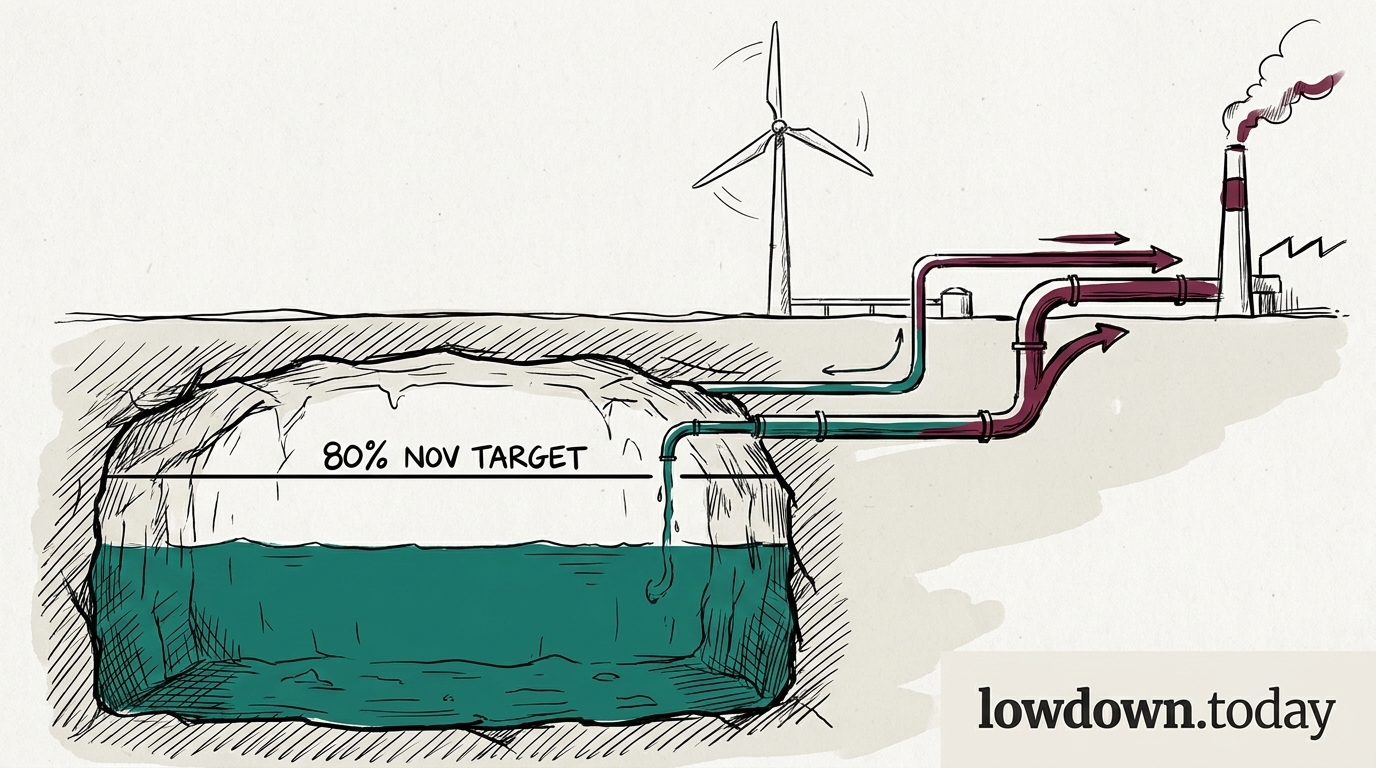
German caverns kept buying prompt gas at TTF near EUR 58-60 through the inversion; the wind collapse to 2.4 GW then flipped the spark spread to plus EUR 29 and put turbines back in the same queue. Every day turbines win that bid, injection at a third of the 877 GWh/day pace needed falls further behind.
Slovakia
Slovakia
Slovakia says it dropped its hold-out on the 21st sanctions package only after Ursula von der Leyen personally signed written gas-price and supply guarantees. The Council of the European Union's own 17,238-character release on the package names neither Slovakia nor any guarantee, leaving Bratislava's account unconfirmed by the institutional record.



