Skip to content
You can now search across every topic, entity and event.What's new
European Energy Markets
31JUL

Friday's German spark briefly broke even

2 min read
09:44UTC

At the top of the war premium the German clean spark spread printed plus EUR 4.81/MWh at 58 per cent efficiency and minus EUR 1.16 at 55 per cent. It was the only near-breakeven print of the cycle.

EconomicAssessed
Key takeaway

Friday's near-breakeven print sets the fleet's break-even power price near EUR 126 to EUR 132/MWh.

German gas plants came within a euro or two of paying their way on 24 July, the Friday the war premium peaked. On day-ahead power at its window high of EUR 130.97/MWh, with TTF near its high and EUA carbon at EUR 83.40/tonne, the clean spark spread printed plus EUR 4.81/MWh at 58 per cent thermal efficiency and minus EUR 1.16 at 55 per cent. 1 2 It is the only near-breakeven reading this desk has calculated all cycle.

German onshore wind ran 2.97 GW that Friday, its weekly low, the same condition that drove German power to EUR 195/MWh at the end of June . 3 The CCGT fleet was called, and for a few hours it was paid for being called.

Keep the number, because it calibrates everything since. On those Friday inputs the fleet's break-even power price sits somewhere around EUR 126 to EUR 132/MWh across the efficiency band. Drop the gas price to Monday's level and that break-even falls to roughly EUR 117 to EUR 123. German day-ahead cleared well under EUR 80. So of the roughly EUR 40 to EUR 46 the spread has lost since Friday, only about EUR 5 came from the fuel side. The rest is the revenue leg, and the revenue leg answers to a weather forecast rather than to a ceasefire.


Deep Analysis

In plain English

For one day only, on Friday 24 July, a German gas power station could just about break even, or make a tiny profit, running flat out. That happened because the price of electricity was unusually high that day, at the same time as very little wind was blowing. As soon as the wind picked back up over the following weekend, that brief window closed, and gas plants went back to losing money on every unit they generated.

Deep Analysis
Root Causes

The near-breakeven window existed only because three inputs peaked together for one session: TTF near its cycle high, EUA at its cycle high, and German onshore wind at its weekly low of 2.97 GW, removing the cheap-renewables competition that normally caps the price gas-fired plant can capture.

Any one of those three easing, which is what happened within 72 hours, removes the condition entirely; the breakeven was never a new floor for the fleet's economics, it was three separate extremes landing on the same day.

What could happen next?
  • Meaning

    The 24 July near-breakeven print required three separate extremes (peak gas, peak carbon, weekly-low wind) to align, which is why it lasted a single session rather than becoming a sustained condition.

First Reported In

Update #30 · Wind, not peace, sank the German spark

SMARD / Bundesnetzagentur via Fraunhofer ISE energy-charts· 27 Jul 2026
Read original
Causes and effects
This Event
Friday's German spark briefly broke even
Friday's print fixes the fleet's break-even power price, which is the number every later spread reading is measured against.
Different Perspectives
Spain's LNG terminal operators
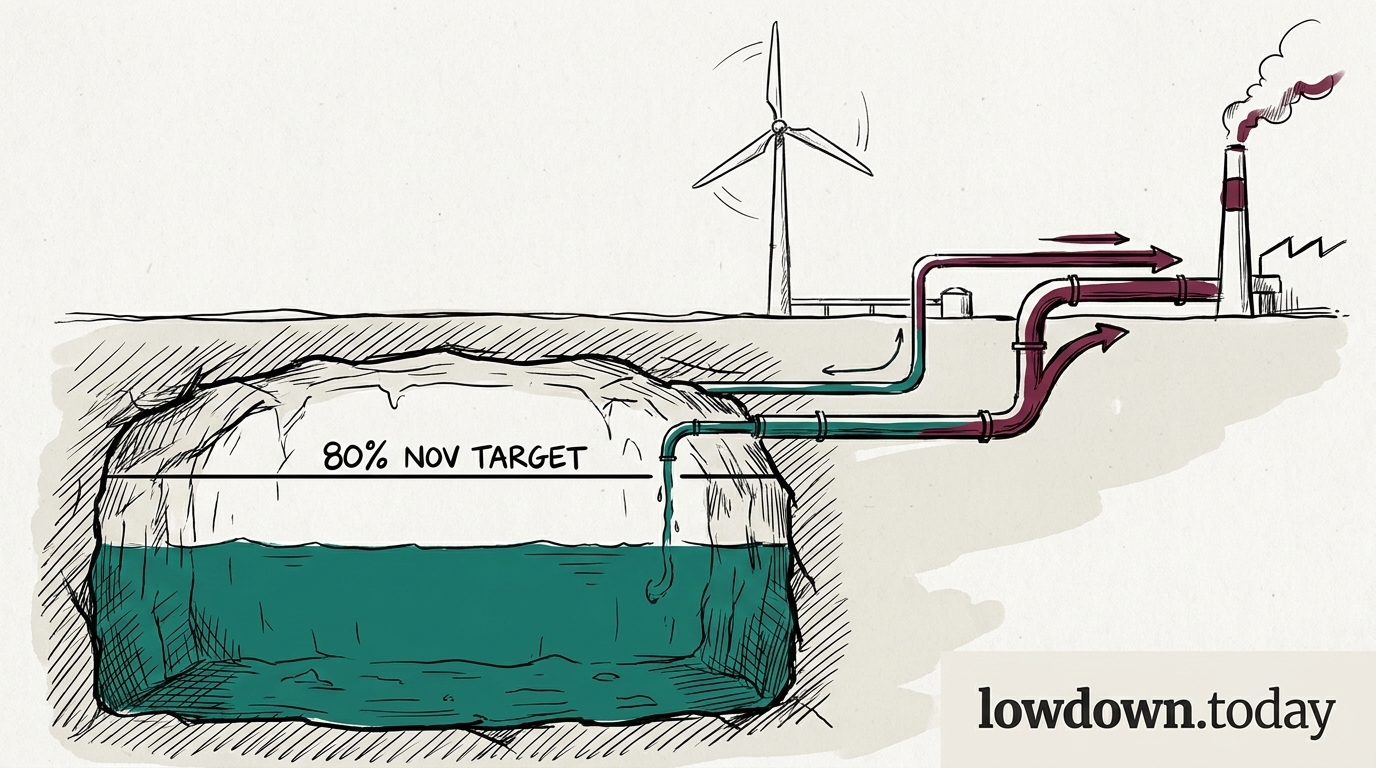
Spain's 9,145 GWh terminal inventory is the largest single stock in the EU LNG network, an option value that can reroute cargoes wherever the winter strip pays best rather than a cavern gas obligation tied to a fixed date. That flexibility matters more as Germany's cavern shortfall pushes more of the winter security question onto import infrastructure.
European Commission
European Commission
Brussels holds the bloc to 90% on a flexible window while Germany, holding roughly a quarter of EU storage capacity, tracks toward missing its own lower 80% figure by 21 points. A national shortfall this size in the anchor market matters more to bloc security than the flexible timetable alone can absorb.
French power exporters and CRE
French day-ahead rose in step with Germany but by less, reopening a EUR 7-17 premium that makes northward export flows commercially attractive again after the EUR 43.09 discount evaporated in days. CRE separately authorised RTE and Enedis to buy flexibility locally, betting the coming winter's binding constraint is grid congestion rather than a shortage of firm capacity.
TTF trading desk
TTF trading desk
A visible national shortfall like Germany's 21-point gap is a directional signal, not noise, for a desk holding the summer-winter spread. TTF's flat EUR 58-60 range through this week's German price swings says the market has not yet chosen to reprice refill risk into the front of the curve.
German cavern and CCGT operators
German caverns kept buying prompt gas at TTF near EUR 58-60 through the inversion; the wind collapse to 2.4 GW then flipped the spark spread to plus EUR 29 and put turbines back in the same queue. Every day turbines win that bid, injection at a third of the 877 GWh/day pace needed falls further behind.
Slovakia
Slovakia
Slovakia says it dropped its hold-out on the 21st sanctions package only after Ursula von der Leyen personally signed written gas-price and supply guarantees. The Council of the European Union's own 17,238-character release on the package names neither Slovakia nor any guarantee, leaving Bratislava's account unconfirmed by the institutional record.



