Skip to content
You can now search across every topic, entity and event.What's new
European Energy Markets
31JUL

EU bars Hungary from €16bn arms fund

2 min read
09:44UTC

The European Commission withheld Budapest's €16.2 billion SAFE allocation while approving France and Czechia the same day, the first use of EU defence spending as punishment against a member state.

EconomicAssessed
Key takeaway

The EU used its own defence budget as punishment against a member state for the first time.

The European Commission froze Hungary's access to €16.2 billion under the SAFE programme (Security Action for Europe) on 25 March 1. France and Czechia had their SAFE plans approved the same day. Hungary is the sole country frozen among 19 participants.

The trigger is Budapest's continued blockade of the €90 billion Ukraine loan . Orbán nominally dropped his objection in exchange for Zelenskyy's commitment to repair the Druzhba pipeline within 1 to 1.5 months, but Hungary re-blocked the loan at the EU summit on 19 March. An EU diplomat told Euronews it is "difficult to agree billions for Orbán when he violates loyal cooperation" 2.

SAFE was designed to incentivise collective European defence spending, not to punish dissent. By freezing a member state's allocation for political non-cooperation rather than technical non-compliance, The Commission has created an enforcement tool outside the Article 7 procedure. This approach is faster and more financially painful than rule-of-law conditionality, which took years to produce results against Hungary.

EU treaty structures require unanimity for foreign policy decisions, giving any single state veto power. The SAFE freeze bypasses this by using Commission-level programme administration, which operates by qualified majority, to punish behaviour that unanimity rules protect. Whether this accelerated coercion produces compliance or hardens Budapest's resistance will shape EU governance for years.


Deep Analysis

In plain English

The EU set up a shared defence spending pot to help member states rearm. Hungary is the only one of 19 participants whose €16.2 billion allocation has been frozen. Why? Hungary keeps blocking an EU loan to Ukraine that the other 26 members agreed on. The EU is using its defence fund as a bargaining chip: comply with the bloc's Ukraine policy, or lose your share of the rearmament money. It matters because it sets a precedent: for the first time, the EU is using its own defence budget as a punishment rather than a reward.

Deep Analysis
Root Causes

Hungary's position stems from Orbán's domestic political economy, not ideological sympathy with Moscow.

Hungary's energy sector is structurally dependent on Russian gas and oil via the Druzhba and Brotherhood pipelines. Orbán has used this dependence as leverage within the EU, trading his veto on Ukraine support for energy exemptions and funding concessions since 2022.

The April 12 Hungarian elections create a short-term incentive for Orbán to appear sovereign against EU pressure, even at the cost of €16.2 billion in frozen rearmament funds. The freeze may harden rather than soften his position in the near term.

The deeper structural issue is that EU treaty design gives any single state veto power over foreign policy, a feature designed for small-scale disagreements that becomes a systemic vulnerability when one member state actively undermines the bloc's security consensus.

First Reported In

Update #8 · Pentagon diverts funds; 948 drones fired

Euronews· 27 Mar 2026
Read original
Different Perspectives
Spain's LNG terminal operators
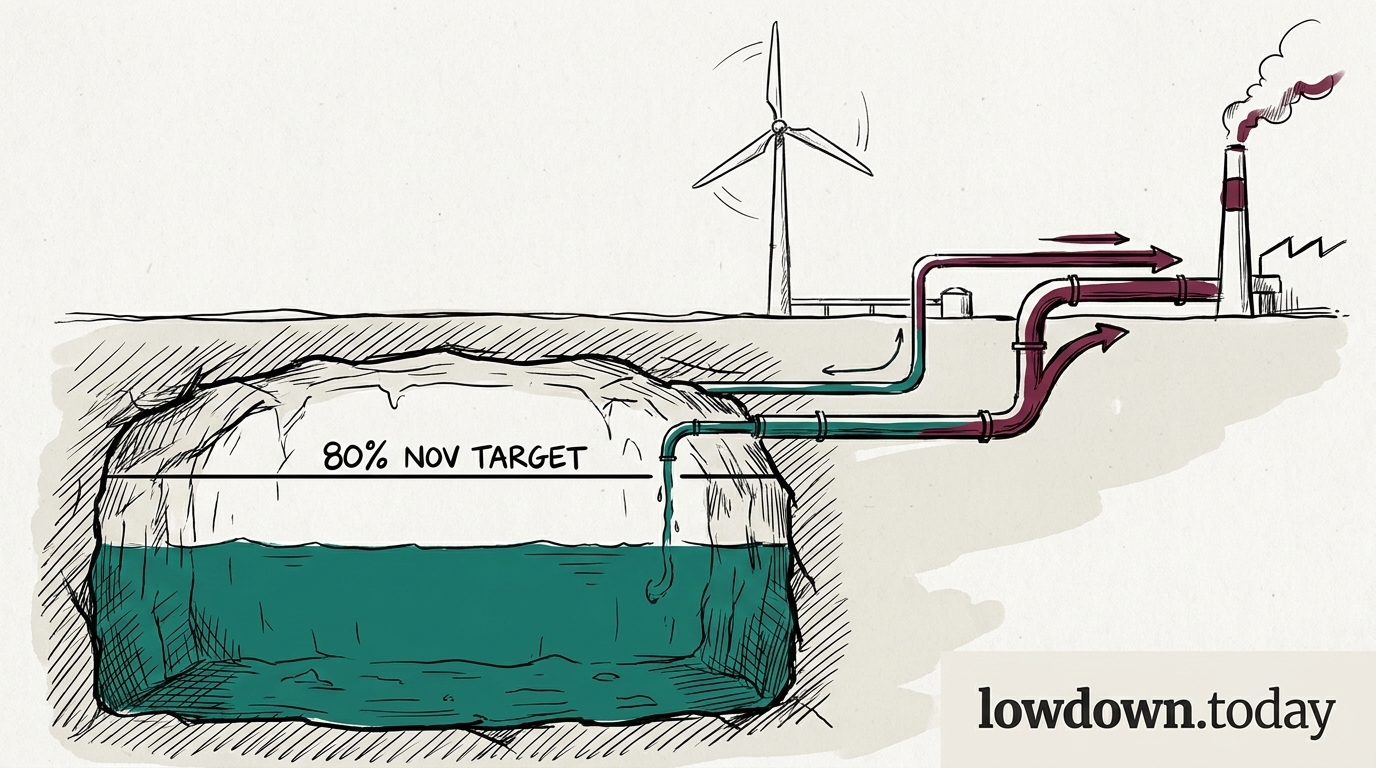
Spain's 9,145 GWh terminal inventory is the largest single stock in the EU LNG network, an option value that can reroute cargoes wherever the winter strip pays best rather than a cavern gas obligation tied to a fixed date. That flexibility matters more as Germany's cavern shortfall pushes more of the winter security question onto import infrastructure.
European Commission
European Commission
Brussels holds the bloc to 90% on a flexible window while Germany, holding roughly a quarter of EU storage capacity, tracks toward missing its own lower 80% figure by 21 points. A national shortfall this size in the anchor market matters more to bloc security than the flexible timetable alone can absorb.
French power exporters and CRE
French day-ahead rose in step with Germany but by less, reopening a EUR 7-17 premium that makes northward export flows commercially attractive again after the EUR 43.09 discount evaporated in days. CRE separately authorised RTE and Enedis to buy flexibility locally, betting the coming winter's binding constraint is grid congestion rather than a shortage of firm capacity.
TTF trading desk
TTF trading desk
A visible national shortfall like Germany's 21-point gap is a directional signal, not noise, for a desk holding the summer-winter spread. TTF's flat EUR 58-60 range through this week's German price swings says the market has not yet chosen to reprice refill risk into the front of the curve.
German cavern and CCGT operators
German caverns kept buying prompt gas at TTF near EUR 58-60 through the inversion; the wind collapse to 2.4 GW then flipped the spark spread to plus EUR 29 and put turbines back in the same queue. Every day turbines win that bid, injection at a third of the 877 GWh/day pace needed falls further behind.
Slovakia
Slovakia
Slovakia says it dropped its hold-out on the 21st sanctions package only after Ursula von der Leyen personally signed written gas-price and supply guarantees. The Council of the European Union's own 17,238-character release on the package names neither Slovakia nor any guarantee, leaving Bratislava's account unconfirmed by the institutional record.



