Skip to content
You can now search across every topic, entity and event.What's new
European Energy Markets
31JUL

EDF March output highest since 2019

2 min read
09:44UTC

French nuclear is on track for 350-370 TWh this year and ran EUR 45 under Germany in Wednesday's day-ahead.

EconomicDeveloping
Key takeaway

French nuclear is the regional buffer until September, then one reactor less for a year.

EDF's French nuclear fleet posted its highest monthly output since 2019 in March 2026 and is on track for 350-370 TWh full-year against a CRE-estimated average sale price of EUR 65.90/MWh under the new VNU mechanism 1. The fleet's output translated directly into wholesale prices on 15 April : France landed well beneath the German print and close to Spanish levels on the same session.

The operational effect is that French nuclear surplus is behaving like a southern-European supply asset rather than a domestic baseload. On a low-wind Iberian print the Franco-Iberian interconnector is the arbitrage; on a gas-set German print the north-south flow absorbs the German power premium. Both directions depend on the fleet holding availability through the heavy-maintenance window that typically begins in autumn.

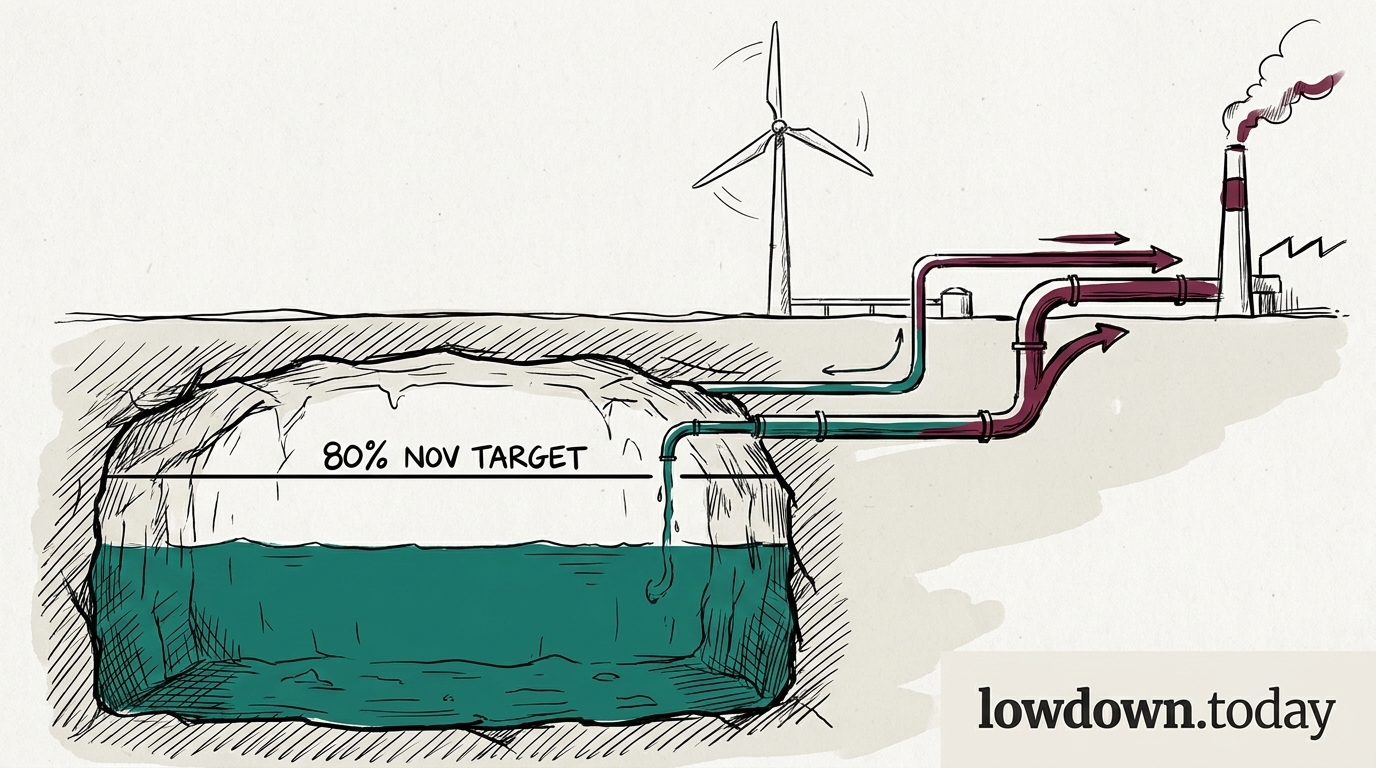
Flamanville-3, France's newest reactor at roughly 1.6 GW, enters a one-year major overhaul from September 2026. That is one unit off the fleet through winter and into the next spring. The shortfall is material relative to the roughly 350-370 TWh target, and it is timed against the autumn-winter window when European storage is either high or exposed. If Germany's April injection fails to recover , the Flamanville-3 overhaul compounds a thin supply stack in the quarter when the stack matters most.

For utilities and industrial offtakers the picture through Q2 is a Franco-Iberian arbitrage while the fleet runs, followed by a material reduction in the regional buffer from September. Positions that lean on French surplus persisting through Q4 2026 need to price the Flamanville-3 calendar, not the March headline.


Deep Analysis

In plain English

France generates about 70% of its electricity from nuclear power stations, more than any other major economy. After several years of problems when safety inspectors found cracks in reactor components and forced many plants offline for repairs, French nuclear output has recovered strongly in early 2026. In March 2026, EDF (the French state utility that owns the nuclear fleet) achieved its highest monthly output since 2019. This matters beyond France because French power stations export surplus electricity to neighbouring countries, helping to keep prices lower in Germany, Spain, and Italy. However, there is a catch: Flamanville-3, France's newest and most powerful reactor, is scheduled for a major one-year overhaul starting September 2026. During that overhaul, France will lose a significant amount of generating capacity, which could raise power prices across the region heading into the following winter.

Deep Analysis
Root Causes

French nuclear's 2019-2022 output collapse had a specific engineering cause: stress corrosion cracking (SCC) found in the primary circuit elbows of PWR reactors, which required simultaneous inspections and repairs across the fleet.

EDF and the French nuclear safety authority ASN eventually developed a standardised repair protocol, allowing the fleet to restart systematically from 2023. The 2026 recovery to seven-year-high output is therefore not a permanent new normal but the completion of a multi-year repair cycle.

Flamanville-3's September 2026 overhaul is the European Pressurised Reactor (EPR), France's first new nuclear unit since 1999 and the first EPR to enter commercial operation anywhere in the world after extensive delays. Major overhauls on first-of-class reactors carry higher schedule risk than fleet maintenance because the repair tooling and procedures have not been standardised.

What could happen next?
  • Risk

    Flamanville-3's one-year overhaul from September 2026 removes the newest and highest-capacity reactor from the fleet precisely as winter 2026-27 demand rises, reducing France's export surplus and increasing Germany and Italy's gas-fired generation hours.

First Reported In

Update #2 · TTF EUR 42 as Russian LNG ban enters range

euenergy.live (ENTSO-E feed)· 15 Apr 2026
Read original
Different Perspectives
Spain's LNG terminal operators
Spain's 9,145 GWh terminal inventory is the largest single stock in the EU LNG network, an option value that can reroute cargoes wherever the winter strip pays best rather than a cavern gas obligation tied to a fixed date. That flexibility matters more as Germany's cavern shortfall pushes more of the winter security question onto import infrastructure.
European Commission
European Commission
Brussels holds the bloc to 90% on a flexible window while Germany, holding roughly a quarter of EU storage capacity, tracks toward missing its own lower 80% figure by 21 points. A national shortfall this size in the anchor market matters more to bloc security than the flexible timetable alone can absorb.
French power exporters and CRE
French day-ahead rose in step with Germany but by less, reopening a EUR 7-17 premium that makes northward export flows commercially attractive again after the EUR 43.09 discount evaporated in days. CRE separately authorised RTE and Enedis to buy flexibility locally, betting the coming winter's binding constraint is grid congestion rather than a shortage of firm capacity.
TTF trading desk
TTF trading desk
A visible national shortfall like Germany's 21-point gap is a directional signal, not noise, for a desk holding the summer-winter spread. TTF's flat EUR 58-60 range through this week's German price swings says the market has not yet chosen to reprice refill risk into the front of the curve.
German cavern and CCGT operators
German caverns kept buying prompt gas at TTF near EUR 58-60 through the inversion; the wind collapse to 2.4 GW then flipped the spark spread to plus EUR 29 and put turbines back in the same queue. Every day turbines win that bid, injection at a third of the 877 GWh/day pace needed falls further behind.
Slovakia
Slovakia
Slovakia says it dropped its hold-out on the 21st sanctions package only after Ursula von der Leyen personally signed written gas-price and supply guarantees. The Council of the European Union's own 17,238-character release on the package names neither Slovakia nor any guarantee, leaving Bratislava's account unconfirmed by the institutional record.



