Skip to content
You can now search across every topic, entity and event.What's new
European Energy Markets
16JUL

TTF round-trips back above EUR 50

2 min read
09:48UTC

TTF front-month firmed to EUR 50.50 on Monday, a 3.49% gain, on renewed Strait of Hormuz shipping risk rather than any European supply tightness.

EconomicDeveloping
Key takeaway

TTF's move above EUR 50 priced Gulf shipping risk, not European scarcity, and could unwind on de-escalation.

TTF front-month gas, Europe's benchmark hub price, settled around EUR 50.00/MWh on Thursday 9 July, eased to EUR 48.80 on Friday 10 July, then firmed to EUR 50.50 by Monday 13 July, a 3.49% gain on the session, per Trading Economics 1. The move round-tripped the benchmark back over EUR 50 after a mid-week dip, and it came stronger than it left.

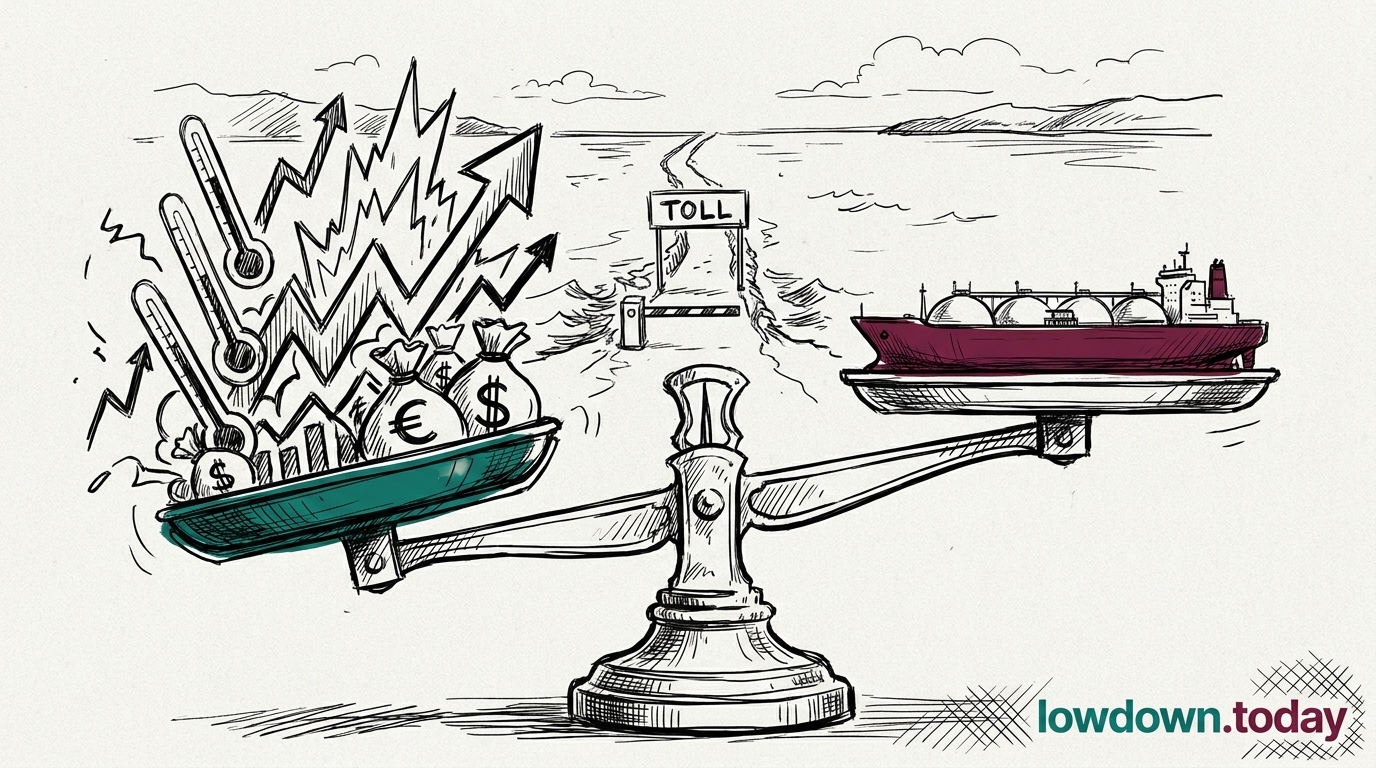
Nothing in the French power story pushed it. The bid came from renewed US-Iran military tension over Strait of Hormuz LNG shipping, the same risk channel that drove TTF's 13% climb to EUR 50.10 a week earlier when QatarEnergy withdrew Ras Laffan supply on 9 July and extended its Asian force majeure into August 2. the strait carries a fifth of global oil and a meaningful slice of LNG through a 33km chokepoint, so any escalation there reprices European gas regardless of what the continent's own storage is doing.

That split matters for anyone trading the gas-power relationship. French curtailment lifted power on a domestic weather event; TTF lifted on a Gulf chokepoint four thousand miles away. The two legs ran on separate clocks in the same week, which means a Hormuz de-escalation could unwind the gas premium quickly without touching the French power story at all.


Deep Analysis

In plain English

TTF is the main price that European gas buyers pay, set at a trading hub in the Netherlands. Since Europe stopped buying much pipeline gas from Russia, it now depends more on gas shipped in on tankers from places like Qatar, which means the price reacts to anything that threatens those ships. Over 9-13 July the price went up, down, then up again, ending close to where it started but slightly higher. None of that had to do with Europe actually running short of gas, its storage was comfortable and Norwegian supply was recovering. It was traders reacting to Gulf shipping-risk headlines rather than any real shortage.

Deep Analysis
Root Causes

Europe's post-2022 pivot away from Russian pipeline gas left TTF far more exposed to LNG-cargo routing than it was a decade ago, so any risk to Gulf shipping lanes now moves the European benchmark even when no cargo has actually been redirected or delayed.

That exposure is compounded by QatarEnergy's reduced Ras Laffan throughput (running near 35% of the 77 MTPA nameplate per ), which removes the buffer capacity that would otherwise let the market shrug off a few days of shipping-risk headlines.

First Reported In

Update #26 · Gas and power decouple as French heat bites

Trading Economics· 13 Jul 2026
Read original
Different Perspectives
LNG spreads desk
LNG spreads desk
The JKM-TTF arb flipped to a TTF premium of roughly USD 0.6/MMBtu on 15 July, the first time this cycle Europe has outbid Asia, yet no Atlantic cargo has rerouted west. Until a cargo actually moves, the desk reads the Hormuz premium as unconfirmed and the EUR 55 print as vulnerable to a fast reversal.
United States
United States
Washington reimposed a blockade on Iranian ports and a 20% Strait of Hormuz cargo toll on 13 July, driving TTF's 9% two-session rally to EUR 54.995/MWh. The posture is again setting Europe's gas benchmark by sentiment rather than by any confirmed change in cargo flows.
EDF
EDF
EDF slipped the Bugey 3, Golfech 2 and Chooz 2 restarts to 19, 22 and 25 July, pushing all three past the 20 July Bugey heat exemption, after river-cooling limits on the Rhone, Garonne and Meuse forced the cuts. The same thermal ceiling has capped the fleet in every major heatwave since 2003, and this cycle is no exception.
German power desk
German power desk
German day-ahead power climbed from EUR 126 to EUR 156/MWh over 14-16 July as the heat dome held, flipping the clean spark spread positive for the first time since 14 July. Gas-for-power demand is now back in competition with mandate storage injection right as the injection margin itself is thinning.
EU carbon and storage regulators
EUA carbon broke EUR 81/tonne on 13 July as the ETS Market Stability Reserve's scheduled withdrawals met fresh fuel-switching demand from France's nuclear curtailment. Brussels' mandatory storage-fill rule kept German and French injection running regardless of the TTF swings, the mechanism working as designed four years after the 2022 shock.
Equinor
Equinor
Equinor returned its Asgard field from maintenance on 11 July, lifting Gassco's exit nominations to 319.8 mcm/day just as TTF round-tripped on Hormuz risk. The restart gave Norway spare pipeline capacity to help Europe absorb the gas rally without drawing down storage, reinforcing its role as the post-2022 swing supplier.
