Skip to content
You can now search across every topic, entity and event.What's new
European Energy Markets
16JUL

The squeeze is the LNG the ban misses

2 min read
09:48UTC

JKM printed USD 18.86/MMBtu on 12 June, more than doubling the arb against TTF to roughly USD 5.26/MMBtu and pulling Atlantic LNG cargoes east to Asia, away from Europe in injection season.

EconomicAssessed

The JKM-TTF arbitrage more than doubled, with JKM printing USD 18.86/MMBtu on Friday 12 June against a TTF equivalent near USD 13.6, up from a far narrower gap on 11 June 1. JKM, the Japan Korea Marker, is the Northeast Asian spot-LNG benchmark; the arb is the gap that decides whether a flexible Atlantic cargo sails east or west. The implied spread works out to roughly USD 5.26/MMBtu, a figure that should be read as approximate, because it converts the EUR-denominated TTF print into USD/MMBtu across a few-day date offset; the sourced anchor is JKM at USD 18.86 and the direction of the pull.

The arb had compressed to USD 1.225 in the week to 1 June before diverging from the flat prompt . At that compressed level a cargo sat near the round-trip threshold between basins. At roughly USD 5.26 the economics firmly favour Asia, and a flexible US or Atlantic Basin cargo routes east rather than discharging into Europe.

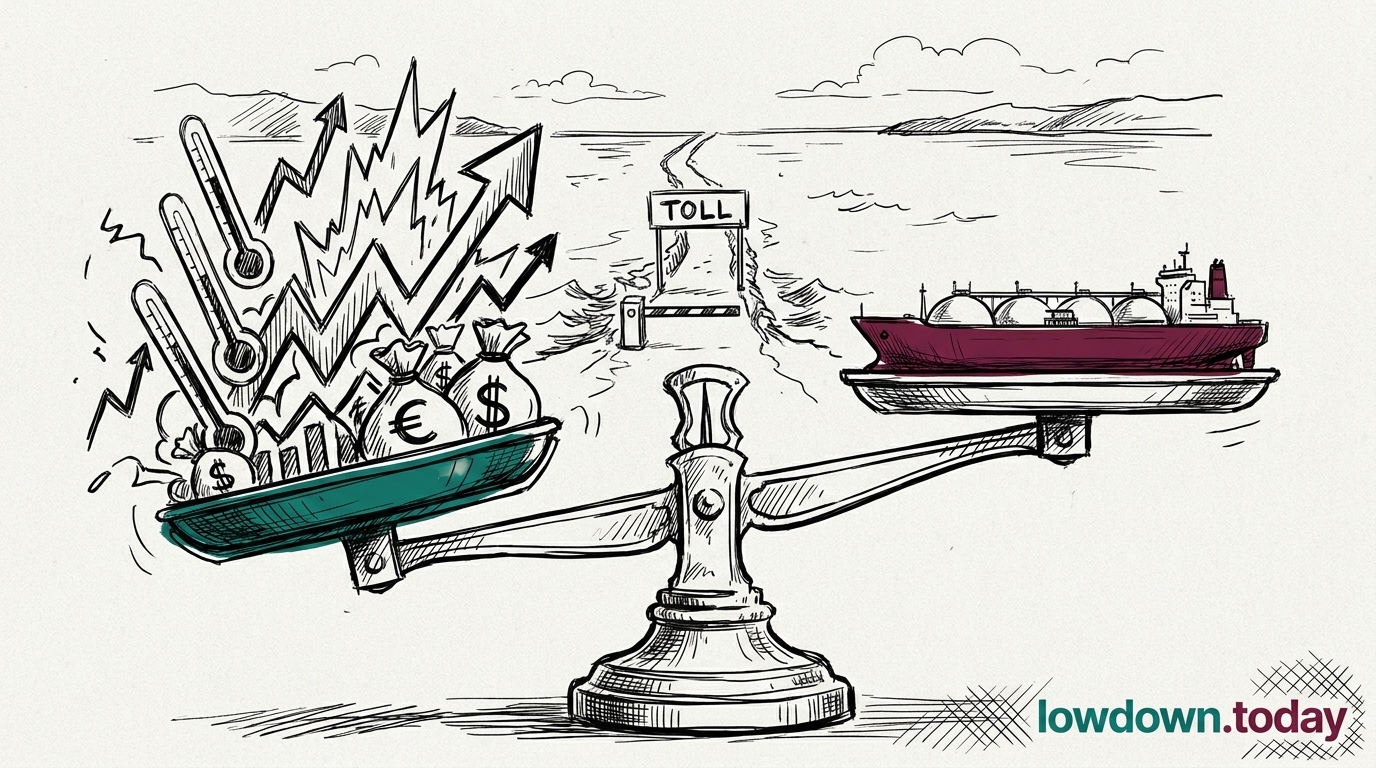
The direction is the opposite of what Europe needs in injection season, when terminals want every spare cargo. This is the genuine supply tightening in the briefing, and the 17 June ban does nothing about it, because the regulation covers pipeline gas, not seaborne LNG. The one force actually pulling molecules away from Europe sits entirely outside the measure's scope, which is why the prompt can fall through its floor in the same week a real tightening is underway.


Deep Analysis

In plain English

JKM is the Japanese-Korean Marker, the price tag on a cargo of liquefied natural gas (LNG) delivered to Japan or South Korea. It is set daily by S&P Global Platts, the same company that prices oil markets. When JKM is higher than the equivalent European gas price (TTF), ship operators load their gas cargoes in the US Gulf, Africa, or the Atlantic and sail east to Asia rather than west to Europe. On 12 June 2026, JKM printed USD 18.86 per million British thermal units while the equivalent European price was around USD 13.6. That USD 5.26 gap is more than enough to cover the extra voyage cost to Asia. So flexible cargoes that could have gone to European storage terminals during the summer injection season headed east instead. This is the market working exactly as designed, but the effect for Europe is reduced supply at a time when storage is already well below target.

Deep Analysis
Root Causes

Japan and South Korea entered mid-June with lower-than-seasonal LNG inventories after a cooler-than-average May that delayed the normal spring demand reduction. Chinese independent power producers simultaneously increased LNG spot procurement from mid-May as domestic coal prices stayed elevated, competing with Japanese utilities for the same Atlantic Basin spot pool. The combination pushed JKM to USD 18.86/MMBtu on 12 June from a base of roughly USD 15-16 in early June.

The Hormuz supply disruption since February 2026 removed Qatari long-term contract flexibility from the Atlantic spot market: LNG that previously appeared as spot supply to European terminals during periods of Asian demand softness now moves on restricted long-term routes. That structural reduction in Atlantic swing supply means the JKM arb threshold that pulls cargoes east is now lower, because the European buffer of spot Qatari supply that would have competed with Asian demand is absent.

What could happen next?
  • Risk

    JKM-TTF at USD 5.26/MMBtu on 12 June pulls every uncommitted Atlantic LNG cargo east for the remainder of the summer loading cycle, reducing spot LNG availability for European storage injection by an estimated 5-8 cargoes per month.

  • Consequence

    The arb widening compounds the EU storage deficit: Europe needs LNG most when the arb is highest and JKM incentivises eastward diversion, creating a structural supply-demand misalignment during the critical June-August injection window.

First Reported In

Update #18 · TTF breaks the floor into the import ban

Bloomberg· 15 Jun 2026
Read original
Causes and effects
This Event
The squeeze is the LNG the ban misses
The widening arb is the one genuine supply tightening in the window, and it is the LNG the pipeline ban does not cover.
Different Perspectives
LNG spreads desk
LNG spreads desk
The JKM-TTF arb flipped to a TTF premium of roughly USD 0.6/MMBtu on 15 July, the first time this cycle Europe has outbid Asia, yet no Atlantic cargo has rerouted west. Until a cargo actually moves, the desk reads the Hormuz premium as unconfirmed and the EUR 55 print as vulnerable to a fast reversal.
United States
United States
Washington reimposed a blockade on Iranian ports and a 20% Strait of Hormuz cargo toll on 13 July, driving TTF's 9% two-session rally to EUR 54.995/MWh. The posture is again setting Europe's gas benchmark by sentiment rather than by any confirmed change in cargo flows.
EDF
EDF
EDF slipped the Bugey 3, Golfech 2 and Chooz 2 restarts to 19, 22 and 25 July, pushing all three past the 20 July Bugey heat exemption, after river-cooling limits on the Rhone, Garonne and Meuse forced the cuts. The same thermal ceiling has capped the fleet in every major heatwave since 2003, and this cycle is no exception.
German power desk
German power desk
German day-ahead power climbed from EUR 126 to EUR 156/MWh over 14-16 July as the heat dome held, flipping the clean spark spread positive for the first time since 14 July. Gas-for-power demand is now back in competition with mandate storage injection right as the injection margin itself is thinning.
EU carbon and storage regulators
EUA carbon broke EUR 81/tonne on 13 July as the ETS Market Stability Reserve's scheduled withdrawals met fresh fuel-switching demand from France's nuclear curtailment. Brussels' mandatory storage-fill rule kept German and French injection running regardless of the TTF swings, the mechanism working as designed four years after the 2022 shock.
Equinor
Equinor
Equinor returned its Asgard field from maintenance on 11 July, lifting Gassco's exit nominations to 319.8 mcm/day just as TTF round-tripped on Hormuz risk. The restart gave Norway spare pipeline capacity to help Europe absorb the gas rally without drawing down storage, reinforcing its role as the post-2022 swing supplier.
