Skip to content
You can now search across every topic, entity and event.What's new
European Energy Markets
15JUN

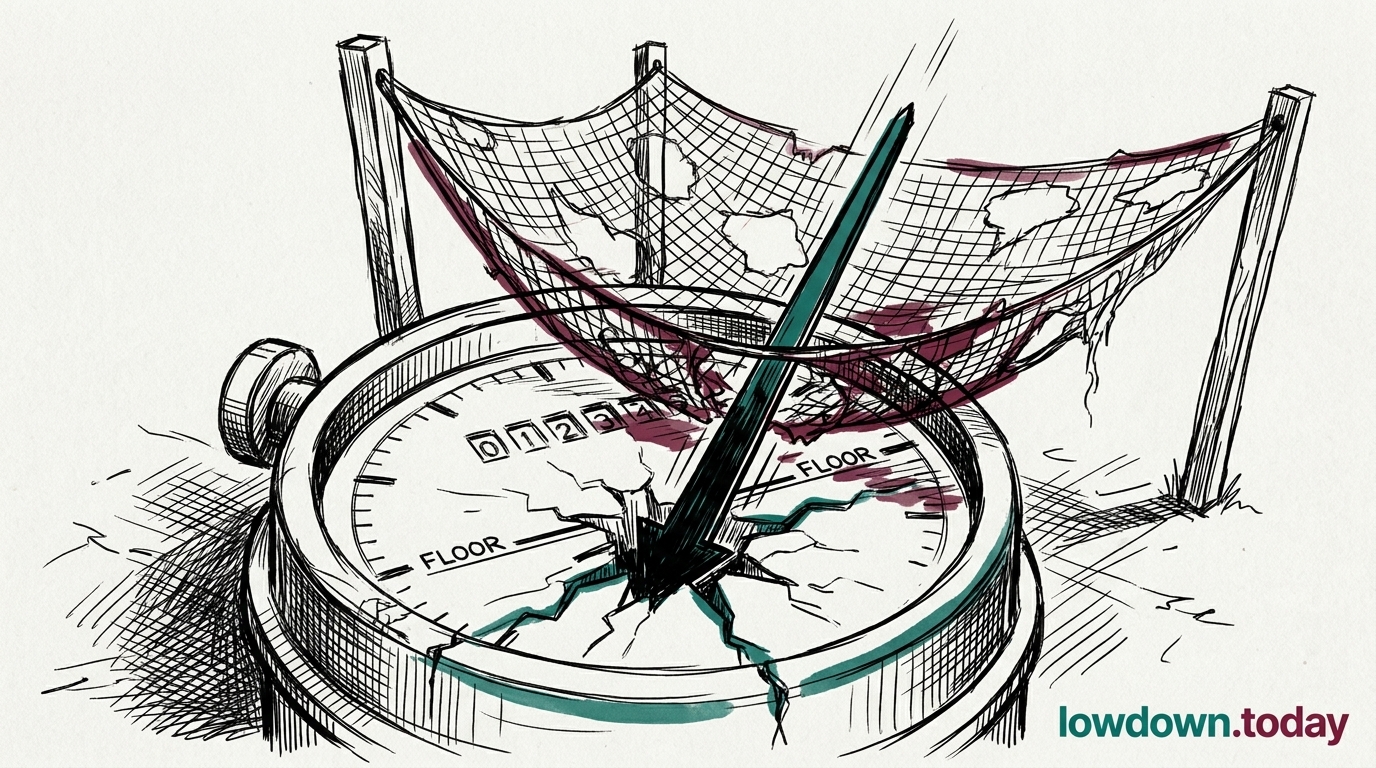
KOSPI hits second circuit breaker

3 min read
12:23UTC

South Korea's KOSPI fell more than 8% on Monday as the oil shock hit the world's most energy-import-dependent major economy. Samsung dropped over 10%.

EconomicDeveloping
Key takeaway

Two circuit breakers in four sessions signals that Korean market stabilisation mechanisms are being exhausted, not absorbing the shock — indicating traders are pricing in a structural change to Korea's cost base, not a temporary disruption.

South Korea's KOSPI fell more than 8% on Monday morning, triggering its second circuit breaker — a 20-minute trading suspension — in four sessions. Samsung Electronics dropped over 10%. SK Hynix, the world's second-largest memory chipmaker, fell 12.3%.

South Korea imports 98% of its crude oil, almost all of it from The Gulf. The country consumed approximately 2.6 million barrels per day in 2025. At Monday's Brent price of $116, South Korea's daily crude import bill is roughly $300 million — up from approximately $175 million before the war began. That difference, sustained over a quarter, would strip roughly $11 billion from the Korean economy before it reaches consumers as higher petrol, heating, and manufacturing input costs.

The semiconductor sector is particularly exposed. Chip fabrication is extraordinarily energy-intensive — a single advanced fab consumes as much electricity as a small city. Samsung and SK Hynix together account for roughly 60% of global DRAM production and a substantial share of NAND flash. Their cost structures assumed energy prices in the $65–80 range. At $116 Brent, downstream electricity and petrochemical feedstock costs erode the margin advantage that Korean chipmakers hold over competitors in the United States and Japan, where energy mixes are less Gulf-dependent.

The circuit breaker mechanism itself is the signal. Korean exchanges trigger a halt when the KOSPI moves 8% from the previous close — a threshold designed for extraordinary events. Two triggers in four days means the market is not experiencing a single shock and adjusting; it is experiencing a continuous repricing that the normal trading mechanism cannot absorb in orderly fashion. The last time KOSPI triggered consecutive circuit breakers was March 2020, during the initial COVID-19 selloff.


Deep Analysis

In plain English

Circuit breakers are automatic 20-minute trading pauses triggered when a market falls too far too fast. When the same exchange triggers two in four days, it means traders resume selling as soon as the pause ends — the mechanism is not working. South Korea imports essentially all its oil, meaning a 72% price spike directly compresses profits across its entire industrial base simultaneously: car manufacturers, chip fabs, steel mills, petrochemical plants. The market is not overreacting; it is repricing the permanent cost structure of the Korean economy at current energy prices.

Deep Analysis
Synthesis

The semiconductor dimension is the globally significant variable the body does not develop. Samsung and SK Hynix together represent approximately 60–70% of global DRAM and a large share of NAND flash production. A sustained Korean industrial energy shock could disrupt global semiconductor supply chains — adding a technology supply crisis to the energy and financial contagion already underway, with downstream effects on every industry that depends on memory chips.

Root Causes

South Korea's 98%+ oil import dependency is a structural vulnerability that Korean industrial policy partially hedged through supply-route diversification and a 90-day strategic reserve — but both were designed for a 1–2 week disruption, not a sustained Hormuz closure. The concentration of strategic industries (semiconductors, shipbuilding, petrochemicals) in energy-intensive production means there is no rapid domestic substitution pathway.

Escalation

Korean institutional investors — pension funds, insurance companies — may be being forced to sell equities to meet margin calls or liquidity requirements, which creates a mechanical amplifier independent of underlying fundamentals. Simultaneously, won depreciation against the dollar (oil is priced in USD) would further inflate import costs in local currency terms, creating a feedback loop that circuit breakers cannot interrupt.

What could happen next?
  • Consequence

    Samsung and SK Hynix production cost increases will feed into global DRAM and NAND pricing within 2–3 quarters, transmitting the Korean energy shock into consumer electronics and data centre capex globally.

    Medium term · Suggested
  • Risk

    Won depreciation against the dollar could compound the oil import cost shock beyond what the dollar oil price alone implies, forcing Bank of Korea FX intervention that depletes reserves needed for a potentially longer crisis.

    Immediate · Assessed
  • Risk

    Forced institutional selling by Korean pension funds and insurers — triggered by margin calls — could transmit Korean equity stress into global bond markets through portfolio rebalancing, even before European and US markets open.

    Immediate · Suggested
First Reported In

Update #30 · Mojtaba named leader; oil $116; acid rain

CNBC· 9 Mar 2026
Read original
Causes and effects
This Event
KOSPI hits second circuit breaker
The second KOSPI circuit breaker in four sessions signals that Korean markets cannot absorb the repricing of energy costs at this speed. South Korea imports 98% of its crude oil; a sustained Brent price above $100 compresses margins across the country's entire export-manufacturing base, from semiconductors to shipbuilding.
Different Perspectives
Spain's LNG terminal operators
Spain's 9,145 GWh terminal inventory is the largest single stock in the EU LNG network, an option value that can reroute cargoes wherever the winter strip pays best rather than a cavern gas obligation tied to a fixed date. That flexibility matters more as Germany's cavern shortfall pushes more of the winter security question onto import infrastructure.
European Commission
European Commission
Brussels holds the bloc to 90% on a flexible window while Germany, holding roughly a quarter of EU storage capacity, tracks toward missing its own lower 80% figure by 21 points. A national shortfall this size in the anchor market matters more to bloc security than the flexible timetable alone can absorb.
French power exporters and CRE
French day-ahead rose in step with Germany but by less, reopening a EUR 7-17 premium that makes northward export flows commercially attractive again after the EUR 43.09 discount evaporated in days. CRE separately authorised RTE and Enedis to buy flexibility locally, betting the coming winter's binding constraint is grid congestion rather than a shortage of firm capacity.
TTF trading desk
TTF trading desk
A visible national shortfall like Germany's 21-point gap is a directional signal, not noise, for a desk holding the summer-winter spread. TTF's flat EUR 58-60 range through this week's German price swings says the market has not yet chosen to reprice refill risk into the front of the curve.
German cavern and CCGT operators
German caverns kept buying prompt gas at TTF near EUR 58-60 through the inversion; the wind collapse to 2.4 GW then flipped the spark spread to plus EUR 29 and put turbines back in the same queue. Every day turbines win that bid, injection at a third of the 877 GWh/day pace needed falls further behind.
Slovakia
Slovakia
Slovakia says it dropped its hold-out on the 21st sanctions package only after Ursula von der Leyen personally signed written gas-price and supply guarantees. The Council of the European Union's own 17,238-character release on the package names neither Slovakia nor any guarantee, leaving Bratislava's account unconfirmed by the institutional record.



