Skip to content
You can now search across every topic, entity and event.What's new
European Energy Markets
15JUN

Russian deaths up while engagements fall

3 min read
12:23UTC

Russia's daily kill rate rose to ~1,115 from 1,047 in mid-April even as engagements fell from a 173 peak to a 114-138 band; ISW found Gerasimov's 1,700 km² gain claim was 5x the 340 km² it could verify.

EconomicDeveloping
Key takeaway

Russia is taking heavier losses per fight at lower fight tempo, a swap signalling manpower stress.

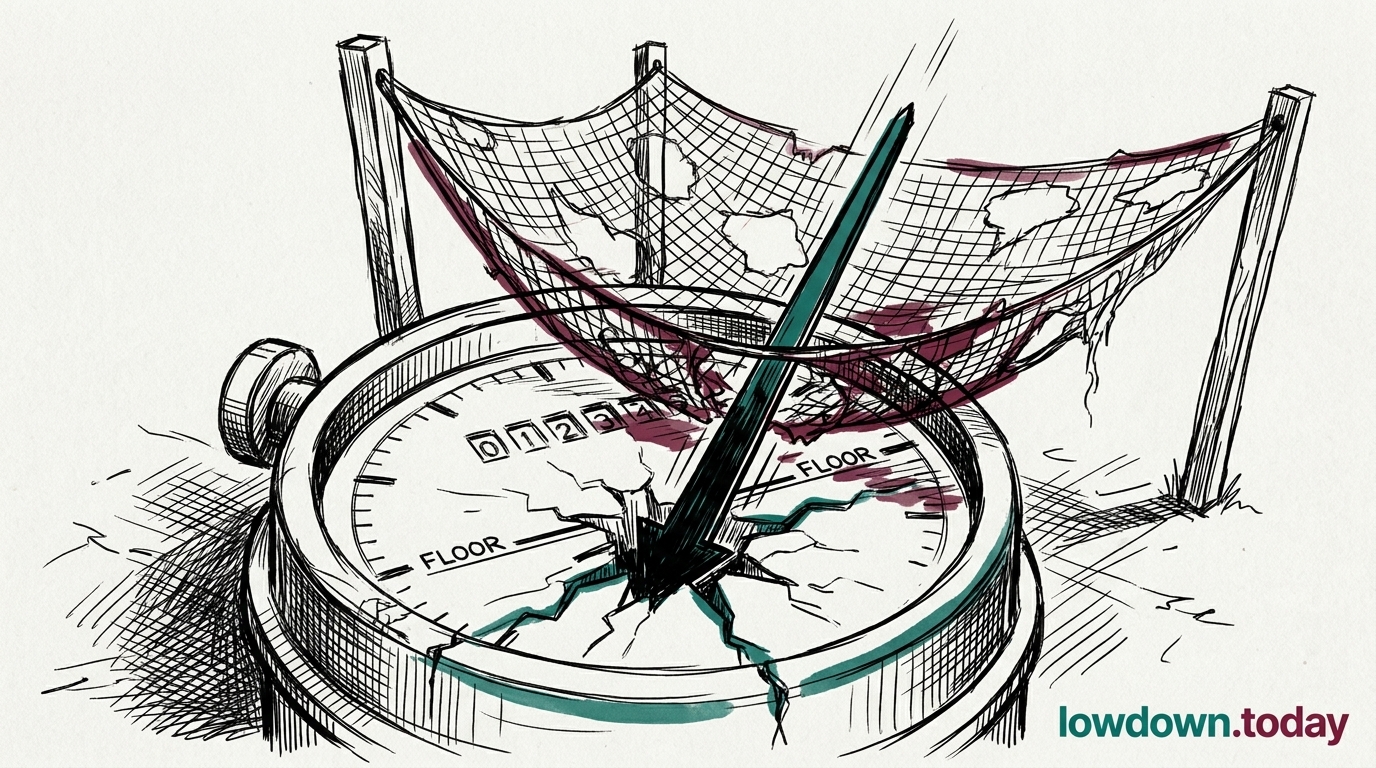
The Ukrainian General Staff's 3 May ledger shows Russia's daily loss rate at roughly 1,115 men against the 1,047 logged in mid-April , a 6.5% uptick. Daily combat engagements have eased from the April peak of 173 to a 114-138 band in early May. Russia is sustaining higher attrition at lower engagement tempo: fewer fights producing more deaths per fight. The engagement peak had set the upper bound that the early-May band now sits well below.

The pattern fits a battlefield in which Russian commanders are trading infantry mass for fire mass. Artillery-led pressure replaces the wave-attack pulses that produced the April engagement surge. Historically, that swap is associated with manpower stress rather than choice: when reinforcements thin out, commanders concentrate available fires on smaller axes and hold infantry back. The Day 1500 cumulative loss baseline provides the longer-range anchor against which the rate-trend acceleration registers.

Institute for the Study of War (ISW) verified Russia's 2026 territorial gains at 340 km² against Valery Gerasimov's claimed 1,700 km², a documented 5:1 exaggeration ratio. The verified-versus-claimed gap is widening rather than narrowing; the comparable 22 April reading showed the same ratio holding through the spring offensive's heaviest phase.

Mediazona's forensic verification reached 216,205 confirmed Russian military deaths by 1 May, with officers at 7,043 or 3.3% of confirmed dead. The officer share sits roughly twice the post-1945 NATO benchmark, which means Russia's junior-officer cadres are absorbing front-line tempo their replacement pipeline does not match. Inflation in the territorial bulletins and concentration of dead in the officer pipeline point at the same bottleneck: the offensive is buying ground at a price the commanders writing the bulletins prefer to round down.


Deep Analysis

In plain English

Two contradictory statistics defined Russia's battlefield in early May 2026. On one hand, Russia's daily rate of soldiers killed or wounded rose by about 6.5% compared to mid-April, reaching roughly 1,115 per day. On the other hand, the number of individual engagements, meaning separate clashes across the front line, fell from a peak of 173 per day to between 114 and 138. Separately, Russia's top general, Valery Gerasimov, told parliament that Russian forces had seized 1,700 square kilometres of Ukrainian territory in 2026. The Institute for the Study of War, a US think tank that tracks satellite imagery, found the verified figure was about 340 square kilometres, roughly a fifth of Gerasimov's claim.

Deep Analysis
Root Causes

The higher kill rate at lower engagement count reflects Russia's battalion tactical group (BTG) structure reaching its operational limit. BTGs were designed for high-tempo manoeuvre warfare; the war has evolved into positional attritional combat for which the BTG template is structurally inefficient.

Russia has been converting BTGs into infantry-heavy assault formations, but the conversion is incomplete and the assault formations lack the combined-arms depth of the original BTG design. The result is higher casualties per engagement as under-supported infantry attempt to hold or advance ground that would previously have been supported by armoured manoeuvre.

Gerasimov's 5:1 territorial exaggeration to the State Duma also reveals a reporting chain problem. ISW's Kateryna Stepanenko documented in March 2026 that Russian unit-level reporting inflates local advances to meet senior-command targets, and those inflated figures aggregate into claims that bear no relationship to satellite-verified ground truth.

The reporting chain failure is structural, not incidental: a command structure that executes soldiers for retreat (as documented in multiple Mediazona reports from 2025) creates an incentive to report advances rather than ground-truth positions.

What could happen next?
  • Consequence

    The ISW 5:1 verification gap in Gerasimov's territorial claims, if it persists, will further erode Russian milblogger credibility and reduce the effectiveness of domestic public support messaging for the war.

    Short term · 0.8
  • Risk

    Higher kill rate at lower engagement count, sustained over four to six weeks, points toward a manpower ceiling that Russia's current recruitment rate cannot replenish without another forced mobilisation.

    Medium term · 0.68
  • Consequence

    Mediazona's 216,205 verified deaths, with officers at 3.3% of total, indicates a disproportionate officer-casualty rate that degrades institutional knowledge at the unit level faster than replacement training can compensate.

    Medium term · 0.75
First Reported In

Update #15 · Hardware-free parade; crude waiver lives on

Kyiv Independent· 3 May 2026
Read original
Different Perspectives
Spain's LNG terminal operators
Spain's 9,145 GWh terminal inventory is the largest single stock in the EU LNG network, an option value that can reroute cargoes wherever the winter strip pays best rather than a cavern gas obligation tied to a fixed date. That flexibility matters more as Germany's cavern shortfall pushes more of the winter security question onto import infrastructure.
European Commission
European Commission
Brussels holds the bloc to 90% on a flexible window while Germany, holding roughly a quarter of EU storage capacity, tracks toward missing its own lower 80% figure by 21 points. A national shortfall this size in the anchor market matters more to bloc security than the flexible timetable alone can absorb.
French power exporters and CRE
French day-ahead rose in step with Germany but by less, reopening a EUR 7-17 premium that makes northward export flows commercially attractive again after the EUR 43.09 discount evaporated in days. CRE separately authorised RTE and Enedis to buy flexibility locally, betting the coming winter's binding constraint is grid congestion rather than a shortage of firm capacity.
TTF trading desk
TTF trading desk
A visible national shortfall like Germany's 21-point gap is a directional signal, not noise, for a desk holding the summer-winter spread. TTF's flat EUR 58-60 range through this week's German price swings says the market has not yet chosen to reprice refill risk into the front of the curve.
German cavern and CCGT operators
German caverns kept buying prompt gas at TTF near EUR 58-60 through the inversion; the wind collapse to 2.4 GW then flipped the spark spread to plus EUR 29 and put turbines back in the same queue. Every day turbines win that bid, injection at a third of the 877 GWh/day pace needed falls further behind.
Slovakia
Slovakia
Slovakia says it dropped its hold-out on the 21st sanctions package only after Ursula von der Leyen personally signed written gas-price and supply guarantees. The Council of the European Union's own 17,238-character release on the package names neither Slovakia nor any guarantee, leaving Bratislava's account unconfirmed by the institutional record.



