Skip to content
Briefings are running a touch slower this week while we rebuild the foundations.See roadmap
European Energy Markets
4JUN

Trading desks stretch to 21-hour days

2 min read
10:45UTC

European energy trading hours have more than doubled from 10 to 21 hours as volatility forces round-the-clock coverage.

EconomicDeveloping
Key takeaway

Trading hours doubled to 21 per day; bank forecasts diverge by EUR 30/MWh on Hormuz timing.

European gas and power trading hours are extending from 10 to 21 hours per day, according to Bloomberg, a structural adaptation to sustained market volatility. The extension reflects the reality that price-moving events (Hormuz threats, ceasefire announcements, force majeure declarations) arrive outside traditional European trading hours, and desks that are not staffed miss the move.

Standard Chartered forecast TTF could breach the EUR eighty mark if the conflict remains unresolved at summer injection start. Goldman Sachs forecast Q2 TTF at EUR 50/MWh, but that assumes Hormuz normalisation by mid-April, an assumption already overtaken by events. That forecast gap captures the market's fundamental uncertainty: whether the Strait reopens in weeks or months is the single variable that separates a manageable injection season from another winter of extreme price spikes.


Deep Analysis

In plain English

European gas and electricity traders are now working much longer days. The markets that allow energy companies, utilities, and industrials to buy and sell gas and power have extended their operating hours from 10 to 21 hours per day. This is because prices are moving so sharply, driven by news about the Hormuz disruption, that participants need more time to respond and manage their risk positions. Standard Chartered bank thinks prices could reach EUR 80/MWh if the disruption continues into summer. Goldman Sachs predicted EUR 50/MWh, but its forecast assumed Hormuz would normalise by mid-April, which has not happened.

Deep Analysis
Root Causes

The shift from 10 to 21 hours of trading reflects a practical response to a structural change in the volatility regime: when geopolitical events can move prices by EUR 5-10/MWh in a single session, and those events arrive on Middle Eastern time zones (which are 2-4 hours ahead of European market open), market participants face unhedgeable overnight gap risk under a 10-hour trading window.

Extended hours reduce the overnight gap risk by allowing participants to react to news as it emerges, but they also require 24-hour desk coverage for energy trading operations, increasing operational costs for smaller trading firms and potentially concentrating market activity among larger participants with the infrastructure to maintain extended desks.

What could happen next?
  • Risk

    Goldman Sachs's EUR 50/MWh Q2 forecast was conditioned on Hormuz normalisation by mid-April. With that deadline passed, a Goldman forecast revision upward would signal that consensus market expectations are moving toward the Standard Chartered EUR 80+/MWh scenario.

  • Consequence

    Extended trading hours concentrate market-making capacity among larger institutions, potentially reducing liquidity during off-peak trading windows and widening bid-ask spreads for smaller energy buyers.

First Reported In

Update #1 · Europe's thinnest gas cushion since 2018

Bloomberg· 13 Apr 2026
Read original
Causes and effects
This Event
Trading desks stretch to 21-hour days
The operational shift from 10 to 21-hour trading days is a structural adaptation that increases staffing costs and operational risk across every European energy trading desk.
Different Perspectives
TTF traders / Amsterdam hub desks
TTF broke its 38-session EUR 46-47 band on 2 June to EUR 48.9 on stalled Iran diplomacy and an unconfirmed Troll A restart; Dutch EBN mandates carry storage trajectory while commercial injection books nothing. The 17 June pipeline expiry is the next binary level: Central European hub premium above EUR 2/MWh widens sharply on any physical step-down.
Red Electrica / Spanish grid operators
Spain logged 397 negative-price hours in Q1 2026, eight times the 48 hours of Q1 2025, documenting midday solar surplus now embedding structurally into Continental pricing. Spain is four to six quarters ahead of France and Germany on the solar-penetration curve, making it the clearest forward indicator of where Continental midday clearing is heading.
Equinor
Equinor
Equinor issued no Troll A restart notice through 4 June despite extending the combined outage to 31 May, keeping up to 51 mcm/day of Norwegian supply offline alongside Hammerfest LNG dark since 22 April. The company's silence follows its 2025 Hammerfest pattern, which ran 24 days past target, and each day without a notice sustains the TTF supply premium.
European Commission / GMTF
SWD(2026)147 found EU gas spot and derivatives markets functioning well on 2 June, recommending MiFID-REMIT legislative alignment rather than emergency intervention. The GMTF verdict addressed derivatives-market integrity, not the physical injection mechanism FNB Gas declared broken five days earlier: the Commission's immediate next step is a legislative proposal, not an emergency storage order.
FNB Gas / Bundesnetzagentur
FNB Gas declared the storage-refill mechanism broken on 27 May after zero bookings in January 2026 auctions, and German day-ahead cleared EUR 102.64 on 3 June on a CCGT stack set by TTF near EUR 49 plus EUA near EUR 78. Winter storage fill now depends on state mandates with no commercial self-correction.
EDF / French government
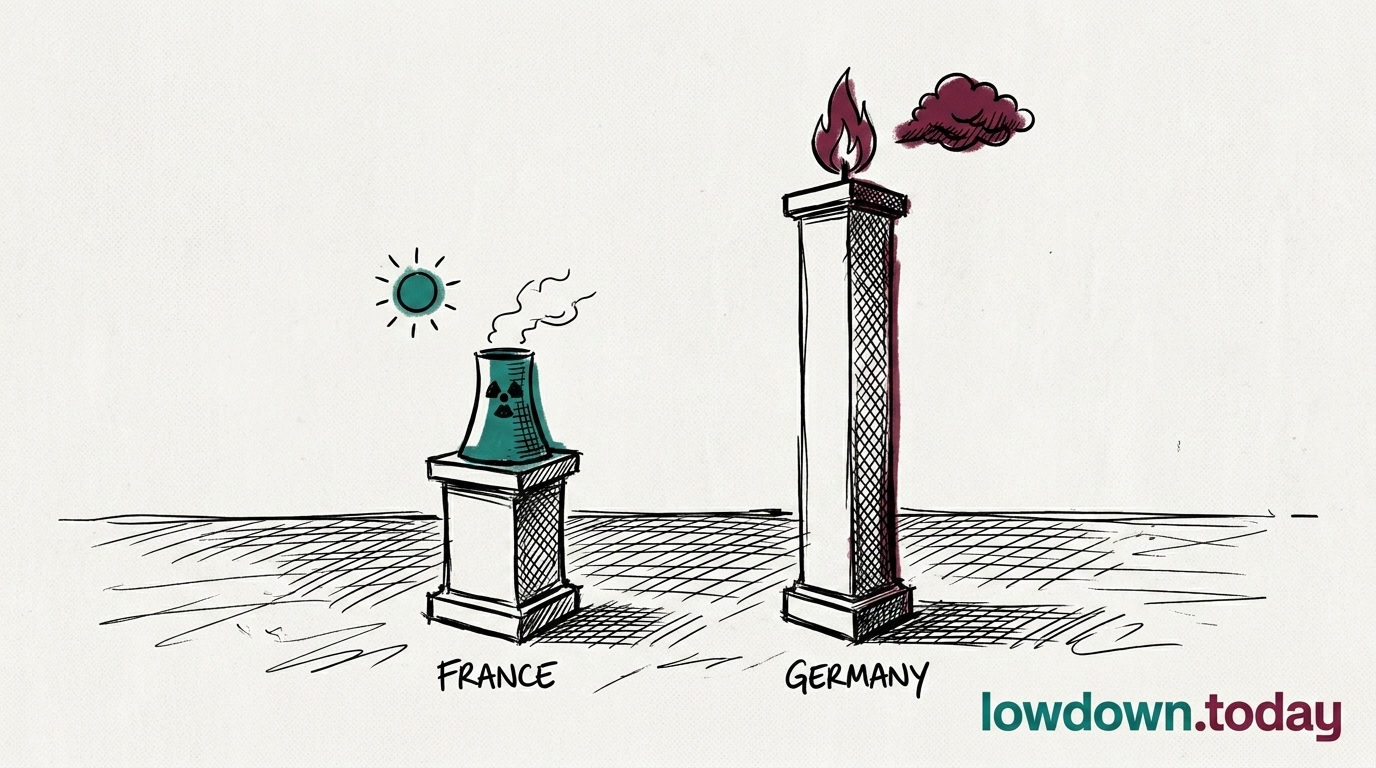
EDF held full-year nuclear guidance at 350-370 TWh after April output of 29.3 TWh, anchoring the surplus that collapsed French day-ahead to EUR 8.96 on 3 June and passed that price to VNU industrials. Flamanville-3's September overhaul removes 1.6 GW at heating-season onset, reversing the nuclear surplus that made VNU pricing competitive.
