Skip to content
You can now search across every topic, entity and event.What's new
European Energy Markets
4JUN

French heat flips the FR-DE spread

3 min read
10:45UTC

EDF took Chooz, Golfech and Bugey fully offline on Sunday as river-cooling limits bit, flipping French day-ahead power to roughly EUR 7/MWh above Germany for the first time in weeks.

EconomicDeveloping
Key takeaway

French power briefly cleared dearer than German on a weather-bounded reactor outage, with restarts due late July.

EDF (Electricite de France, France's state nuclear operator) took three reactors fully offline on Sunday 12 July, shutting Chooz on the Meuse, Golfech on the Garonne and Bugey on the Rhone on cooling-water discharge limits 1. Eight further reactors ran at reduced power. EDF had won a Rhone-temperature exemption for Bugey from the economy ministry on Saturday 11 July, valid to 20 July, with the government judging grid security worth the environmental breach 2.

EDF's plants on the Rhone, Garonne and Meuse draw river water to cool their condensers and must throttle output when the returned water would push downstream temperatures past regulatory ceilings. Reactor hardware sat available; the rivers, not the turbines, forced the cut. That distinction is why the government can relax the constraint by decree, as it did for Bugey, and why the summer France-Germany trade now carries a policy-discretion component on top of a weather one.

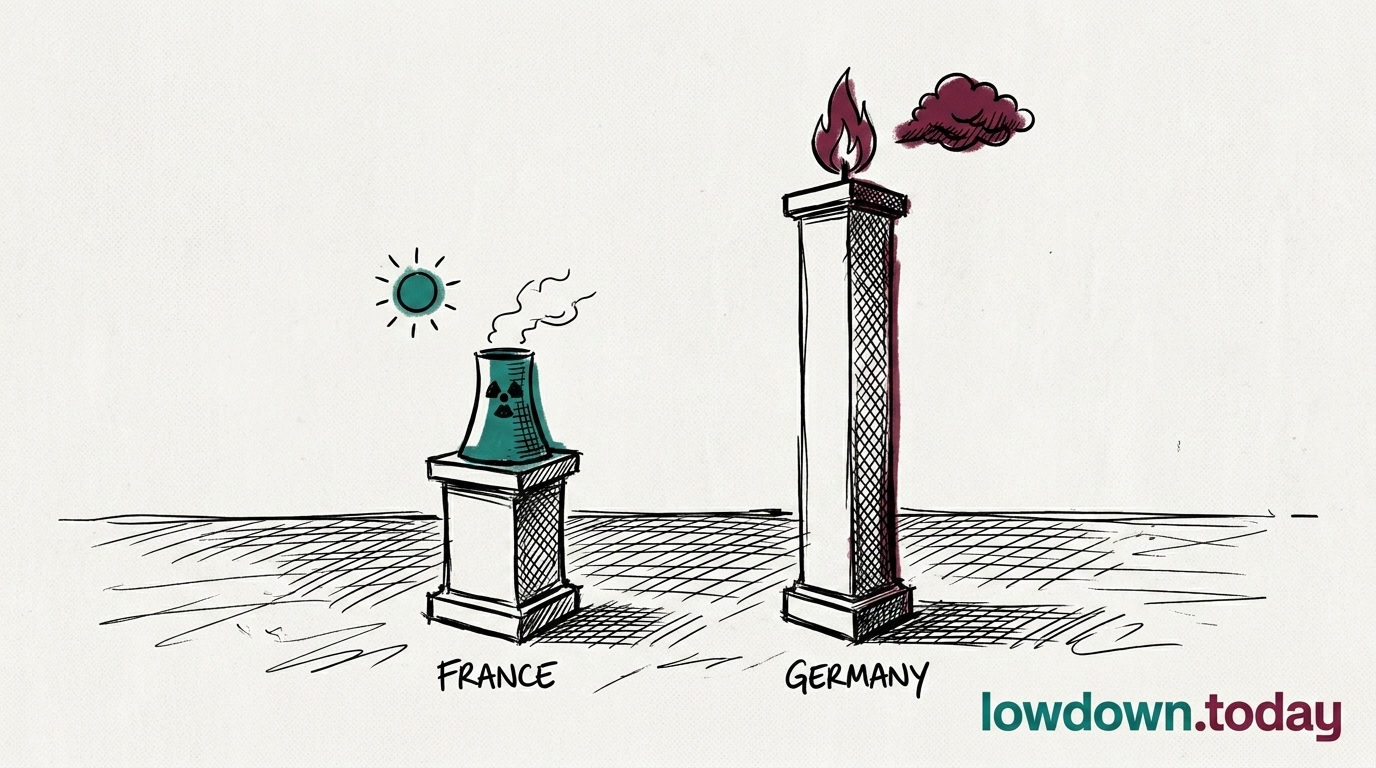
The curtailment inverted the topic's defining trade. French day-ahead power cleared roughly EUR 7/MWh above Germany on Sunday 12 July, reversing the EUR 18-26/MWh France-cheaper spread of 5 July 3. With reactors off, gas-fired plant moved up the merit order to set the French marginal price, so the nuclear-long-France, carbon-short-Germany relative-value play briefly ran the other way. That play had reset France cheaper by EUR 17.29 barely a fortnight earlier . EDF had flagged fresh heat-curtailment risk at Chooz only three days earlier, on 9 July , and the risk duly materialised.

By Monday 13 July the spread had settled back to about EUR 3/MWh with France cheaper again, still far inside the early-July gap 4. The reversal carries a clock: Bugey's exemption expires 20 July, and one market report puts Chooz-2 back on 25 July 5. Treat the daily averages as approximate, drawn from hourly prints on Fraunhofer ISE's energy-charts feed; the sign flip itself is robust.


Deep Analysis

In plain English

France gets most of its electricity from nuclear power plants, and several of them sit on rivers rather than the coast. They use river water to cool the reactor, then release warmer water back into the river. To protect fish and river ecosystems, French rules cap how warm that returned water can get. During a hot spell the river is already warm, so a plant hits its legal limit faster and has to power down, even though nothing is wrong with the reactor itself. That is what happened at Chooz, Golfech and Bugey on 12 July: three plants went offline for environmental-permit reasons, not a fault, which briefly made French electricity more expensive than German electricity before regulators eased the limit at Bugey and prices settled back down.

Deep Analysis
Root Causes

The constraint is regulatory, not mechanical: EDF's river-cooled reactors (Chooz on the Meuse, Golfech on the Garonne, Bugey on the Rhone) operate under discharge-temperature permits that cap how much heat the plant may add to the river. When river temperatures climb during a heatwave, the permitted discharge margin shrinks even though the reactor itself is undamaged, forcing a shutdown or derated output regardless of grid need.

The fix is administrative rather than physical: France's nuclear safety authority can issue a temporary derogation raising the discharge ceiling, as it did for Bugey to 20 July, which is why some of the fleet returns within days while the rest stays offline until the exemption is granted.

First Reported In

Update #26 · Gas and power decouple as French heat bites

energy-charts.info (Fraunhofer ISE)· 13 Jul 2026
Read original
Different Perspectives
Marine insurers and AIS trackers covering Hormuz
AIS data shows severe curtailment on 20 July, 479 vessels anchored, 36 dark, 123 still broadcasting inside the strait, not the closure the IRGC claims. War-risk premiums move on the unresolved CENTCOM-IRGC contest itself, since underwriters price the dispute as much as the count.
QatarEnergy
QatarEnergy
Ras Laffan has run at minimum output under force majeure into August since 9 July, a constraint already priced before this week's claim. The 17-20 July move is risk premium stacked on that standing loss, not a new physical loss at the plant.
ACER and the European Commission
ACER opened the REMIT reporting consultation on schedule on 16 July, giving firms to 11 September before a quarter to build systems against Regulation 648/2012. Brussels' separate silence on StromVKG state-aid clearance leaves Berlin's own capacity mechanism without legal authorisation.
EDF and French grid operator RTE
France's discount to Germany rests on an ASNR derogation from the 28C river-cooling limit at Bugey that expires today, not on a nuclear recovery; Chooz, Golfech and Bugey restarts run to 25 July. The cheap leg holds only as long as regulators keep waiving the limit each heatwave.
German CCGT operators and grid balancers
German gas plants went off-merit on 20 July as the clean spark spread inverted to minus EUR 15 to minus EUR 21/MWh, sidelining the flexible capacity storage injection needs. Operators are pricing 2027-28 capacity revenue against Bundesnetzagentur's own admission that Brussels has not cleared the 9 GW StromVKG auctions.
LNG spreads desk
LNG spreads desk
The JKM-TTF arb flipped to a TTF premium of roughly USD 0.6/MMBtu on 15 July, the first time this cycle Europe has outbid Asia, yet no Atlantic cargo has rerouted west. Until a cargo actually moves, the desk reads the Hormuz premium as unconfirmed and the EUR 55 print as vulnerable to a fast reversal.
